

Science News Roundup: Kangaroos can learn to communicate with humans, researchers say; China's moon probe lands back on Earth - state media and more
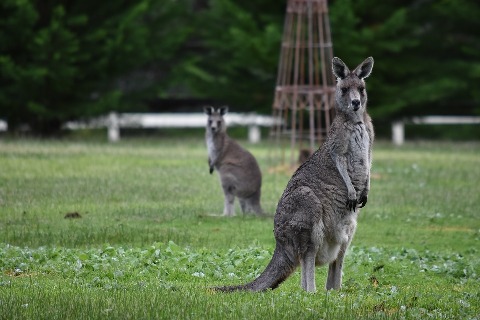
The return capsule touched down in the Siziwang, or Dorbod, banner of Inner Mongolia, in the early hours of Thursday local time, Xinhua said, citing the China National Space Administration. Kangaroos can learn to communicate with humans, researchers say Kangaroos can learn to communicate with humans similar to how domesticated dogs do, by using their gaze to "point" and ask for help, researchers said in a study published on Wednesday.
Following is a summary of current science news briefs.
Narrow hallways pose higher infection risk; hospitalized COVID-19 patients often need readmission
The following is a roundup of some of the latest scientific studies on the novel coronavirus and efforts to find treatments and vaccines for COVID-19, the illness caused by the virus.
Narrow hallways present higher infection risks Samples from asteroid more than hoped for, Japan researchers say
Samples of dust collected by a Japanese space probe from an asteroid some 300 million km (186 million miles) from Earth were better than hoped for, with one researcher saying he was lost for words when they opened the capsule for the first time. The samples, the climax of a six-year space odyssey to the Ryugu asteroid by the space probe Hayabusa2, arrived in Japan last week but researchers did not know for sure until this week if they had actually gotten anything.
China's moon probe lands back on Earth - state media
China's Chang'e-5 moon probe has landed in the northern Chinese region of Inner Mongolia, the official Xinhua news agency reported, completing its return to Earth and bringing back the first lunar samples since the 1970s. The return capsule touched down in the Siziwang, or Dorbod, banner of Inner Mongolia, in the early hours of Thursday local time, Xinhua said, citing the China National Space Administration.
Kangaroos can learn to communicate with humans, researchers say
Kangaroos can learn to communicate with humans similar to how domesticated dogs do, by using their gaze to "point" and ask for help, researchers said in a study published on Wednesday. The study involved 11 kangaroos that lived in captivity but had not been domesticated. Ten of the 11 marsupials intently gazed at researchers when they were unable to open a box with food, according to the report. Nine alternately looked at the human and at the container, as a way of pointing or gesturing toward the object.
Antarctica rocked by 30,000 tremors in 3 months, Chilean scientists say More than 30,000 tremors have rocked Antarctica since the end of August, according to the University of Chile, a spike in seismic activity that has intrigued researchers who study the remote, snowbound continent. Scientists with the university's National Seismological Center said the small quakes - including one stronger shake of magnitude 6 - were detected in the Bransfield Strait, a 60-mile wide (96-km) ocean channel between the South Shetland Islands and the Antarctic Peninsula.
A dinosaur with 'hair' and 'ribbons' has scientists enthralled About 110 million years ago along the shores of an ancient lagoon in what is now northeastern Brazil, a two-legged chicken-sized Cretaceous Period dinosaur made a living hunting insects and perhaps small vertebrates like frogs and lizards. On the inside, it was ordinary, with a skeleton similar to many small dinosaurs from the preceding Jurassic Period, scientists said on Tuesday. On the outside, it was anything but.
Canada signs deal to send first astronaut on U.S. mission around the moon Canada will for the first time send an astronaut to circle the moon on a U.S. mission planned for 2023, Innovation Minister Navdeep Bains said on Wednesday, announcing a formal deal with Washington. U.S. Vice President Mike Pence last week unveiled an 18-strong pool of people who could go to the moon under NASA's Artemis program, which Canada is now a part of.
New and rediscovered species found in pristine Andes of Bolivia A scientific expedition high in the Bolivian Andes revealed 20 species new to science, including "lilliputian frog" plus four rediscovered species including the "devil-eyed frog" previously thought to be extinct, Conservation International said. The expedition was led by the environmental group and the government of capital city La Paz. It included 17 scientists who went to the Chawi Grande, a locality belonging to the Huaylipaya indigenous community near La Paz.
Thai researcher wonders if chicken feathers on the menu might fly When Sorawut Kittibanthorn was looking for new types of waste to recycle, the then London-based student was drawn to the millions of tons of chicken feathers being discarded each year.
Now back in his homeland of Thailand, the 30-year-old is seeking funding to continue his research into how best to convert the nutrient component found in the feathers into a powder that can be transformed into a lean, protein-rich source of edible food.


 Google News