

NASA scientists crack 60-yr mystery of fast magnetic explosions
- Country:
- United States
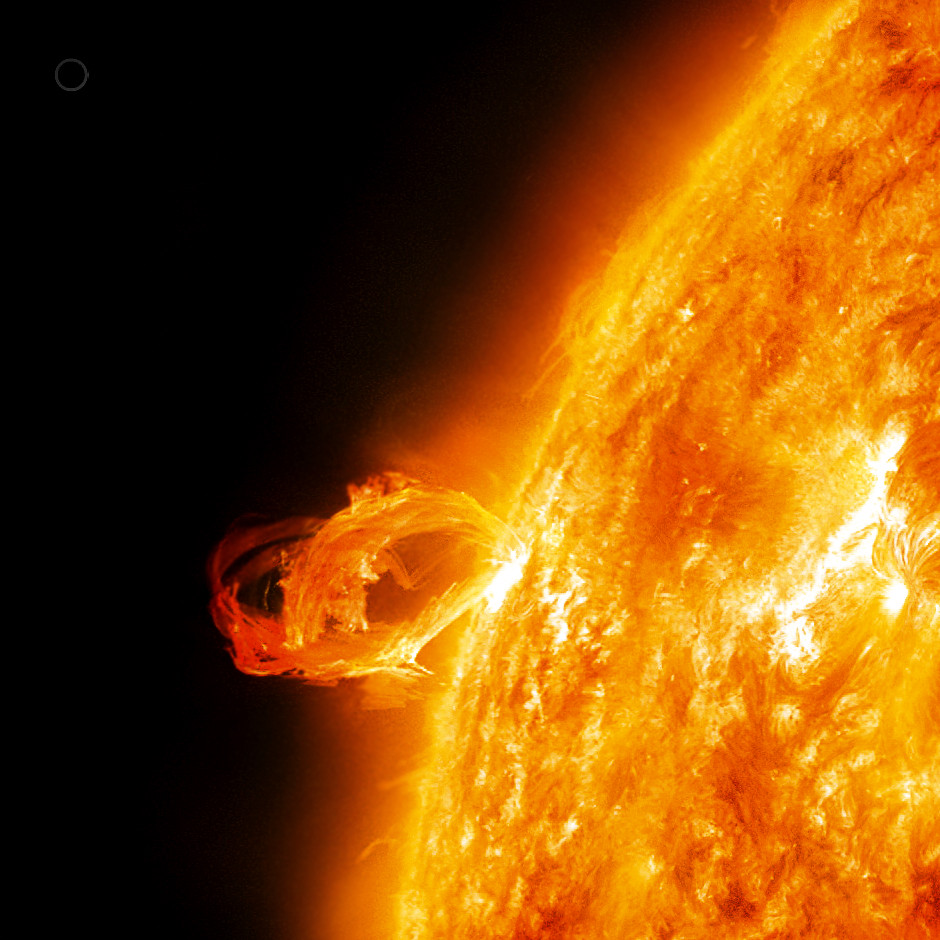
Scientists with NASA's Magnetospheric Multiscale Mission (MMS) have finally figured out how the most explosive type of magnetic reconnection – called fast reconnection – occurs and why it happens at a consistent speed.
Magnetic reconnection occurs in plasma, which is exquisitely sensitive to magnetic fields. The new research explains how fast reconnection occurs specifically in collisionless plasmas – a type of plasma whose particles are spread out enough that the individual particles don't collide with one another.
In just minutes, a flare on the Sun can release enough energy to power the whole world for 20,000 years. New research from our MMS mission shows the process that triggers these events uses a common magnetic effect that's found in household devices.https://t.co/ng18dx0OUI
— NASA Sun & Space (@NASASun) April 28, 2022
According to the researchers, fast reconnection is likely sped up by the Hall effect - a common magnetic phenomenon that's found in household devices like vehicle wheel speed sensors and 3D printers.
During fast magnetic reconnection, charged particles in a plasma – ions and electrons – start moving separately rather than as a group. These particles then give rise to the Hall effect, creating an unstable energy vacuum where reconnection happens. Pressure from the magnetic fields around the energy vacuum causes the vacuum to implode, which quickly releases immense amounts of energy at a predictable rate.
"We finally understand what makes this type of magnetic reconnection so fast. We now have a theory to explain it fully," said the lead author on the new study Yi-Hsin Liu, a physics professor at Dartmouth College in New Hampshire and the deputy-lead of MMS' theory and modeling team.
In the coming years, the new theory will be tested with MMS. Launched on March 12, 2015, the mission uses four identical spacecraft flying in a pyramid-shape to measure magnetic field lines and charged particles in three dimensions.
The research is published in a paper in Nature's Communications Physics journal.


 Google News