

Black hole burps up stellar remains years after shredding and consuming star
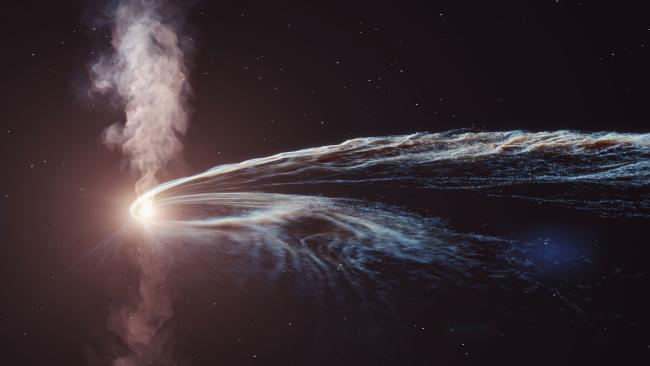
Three years after shredding and consuming a star, a black hole is burping up stellar remains without swallowing anything new. Astronomers observed the unusual outburst while revisiting tidal disruption events (TDEs) - when encroaching stars are spaghettified by black holes - that occurred over the last several years.
The team found that the black hole is ejecting material travelling at half of the speed of light, but are unsure why the outflow was delayed by several years. This is the first time that such a long delay was witnessed between the feeding and the outflow, the researchers said.
"This caught us completely by surprise - no one has ever seen anything like this before," Yvette Cendes, a research associate at the Center for Astrophysics | Harvard & Smithsonian (CfA) and lead author of a new study analyzing the phenomenon, said in a statement.
Radio data from the Very Large Array (VLA) in New Mexico showed that the black hole had mysteriously reanimated in June 2021. Cendes and the team rushed to examine the event more closely.
Using the VLA, the ALMA Observatory in Chile, MeerKAT in South Africa, the Australian Telescope Compact Array, and the Chandra X-Ray Observatory and the Neil Gehrels Swift Observatory, the team collected observations of the TDE, dubbed AT2018hyz, in multiple wavelengths of light.
"We have been studying TDEs with radio telescopes for more than a decade, and we sometimes find they shine in radio waves as they spew out material while the star is first being consumed by the black hole. But in AT2018hyz there was radio silence for the first three years, and now it's dramatically lit up to become one of the most radio luminous TDEs ever observed," said Edo Berger, professor of astronomy at Harvard University and the CfA, and co-author on the new study.
The outflow of material is travelling as fast as 50 percent the speed of light. For comparison, most TDEs have an outflow that travels at 10 percent the speed of light, Cendes says.
The findings are published in the Astrophysical Journal and may help scientists better understand black holes' feeding behaviour.


 Google News