

Scientists Discover New Method to Detect Hidden Turbulence in the Sun’s Corona
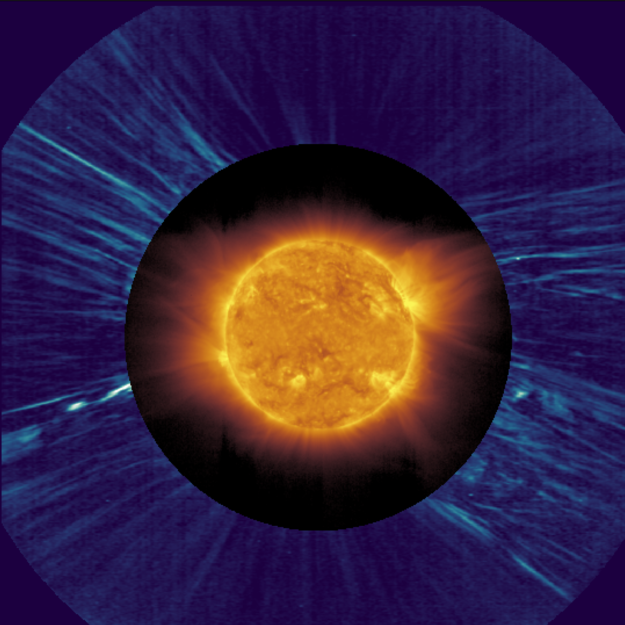
One of the biggest unanswered questions in solar physics is why the Sun’s corona — its outermost atmosphere — is vastly hotter than the visible solar surface beneath it.
- Country:
- India
Indian scientists have developed a novel method to detect hidden turbulence in the Sun's outer atmosphere, known as the corona, potentially offering new insights into one of solar physics' greatest mysteries — why the corona is dramatically hotter than the Sun's visible surface.
The breakthrough study, conducted by researchers from the Aryabhatta Research Institute of Observational Sciences (ARIES), Nainital, and the Indian Institute of Technology (IIT) Delhi, demonstrates how previously overlooked wave-driven turbulence in the solar corona can produce detectable signatures in solar spectral lines.
The findings could significantly improve scientists' understanding of solar atmospheric dynamics, magnetic energy transport and the mechanisms responsible for heating the Sun's corona to millions of degrees.
The Long-Standing Mystery of the Super-Hot Solar Corona
One of the biggest unanswered questions in solar physics is why the Sun's corona — its outermost atmosphere — is vastly hotter than the visible solar surface beneath it.
While the Sun's surface temperature is around 5,500 degrees Celsius, the corona can reach temperatures exceeding one million degrees Celsius. Scientists have long suspected that magnetic waves and turbulence inside the corona play a major role in transferring and dissipating energy, but the exact mechanisms remain poorly understood.
The Sun's corona is filled with magnetic structures through which various types of waves constantly travel.
Among the most common are propagating transverse magnetohydrodynamic (MHD) waves, also known as:
-
Alfvénic waves
-
Kink waves
These waves cause magnetic structures in the corona to oscillate sideways as they move outward through the Sun's magnetic field.
Understanding Spectral Signatures in the Corona
When scientists observe the corona using spectroscopy, these transverse waves typically produce alternating red and blue Doppler shifts.
These shifts occur because plasma within the corona moves toward or away from the observer due to the sideways oscillatory motion generated by the waves.
Until now, scientists primarily associated asymmetries in coronal spectral lines with:
-
Upward plasma flows
-
Jets
-
Mass motions along magnetic field lines
Transverse waves, on the other hand, were generally considered nearly incompressible and therefore not expected to generate strong asymmetrical distortions in spectral line profiles.
As a result, the contribution of wave-driven turbulence to spectral asymmetries had received comparatively little scientific attention.
ARIES and IIT Delhi Use Advanced 3D Simulations
In the new study, researchers from ARIES and IIT Delhi used advanced three-dimensional magnetohydrodynamic (MHD) simulations combined with forward modelling techniques to investigate whether propagating transverse waves could indeed generate detectable spectral asymmetries.
The research team included:
-
Ms. Ambika Saxena, PhD student at ARIES
-
Prof. Vaibhav Pant, Department of Physics, IIT Delhi
The scientists simulated an open-field coronal region containing density irregularities across its transverse structure.
Transverse waves were generated at the lower boundary of the simulated region and allowed to propagate upward along structured magnetic fields.
Using forward modelling, the researchers then calculated how plasma emissions would appear in a commonly observed coronal spectral line:
Fe XIII 10749 Å
Simulations Reveal Wave-Driven Turbulence
The simulations revealed a striking and consistent pattern.
As transverse waves propagated through the structured magnetic plume, the plasma inside the structure did not move uniformly. Density variations across the plume caused increasingly fine-scale structures to emerge through a process known as phase mixing.
This process ultimately generated turbulence within the magnetic structures, producing small-scale variations in both velocity and density.
Because the solar corona is optically thin, emissions from many different regions overlap along the observer's line of sight.
At any given moment, different parts of the structure move at different speeds. When these emissions combine, the resulting spectral line becomes asymmetrical rather than perfectly Gaussian.
The researchers observed:
-
Alternating blue-wing asymmetries
-
Alternating red-wing asymmetries
-
Time-varying spectral distortions
-
Height-dependent asymmetry patterns
These asymmetries switched dynamically as the waves travelled outward through the corona.
Significant Spectral Effects Detected
The study found that the wave-driven asymmetries could reach up to approximately 20% of the spectral line's peak intensity.
The simulations also produced apparent secondary velocities of:
-
30 to 40 kilometres per second
Importantly, the alternating red-blue asymmetry patterns themselves propagated outward at speeds consistent with the travelling transverse waves.
The findings demonstrate for the first time that propagating transverse MHD waves alone can naturally generate systematic and measurable spectral asymmetries in the solar corona.
New Tool for Studying Solar Turbulence
The discovery provides scientists with a potentially powerful new diagnostic tool for observing hidden wave-driven turbulence in the Sun's atmosphere.
Researchers believe future high-resolution observations may soon confirm these simulated signatures directly.
The study notes that modern solar observatories such as the:
-
Daniel K. Inouye Solar Telescope (DKIST)
now possess the spatial and spectral resolution necessary to potentially detect these wave-driven asymmetry patterns in real solar observations.
If confirmed observationally, the phenomenon could open a new window into understanding:
-
Coronal heating
-
Wave energy dissipation
-
Solar magnetic turbulence
-
Plasma dynamics in the corona
Importance for Space Weather and Solar Science
Understanding turbulence and energy transfer in the solar corona is not only important for fundamental physics but also for improving space weather forecasting.
Solar activity, including flares, coronal mass ejections and magnetic disturbances, can significantly affect:
-
Satellites
-
GPS systems
-
Power grids
-
Communication networks
-
Space missions
Improved understanding of coronal dynamics may help scientists develop more accurate models of solar behaviour and space weather impacts on Earth.
Major Contribution from Indian Researchers
The research highlights India's growing contribution to cutting-edge astrophysics and solar science.
ARIES, an autonomous institute under the Department of Science and Technology (DST), and IIT Delhi continue to play important roles in advancing theoretical and computational astrophysics research.
The study has been published in the internationally reputed journal The Astrophysical Journal.
Publication Link:https://iopscience.iop.org/article/10.3847/1538-4357/ae2482


 Google News