



Science News Roundup: New image reveals violent events near a supermassive black hole; Japan's ispace says moon lander unexpectedly accelerated and likely crashed and more
A new study based on seismic data obtained by NASA's robotic InSight lander is offering a fuller understanding of the Martian deep interior and fresh details about dissimilarities between Earth, the third planet from the sun, and Mars, the fourth. EU court dismisses OHB complaint about Galileo satellites contract The European Union Court of Justice said on Wednesday it had dismissed German satellite company OHB System's complaint about a contract awarded to competitors Thales and Airbus to supply new satellites for Europe's Galileo programme.
Following is a summary of current science news briefs.
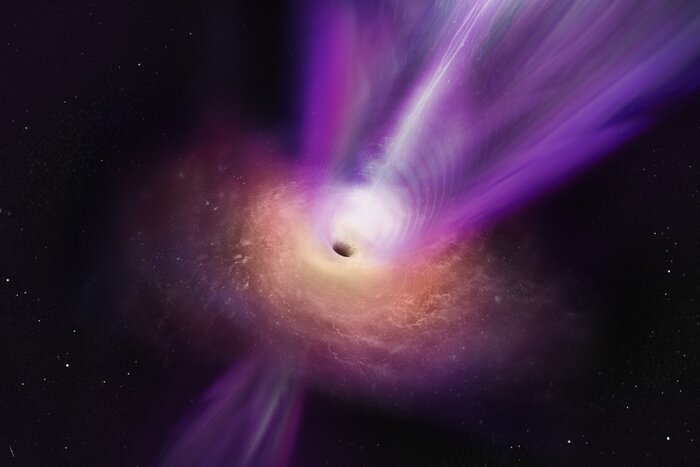
New image reveals violent events near a supermassive black hole
Expanding upon the historic first images of black holes, scientists on Wednesday unveiled the first picture showing the violent events unfolding around one of these ravenous cosmic behemoths, including the launching point of a colossal jet of high-energy particles shooting outward into space. The new image was obtained using 16 telescopes at various locations on Earth that essentially created a planet-sized observational dish. The supermassive black hole pictured resides at the center of a relatively nearby galaxy called Messier 87, or M87, about 54 million light-years from Earth.
Japan's ispace says moon lander unexpectedly accelerated and likely crashed
Japan's ispace inc said its attempt to make the first private moon landing had failed after losing contact with its Hakuto-R Mission 1 (M1) lander when it unexpectedly accelerated and probably crashed on the lunar surface. The startup said it was possible that as the lander approached the moon, its altitude measurement system had miscalculated the distance to the surface.
Study details differences between deep interiors of Mars and Earth
Mars is Earth's next-door neighbor in the solar system - two rocky worlds with differences down to their very core, literally. A new study based on seismic data obtained by NASA's robotic InSight lander is offering a fuller understanding of the Martian deep interior and fresh details about dissimilarities between Earth, the third planet from the sun, and Mars, the fourth.
EU court dismisses OHB complaint about Galileo satellites contract
The European Union Court of Justice said on Wednesday it had dismissed German satellite company OHB System's complaint about a contract awarded to competitors Thales and Airbus to supply new satellites for Europe's Galileo programme. Following a 2018 European Space Agency (ESA) tender for next-generation satellites for the Galileo global navigation satellite system, the European Commission in 2021 selected Airbus Defence and Space and Thales Alenia Space Italia, rejecting a bid by its traditional supplier OHB System, which has built most of Galileo's current operating satellites.
China unveils plan to build satellite system for space exploration
China will start building relay satellites that by 2030 will act as a communication bridge between missions to the moon and beyond, and ground operations on Earth, Chinese state media reported on Wednesday. A pilot of the satellite constellation will support China's ongoing lunar exploration programme and the building of the International Lunar Research Station (ILRS), the official Xinhua news agency reported, citing Wu Yanhua, chief designer of China's deep space exploration project.
NASA chief sees Russians and Americans together on space station through 2030
NASA Administrator Bill Nelson on Tuesday condemned Russian President Vladimir Putin's invasion of Ukraine, but said in Ottawa that he expected Russians and Americans to work together on the International Space Station (ISS) until it is decommissioned. American-Russian space cooperation was put in doubt after the invasion of Ukraine in February 2022.
SpaceX, Rogers to connect mobiles phones to satellites in remote Canadian areas
Rogers Communications and Elon Musk's SpaceX plan to connect mobile phones to satellite-based services aiming to expand coverage to remote areas in Canada, the companies said on Wednesday. The service, which will be delivered via the space company's Starlink satellite network, will cover 4G and 5G phones starting with SMS text and will eventually expand to voice and data service in Canadian areas without networks.


 Google News