

AI, causality, and the universe: Are we on the brink of machine comprehension?
Understanding is often defined as the ability to form mental models of the world, reason about cause and effect, and predict outcomes. Human understanding is deeply rooted in intuition and causality, allowing us to navigate complex environments and infer relationships between events. The study examines whether AI can develop similar or even superior capabilities in these areas.
 COE-EDP
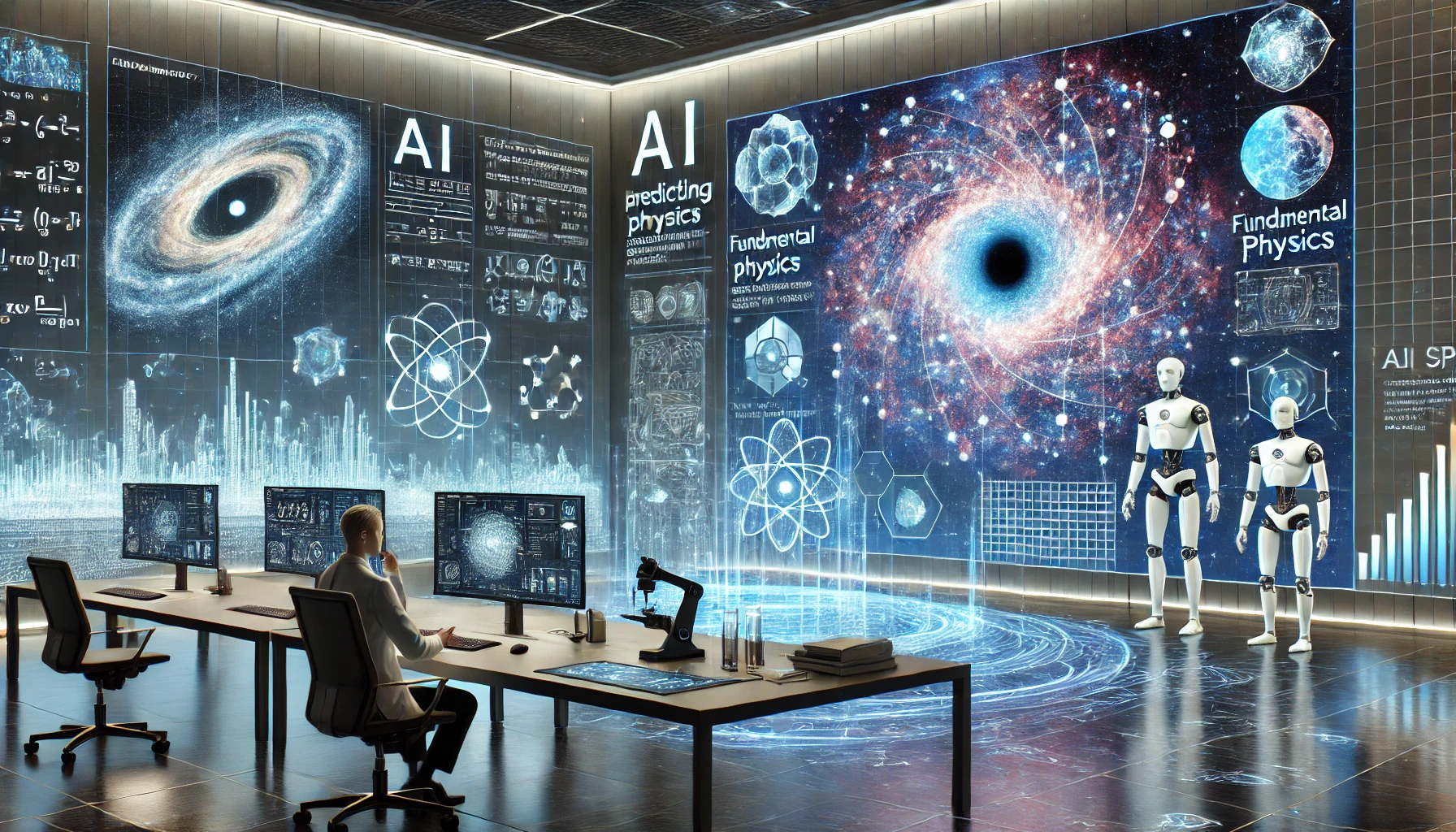
Artificial intelligence (AI) has made remarkable strides in natural language processing, reasoning, and data analysis, but a fundamental question remains - can AI truly understand our universe? While AI can process vast amounts of scientific data, recognize patterns, and even make predictions, its ability to form conceptual understanding in the way humans do remains debated.
A recent study titled "Reflections on 'Can AI Understand Our Universe?'" by Yu Wang, published in the International Journal of Modern Physics D (World Scientific Publishing Company, January 2025), explores the philosophical and technical aspects of AI understanding. The study focuses on two major concepts - intuition and causality - while highlighting three AI technologies that contribute to AI's progress toward understanding: Transformers, chain-of-thought reasoning, and multimodal processing. The research provides insight into whether AI can develop an advanced form of comprehension beyond pattern recognition, potentially allowing it to unravel the mysteries of the universe.
Two concepts of understanding: Intuition and causality
Understanding is often defined as the ability to form mental models of the world, reason about cause and effect, and predict outcomes. Human understanding is deeply rooted in intuition and causality, allowing us to navigate complex environments and infer relationships between events. The study examines whether AI can develop similar or even superior capabilities in these areas.
Intuition: Can AI Develop an Instinctive Sense of the Universe?
Intuition refers to the immediate grasp of concepts without explicit reasoning. In humans, intuition is shaped by sensory experiences and evolutionary adaptations. For example, our perception of space and time is based on binocular vision, memory, and event sequences, enabling us to make quick decisions without detailed analysis. AI, however, lacks sensory perception and must rely on data-driven learning to develop a form of intuition.
AI's version of "intuition" is built through pattern recognition, probabilistic reasoning, and high-dimensional data analysis. Unlike humans, AI can process multimodal data at multiple scales, allowing it to perceive aspects of reality that are inaccessible to human senses. For instance, AI can analyze gravitational wave data to "hear" cosmic events or process thousands of genomic variables to detect hidden biological patterns.
One key advantage of AI is its ability to extend human perception beyond traditional sensory limitations. AI-powered telescopes can process infrared, ultraviolet, and neutrino signals, allowing it to observe cosmic phenomena invisible to the human eye. This "super-intuition" gives AI the potential to construct new scientific insights beyond human intuition alone.
Causality: Can AI Discover the Fundamental Principles of the Universe?
Causal reasoning is central to scientific discovery. Humans understand causality through direct experience, logical deduction, and experimental validation. We recognize simple causal relationships (e.g., "The sky rains, so the ground gets wet") but also develop deeper theoretical explanations (e.g., "Water vapor condenses in the atmosphere, forming raindrops").
AI's approach to causality relies on statistical inference, counterfactual reasoning, and causal modeling. Unlike traditional machine learning models that focus on correlation, modern AI systems employ causal graphs, Bayesian networks, and intervention-based learning to identify true cause-and-effect relationships. In genomics, AI can detect causal pathways between genetic mutations and diseases, a task that would take human scientists decades to accomplish.
Moreover, AI can simulate alternative realities, enabling it to test hypotheses at an unprecedented scale. In drug discovery, AI can model thousands of molecular interactions before selecting promising candidates, significantly accelerating the scientific process. Similarly, in climate modeling, AI can run millions of scenario-based simulations to predict the impact of policy decisions on global temperatures.
While humans have intuitive limitations in processing complex causal networks, AI can construct and analyze deeply nested causal relationships, making it a powerful tool for scientific exploration. However, the study acknowledges that AI still lacks the philosophical depth of human reasoning and may struggle with abstract conceptualization beyond data-driven inference.
Key AI technologies driving understanding
The study identifies three major AI technologies that contribute to AI's ability to process information, reason through problems, and integrate multimodal data.
Attention and Transformer Models
The Transformer architecture, introduced in natural language processing, has become the foundation of modern AI models, including GPT (Generative Pre-trained Transformers) and Claude AI. Transformers use self-attention mechanisms to capture long-range dependencies in data, allowing AI to connect pieces of information across large datasets.
In scientific applications, Transformer-based models are revolutionizing astrophysics, genomics, and materials science. For example, fine-tuned GPT models have demonstrated:
- 82% accuracy in celestial object classification using Sloan Digital Sky Survey (SDSS) data.
- 95.15% agreement in gamma-ray burst (GRB) classification using spectral properties.
- 100% accuracy in black hole spin direction inference, and over 90% accuracy in spin parameter estimation.
These breakthroughs suggest that AI-powered models can process complex scientific data with increasing precision, potentially leading to new astronomical discoveries.
Chain-of-Thought (CoT) Reasoning
Chain-of-thought (CoT) reasoning enhances AI's logical deduction and multi-step problem-solving abilities. Unlike traditional AI models that provide direct answers, CoT reasoning breaks down problems into structured steps, simulating human-like thought processes.
For example, OpenAI's CoT-based models use reasoning tokens to generate intermediate steps in complex problems. This technique allows AI to solve multi-step mathematical proofs, generate structured code, and analyze cause-and-effect relationships in scientific research.
By explicitly modeling reasoning steps, CoT reasoning improves AI's ability to handle complex physics simulations, economic forecasting, and strategic decision-making, making it a crucial tool for AI's journey toward true understanding.
Multimodal processing: AI's Ability to Integrate Diverse Data Sources
Originally designed for text, AI models have expanded into multimodal processing, enabling them to handle images, audio, video, and sensor data. This evolution allows AI to integrate diverse scientific data into unified models.
Multimodal AI is revolutionizing research by:
- Combining telescope images with spectral data for astrophysical classification.
- Processing genomic sequences alongside medical imaging to enhance diagnostics.
- Using AI-driven simulations to model molecular interactions in drug discovery.
These capabilities suggest that AI is moving toward a more holistic approach to scientific exploration, where it can synthesize insights from multiple domains simultaneously.
- FIRST PUBLISHED IN:
- Devdiscourse


 Google News