

Farmers of both sides suffer locust attack as tensions rise between India and Pakistan
While India has adopted aggressive defence against Pakistan, later not only denied sharing information regarding movement of locusts but is allegedly ignoring the locust attack on its own farmers so that they could cross the international border and damage the crops on the Indian side.
 Rajender Kumar
- Country:
- India
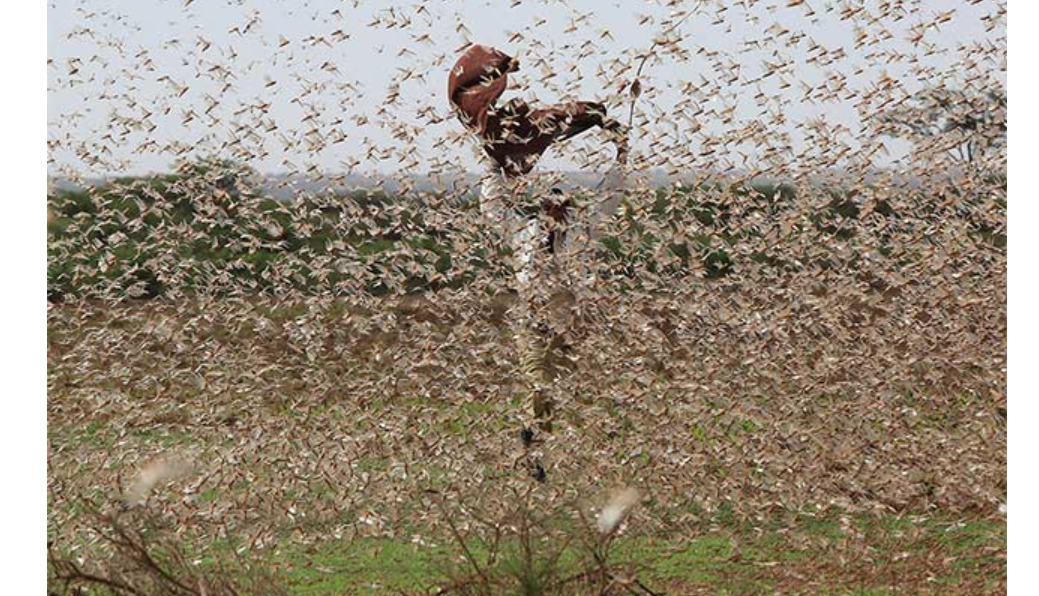
Locust swarms destroying the crops may be a natural calamity for agricultural scientists throughout the world but its more a diplomatic issue between India and Pakistan. The farmers of both the sides along 2,101 km long international border have become a soft target of locust swarms due to rising tensions. According to the experts, the farmers in the bordering districts of Gujarat, Rajasthan and Punjab provinces of India; and Punjab and Sindh provinces of Pakistan are facing the worst ever locust attack since the 1950s.
After massive destruction of oilseed, cumin and wheat crops in Gujarat and Rajasthan, the farmers in Punjab and Haryana are also simmering under fear of locust attack. According to the estimates of the Rajasthan state government, about 1.49 lakh hectares of the crop was damaged by the locust swarms which landed in the state in December while the crop worth more than Rs 5 crore were destroyed in Gujarat. "Fresh locust swarms entered the country in December 2019 due to wind intensity and lack of effective control over locusts by neighbouring country Pakistan," Rajasthan Agriculture Minister Lal Chand Kataria. The attack of locust swarms was so huge in these states that the Central government had to rush additional teams in the two states to destroy the locusts.
Pakistan violating international norms on the natural calamity
Though Pakistan on February 2, declared a national emergency to fight locust attack in its Punjab province but critics say it deliberately ignored breeding of locusts in Sindh state which crossed the border and attacked crops in the Indian states of Gujarat and Rajasthan. However, locust attack started in Sindh as early as June 2019, but Pakistan authorities continued to ignore until it took the form of a calamity in November. The Central government of Pakistan always adopted a lackadaisical approach in handling the situation until November. Besides, Pakistan never shared information of locust attacks with India which is mandatory as per the provisions of SAARC (South Asian Association for Regional Cooperation) and Shanghai Cooperation.
As the scientists are issuing warnings for locust attack in Punjab and Haryana, Indian State Punjab's Chief Minister Capt. Amarinder Singh wrote a letter to Prime Minister Narendra Modi on January 28. In the letter, he demanded the Prime Minister to direct Ministry of External Affairs and Indian High Commission in Pakistan to take up the matter with the Government of Pakistan. He also emphasized that India should invoke provisions of international agreements to ask Pakistani authorities for immediate action against locusts as the pests were originating from their side. Singh also suggested to approach the Food and Agriculture Organisation (FAO) of the United Nations, which is mandated to control locusts internationally. However, international organizations also seem to have become mute spectators on sufferings of millions of farmers in both the warring countries. According to media reports, the Pakistan government has neither responded nor taken any effective action to control the locust population in line to the recommendations of international organizations.
Early Monsoon aggravated Locust problem
In an Interview, Keith Cressman, a senior locust-forecasting officer with the FAO mentioned categorically "this has happened for the first time since the 1950s. The decades before this witnessed a terrible and long period of locust plague (when there is a swarm attack for more than two continuous years, it is called plague). This time, they stayed for long because of good monsoon". In 2019, the monsoon started six weeks before time (first week of July) in western India, especially in locust-infested areas. It also lasted a month longer — until November, instead of the usual September-October. Extended rains created excellent breeding conditions for the locust, while also producing natural vegetation on which they could feed longer. He also recommended sanitization of Locusts breeding area in Pakistan which was raised by Capt. Amarinder Singh his letter to the Prime Minister of India.
Locust swarms were first spotted in Jaisalmer district of Rajasthan as early as in May end. Thereafter, it witnessed three generations of breeding instead of the regular one generation. The first two generations caused a lot of damage to crops but the third generation is weak now. According to scientists, locusts breed very fast. The first breeding causes a 20-time increase in number; the second a 400-time rise; and the third 16,000 times. The peak infestation this time was in October, at the end of second-generation when large swarms were reported in Rajasthan and Gujarat. Since natural vegetation dried out in December, the swarms got into cultivated areas and caused damage.
Farmer, a vulnerable community on both the sides
Notable point is that the Agriculture is facing a crucial phase on both sides of the border due to a couple of reasons such as climate change, unaccepted rainfall, high-cost labour, seeds, fertilizers, agro-chemicals and a major issue is lack of adequate minimum support price.
Besides, the indebtedness of farmers has been a major problem in India as well as in Pakistan. They often borrow from private money lenders as well, which aggravates their problem in case of crop destruction. However, farmers have been the largest suffers in case of the battles between the two countries but this time it is locust attack. The non-cooperation in information sharing by Pakistan or its alleged connivance by not controlling locust swarms is being seen in the recent spate between the two neighbouring countries. Since the first surgical strike on September 29, 2016, India is following aggressive defence against Pakistan in which Air Strike was the latest addition. According to critics, the Pakistan which has failed to compete India on diplomatic forums is probably using locust swarms against its neighbour.
In this fight of supremacy between India and Pakistan or efforts to cause maximum damage to one another, farmers of both the countries are ultimate suffers. Whatever may be the reasons, the locust problem has now become an international issue between India and Pakistan in which farmers are sufferings. It's high time, international agriculture organizations such as FAO and humanitarian bodies put their brain together to find out a solution to the crisis.
(Disclaimer: The opinions expressed are the personal views of the author. The facts and opinions appearing in the article do not reflect the views of Devdiscourse and Devdiscourse does not claim any responsibility for the same.)
- FIRST PUBLISHED IN:
- Devdiscourse


 Google News