

Eight Months of War in Gaza Devastate Livelihoods and Economy, Reports ILO and PCBS
Additionally, the conflict has caused real GDP to plummet by 83.5% in the Gaza Strip and by 22.7% in the West Bank over the past eight months. On average, the entire OPT has seen its real GDP shrink by 32.8%.
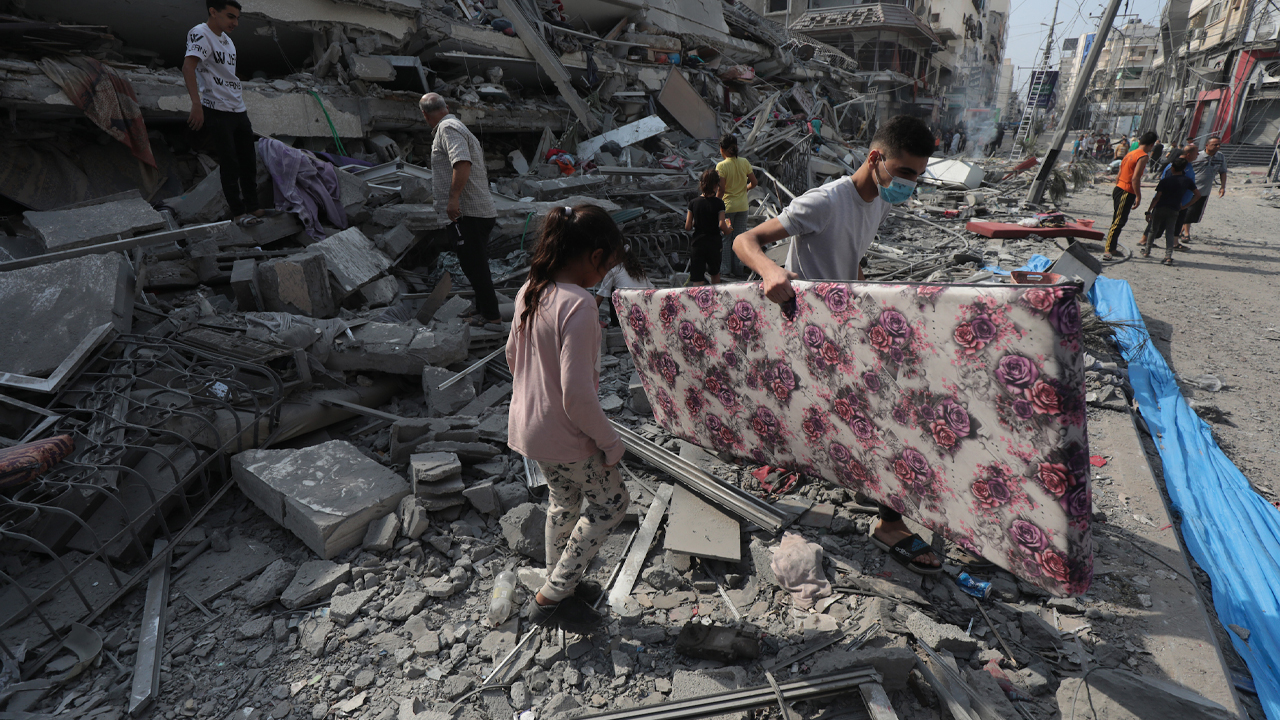
Eight months of conflict in the Gaza Strip have led to widespread job losses, significant livelihood disruptions, and a sharp decline in GDP across the Occupied Palestinian Territory (OPT), according to a new brief by the International Labour Organization (ILO) and the Palestinian Central Bureau of Statistics (PCBS).
Since the hostilities began in October 2023, the Gaza Strip has seen its unemployment rate soar to a staggering 79.1%. The West Bank, also severely affected by the crisis, has experienced an unemployment rate of 32%. These figures bring the overall unemployment rate across the OPT to 50.8%. However, these statistics do not account for individuals who have left the labor force entirely due to the lack of job opportunities, suggesting the actual number of job losses is even higher.
Additionally, the conflict has caused real GDP to plummet by 83.5% in the Gaza Strip and by 22.7% in the West Bank over the past eight months. On average, the entire OPT has seen its real GDP shrink by 32.8%.
These findings are detailed in the fourth bulletin in a series that examines the war's impact on the labor market and livelihoods in the OPT.
"Our latest bulletin shows the extensive damage the war in the Gaza Strip has inflicted on human lives, and the resulting dire humanitarian situation is coupled with a severe economic downturn," said ILO Regional Director for Arab States Ruba Jaradat. "This has compounded the suffering of Palestinians in both Gaza and the West Bank, further jeopardizing their safety and wellbeing."
The private sector has been particularly hard-hit by the economic crisis. In the Gaza Strip, nearly all private sector establishments have either completely ceased or drastically reduced production, leading to an 85.8% loss in production value, equivalent to USD $810 million, in the first four months of the war. In the West Bank, the private sector experienced a 27% reduction in production value, amounting to USD $1.5 billion during the same period. This translates to daily private sector production losses of USD $19 million across the OPT during the initial four months of the conflict.
"Restoring livelihoods and creating decent jobs are crucial for enabling Palestinians in the OPT to recover from the war's devastation," Jaradat emphasized. "This recovery must occur alongside ongoing humanitarian efforts, and the ILO and its partners are implementing an Emergency Response Plan to support this goal."
The fourth bulletin also provides projections on the war's impact on the OPT economy and labor market for the entire year of 2024. If the war concludes in August 2024 and recovery efforts commence, the annual unemployment rate is expected to average 47.1% for 2024. Under this scenario, real GDP would decline by 16.1% and real per capita income by 18.0% compared to 2023, marking the steepest decline in growth rates for these indicators in over two decades.
The bulletin further examines the war's impact on workers and employers in the West Bank, where Israeli closures, movement restrictions, and settler attacks have disrupted supply chains and transportation routes. A survey by the ILO and the Palestinian General Federation of Trade Unions (PGFTU) revealed that 51% of employed West Bank workers faced reduced work hours and 62.8% experienced wage reductions. Another survey by the ILO and the Federation of Palestinian Chambers of Commerce, Industry, and Agriculture (FPCCIA) found that 65.3% of West Bank enterprises reported workforce reductions, with many resorting to layoffs, either temporary or permanent.


 Google News