

C.R. Patil Chairs High-Level Meet on River Tech Under Namami Gange Mission
The discussions focused on developing advanced tools and collaborative approaches for the rejuvenation of both major and small rivers across India.
- Country:
- India
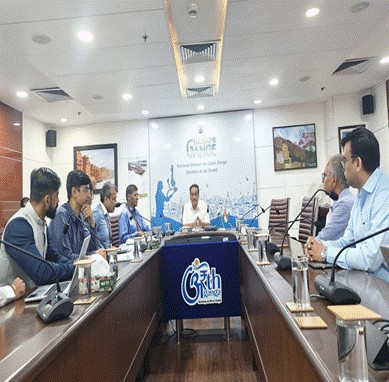
In a landmark move to enhance scientific and technological interventions in river conservation, Union Minister of Jal Shakti Shri C.R. Patil chaired a high-level review meeting in the national capital to assess and accelerate innovations under the Namami Gange Programme. The discussions focused on developing advanced tools and collaborative approaches for the rejuvenation of both major and small rivers across India.
Bringing together top scientists, researchers, and government officials, the meeting showcased how cutting-edge innovations and international partnerships are revolutionizing the management of India's vital water bodies.
"India is fully committed to achieving the vision of 'Aviral aur Nirmal Ganga' (uninterrupted and clean Ganga). The success of this vision depends on how we convert research and innovations into scalable, ground-level interventions," said Minister Patil.
Highlighting Technology Partnerships: IITs, Denmark, Netherlands
Two leading technical institutions—IIT (BHU) and IIT Delhi—presented their innovation initiatives during the session. Both projects are developed in partnership with Denmark and the Netherlands, respectively, and are driving new age river science under the banner of Smart Laboratory on Clean Rivers (SLCR) and IND-RIVERS.
Key Presentations:
-
IIT (BHU): Focused on Varuna River with real-time decision-making tools
-
IIT Delhi (IND-RIVERS): Offered urban river solutions, backed by Dutch water expertise
Both institutions demonstrated how their Decision Support Systems (DSS) and research models are aligned with the National Mission for Clean Ganga (NMCG)'s long-term vision of scientific river rejuvenation.
SRMT: Fast-Response Decision Support for River Management
The centerpiece of the discussions was the Small Rivers Management Tool (SRMT)—a sophisticated Decision Support System designed to manage small rivers like Varuna and easily scalable to others. The tool integrates a wide array of data inputs and modules including:
-
Population forecasting
-
Water demand-supply estimation
-
Sewage load analytics
-
Priority mapping for STP placement
The SRMT comes equipped with robust login security, a user-friendly dashboard, and is positioned to become a key digital tool for policymakers at the national and state levels.
Modernising Groundwater Strategy: Managed Aquifer Recharge (MAR)
In another forward-looking approach, the Ministry reviewed the adoption of Managed Aquifer Recharge (MAR) systems to address groundwater depletion and river base flow issues. The plan includes:
-
Real-time hydrogeological modelling
-
Artificial recharge strategies to sustain year-round base flows
-
Integration of MAR with DSS to ensure targeted implementation
The aim is to support rivers through aquifers, effectively linking surface and groundwater management for holistic ecosystem health.
Next-Gen Pollution Monitoring: FloaTEM and LC-HRMS
The session also showcased two breakthrough monitoring projects:
-
Hydrogeological Modeling in Varuna Basin
-
Fingerprint Analysis of Emerging Pollutants in Ganga Basin
These projects utilise cutting-edge technologies such as:
-
FloaTEM: For sub-surface water and pollution mapping
-
LC-HRMS (Liquid Chromatography–High-Resolution Mass Spectrometry): For detailed pollutant fingerprinting, particularly emerging threats like pharmaceutical residues, microplastics, and other complex chemicals
These advanced tools enable real-time surveillance, improved source attribution, and targeted remediation efforts.
Centre of Excellence and Startup Incubation in Water Sector
A roadmap was also presented for the establishment of a Centre of Excellence (CoE) at IIT Delhi under the IND-RIVERS initiative, with strong backing from the Netherlands and NMCG.
The CoE will focus on:
-
Urban River Management Plans
-
Digital Twins for river systems
-
AI-driven geospatial water modelling
-
Water quality enhancement technologies
-
Training modules and startup incubation in water innovation
"This Centre will act as both a research hub and an innovation incubator, helping India lead global river rejuvenation science," the minister stated.
Way Forward: Scaling Innovation, Local Implementation
Minister Patil directed all stakeholders to ensure that these innovations are not confined to labs but translated into actionable interventions in priority catchments and river basins.
"We are at a turning point. By combining scientific excellence, indigenous innovation, and global expertise, we can secure a cleaner and healthier water future for India."
In the months ahead, the Ministry will push for:
-
Wider adoption of SRMT and DSS tools
-
Faster scaling of MAR systems
-
Expanded monitoring of emerging pollutants
-
Local-level training and awareness programmes


 Google News