

Hubble measures a behemoth comet barreling its way toward Earth
C/2014 UN271 (Bernardinelli-Bernstein) was discovered by astronomers Pedro Bernardinelli and Gary Bernstein in archival images from the Dark Energy Survey at the Cerro Tololo Inter-American Observatory in Chile. With a diameter of approximately 80 miles across, the comet is about 50 times larger than typical comets and its 500 trillion ton mass is a hundred thousand times greater than a typical comet found much closer to the Sun.
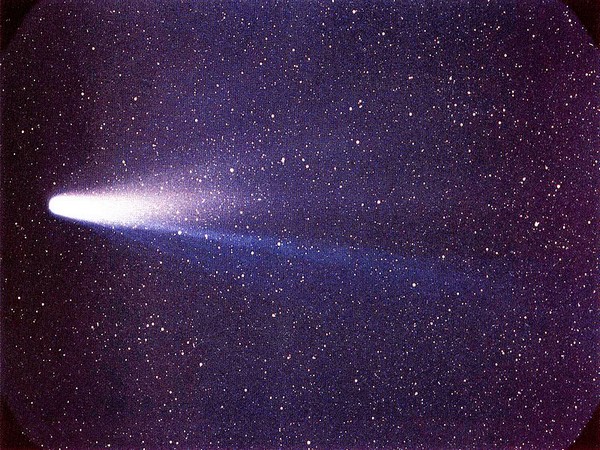
- Country:
- United States
The Hubble Space Telescope, a project of international cooperation between NASA and ESA, has determined the size of the largest icy comet nucleus ever seen by astronomers, thanks to its sharpness and sensitivity.
C/2014 UN271 (Bernardinelli-Bernstein) was discovered by astronomers Pedro Bernardinelli and Gary Bernstein in archival images from the Dark Energy Survey at the Cerro Tololo Inter-American Observatory in Chile. With a diameter of approximately 80 miles across, the comet is about 50 times larger than typical comets and its 500 trillion ton mass is a hundred thousand times greater than a typical comet found much closer to the Sun.
"This is an amazing object, given how active it is when it's still so far from the Sun. We guessed the comet might be pretty big, but we needed the best data to confirm this," said the paper's lead author Man-To Hui of the Macau University of Science and Technology, Taipa, Macau.
Hui and his team used the Hubble telescope to take five photos of the comet on January 8, 2022 and then created a computer model of the surrounding coma and adjusted it to fit the Hubble image. The coma's glow was then subtracted to leave behind the starlike nucleus. Combined with telescope data, the team arrived at a precise measurement of the nucleus size.
The new Hubble measurements are close to the earlier size estimates from the ALMA observatory (Atacama Large Millimeter/submillimeter Array) in Chile's Atacama Desert, but convincingly suggest a darker nucleus surface than previously thought, the researchers say.
You may have heard of a behemoth comet barreling its way toward Earth from the edge of the solar system. Don't worry! It will never get closer than 1 billion miles away from the Sun, which is slightly farther than the distance of the planet Saturn. More: https://t.co/aSNI3z2l24 pic.twitter.com/egbPg9fwYq
— NASA Asteroid Watch (@AsteroidWatch) April 12, 2022
According to the researchers, Bernardinelli-Bernstein is barreling its way at 22,000 miles per hour toward Earth from the edge of the solar system. However, the comet will never get closer than 1 billion miles away from the Sun and that won't be until the year 2031.


 Google News