

This intriguing spiral galaxy has numerous sets of double features: Check out this pic by ESO's VLT
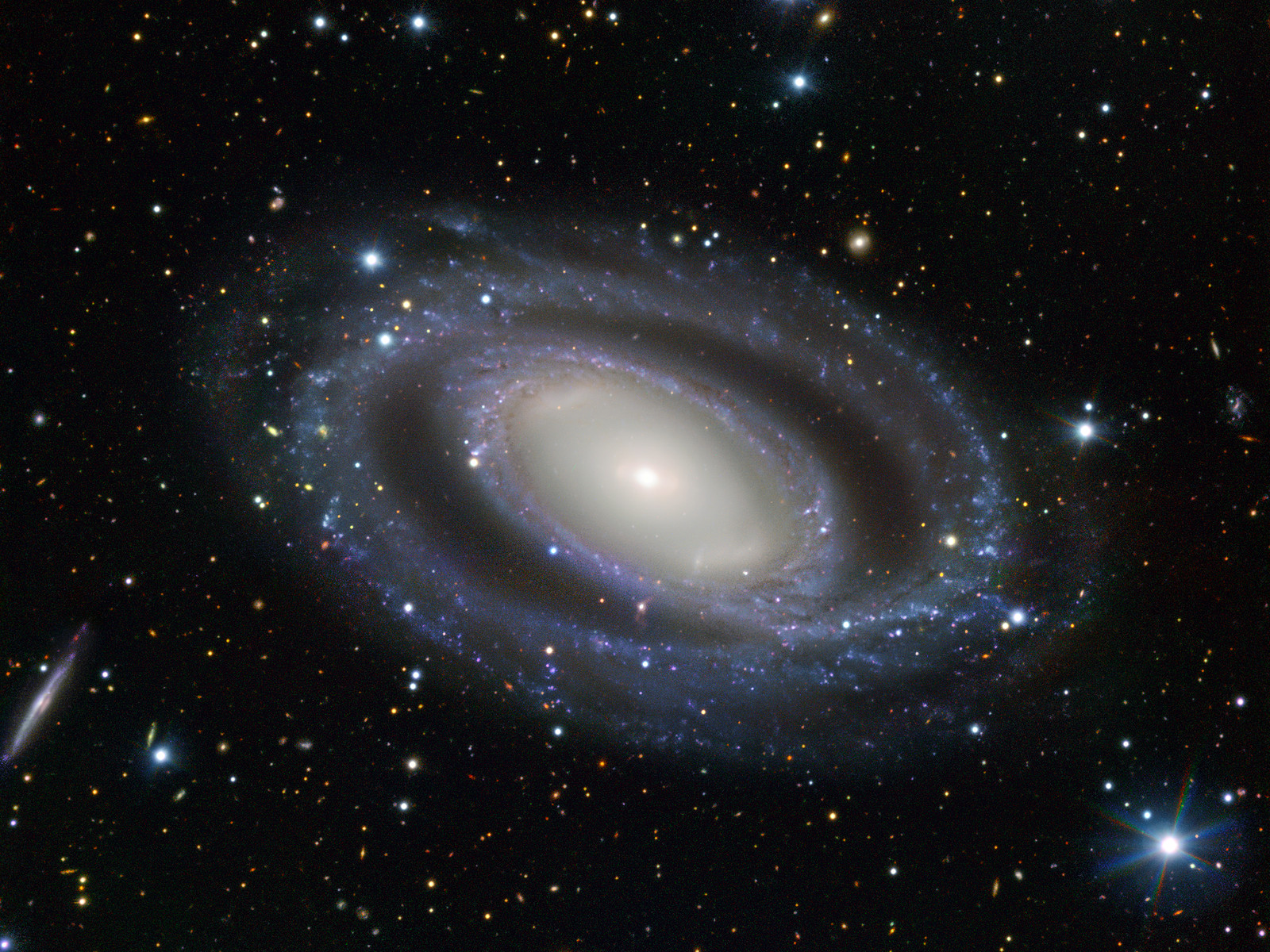
This throwback image captured by European Southern Observatory's Very Large Telescope (VLT) at Paranal Observatory shows NGC 7098 - an intriguing spiral galaxy with numerous sets of double features.
NGC 7098 lies approximately 95 million light-years away, in the southern constellation of Octans (The Octant). This mesmerizing image is formed from data gathered by VLT's FOcal Reducer and low dispersion Spectrograph (FORS) instrument.
ESO #Flashback: Are you seeing double? No, you're seeing NGC 7098 — an intriguing spiral galaxy with numerous sets of double features. How many can you spot? Find out more here: 🔗 https://t.co/3PJUHpVaDGCredit: @ESO pic.twitter.com/DkMjjxza8s
— ESO (@ESO) August 15, 2022
According to ESO, the first of NGC 7098's double features is a duo of distinct ring-like structures that loop around the galaxy's hazy heart. These are the galaxy's spiral arms, which have wound themselves around its luminous core. This central region hosts a second double feature: a double bar.
NGC 7098 has also developed features known as ansae, visible as small, bright streaks at each end of the central region. Ansae are visible areas of overdensity - they commonly take looping, linear, or circular shapes, and can be found at the extremities of planetary ring systems, in nebulous clouds, and, as is the case with NGC 7098, in parts of galaxies that are packed to the brim with stars.
In addition to NGC 7098, an array of distant galaxies are also visible throughout the frame, the most prominent being the small, edge-on, spiral galaxy visible to the left of NGC 7098, known as PGC 246235.
ESO's Paranal Observatory, one of the very best astronomical observing sites in the world, hosts several world-class telescopes including the Very Large Telescope, the Visible and Infrared Survey Telescope for Astronomy (VISTA), and the VLT Survey Telescope. VLT is one of the world's most advanced optical telescopes and has stimulated a new age of discoveries, with several notable scientific firsts.


 Google News