

Jupiter Trojan asteroid Polymele has a satellite of its own, NASA's Lucy mission team finds
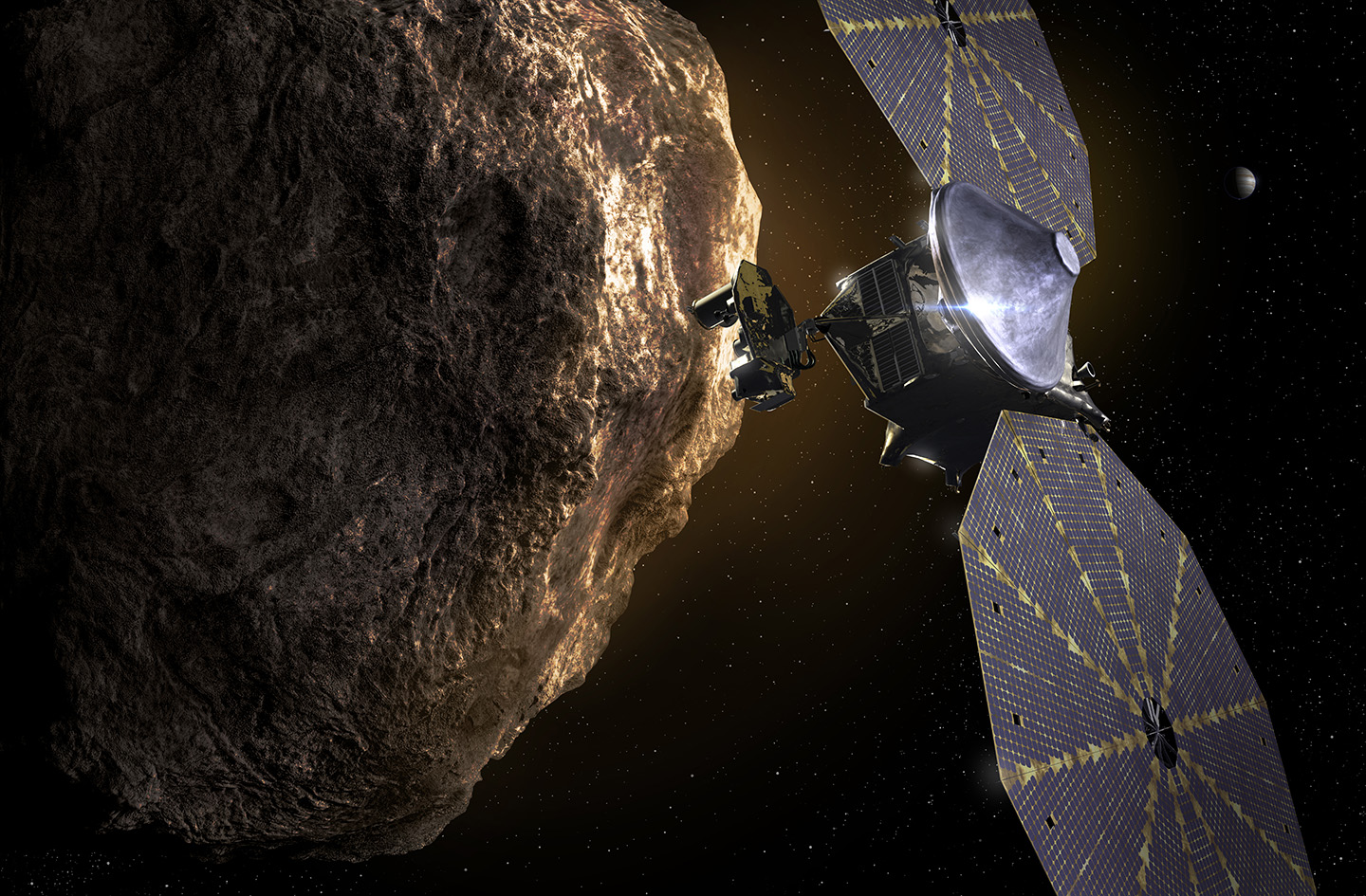
The team at NASA's Lucy mission has discovered a moon around the Jupiter Trojan asteroid Polymele - the smallest of the mission's asteroid targets.
According to NASA, on March 27, Polymele was expected to pass in front of a star, allowing Lucy's science team to observe the star blink out as the asteroid briefly blocked, or occulted, it. The team planned to measure the location, size, and shape of Polymele with unprecedented precision while it was outlined by the star behind it.
26 teams of professional and amateur astronomers were spread across the path where the occultation - an event where one celestial object passes in front of another, blocking the latter object from an observer's view - would be visible. The long-running occulation observation campaign resulted in the discovery of this new satellite.
"We were thrilled that 14 teams reported observing the star blink out as it passed behind the asteroid, but as we analyzed the data, we saw that two of the observations were not like the others. Those two observers detected an object around 200 km (about 124 miles) away from Polymele. It had to be a satellite," said Marc Buie, Lucy occultation science lead at the Southwest Research Institute, which is headquartered in San Antonio.
📣 Discovery Alert! Our #LucyMission has discovered a tiny moonlet around the Jupiter Trojan asteroid Polymele, one of the mission's targets of study. Lucy was already set to visit more asteroids than any other space mission. Add one to the roster! https://t.co/6ztAthkV68
— NASA Solar System (@NASASolarSystem) August 17, 2022
The team found that this newly-discovered satellite is roughly 3 miles (5 km) in diameter, orbiting Polymele, which is itself around 17 miles (27 km) along its widest axis. The observed distance between the two bodies was about 125 miles (200 km).
As the satellite is too close to Polymele to be clearly seen by Earth-based or Earth-orbiting telescopes – without the help of a fortuitously positioned star – that determination will have to wait until either the team gets lucky with future occultation attempts or until Lucy approaches the asteroid in 2027, NASA said in a statement on Tuesday.


 Google News