

Massive volcanic activity may have transformed Venus from wet world to acidic hothouse: Study
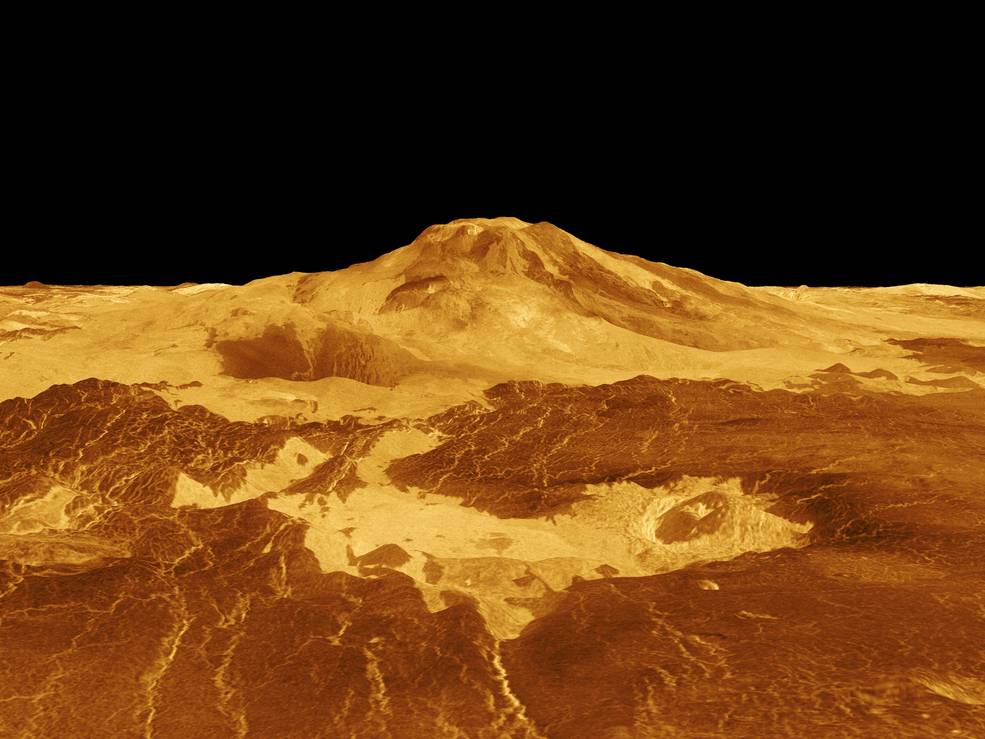
A new study by NASA suggests that volcanic activity lasting hundreds to thousands of centuries and erupting massive amounts of material may have caused the planet's present condition.
At present, Venus boasts surface temperatures of around 864 F on average, and an atmosphere 90 times the surface pressure of Earth's. The new NASA study suggests that these massive volcanic outpourings may have initiated these conditions sometime in the planet's ancient history.
The occurrence of several such eruptions in a short span of geologic time (within a million years) could have led to a runaway greenhouse effect which kicked off Venus' transition from a wet world to an acidic hothouse.
"While we're not yet sure how often the events which created these fields occurred, we should be able to narrow it down by studying Earth's own history," said Dr. Michael J. Way, of NASA's Goddard Institute for Space Studies in New York. He is also the lead author on the paper, published April 22 in the Planetary Science Journal.
The paper also discusses the large igneous provinces - the products of periods of large-scale volcanism lasting tens of thousands or even hundreds of thousands of years - in Earth's history which caused several mass extinctions on our own planet millions of years ago.
A new study reveals hundreds of years of volcanic activity may have helped transform Venus from a temperate wet world to the acidic hot house it is today, boasting temperatures around 864 °F (462 °C) on average. Learn more: https://t.co/5390RNZn8G pic.twitter.com/lhwNA4Grr4
— NASA (@NASA) November 20, 2022
NASA's upcoming DAVINCI mission, short for the Deep Atmosphere Venus Investigation of Noble gases, Chemistry, and Imaging, and the VERITAS mission, short for Venus Emissivity, Radio science, InSAR, Topography, And Spectroscopy, will study the origin, history, and present state of Venus in unprecedented detail. Both Venus probes are scheduled for launch in the late 2020s.


 Google News