

Comet strikes could help bring ingredients for life to ocean in Jupiter's moon Europa: Study
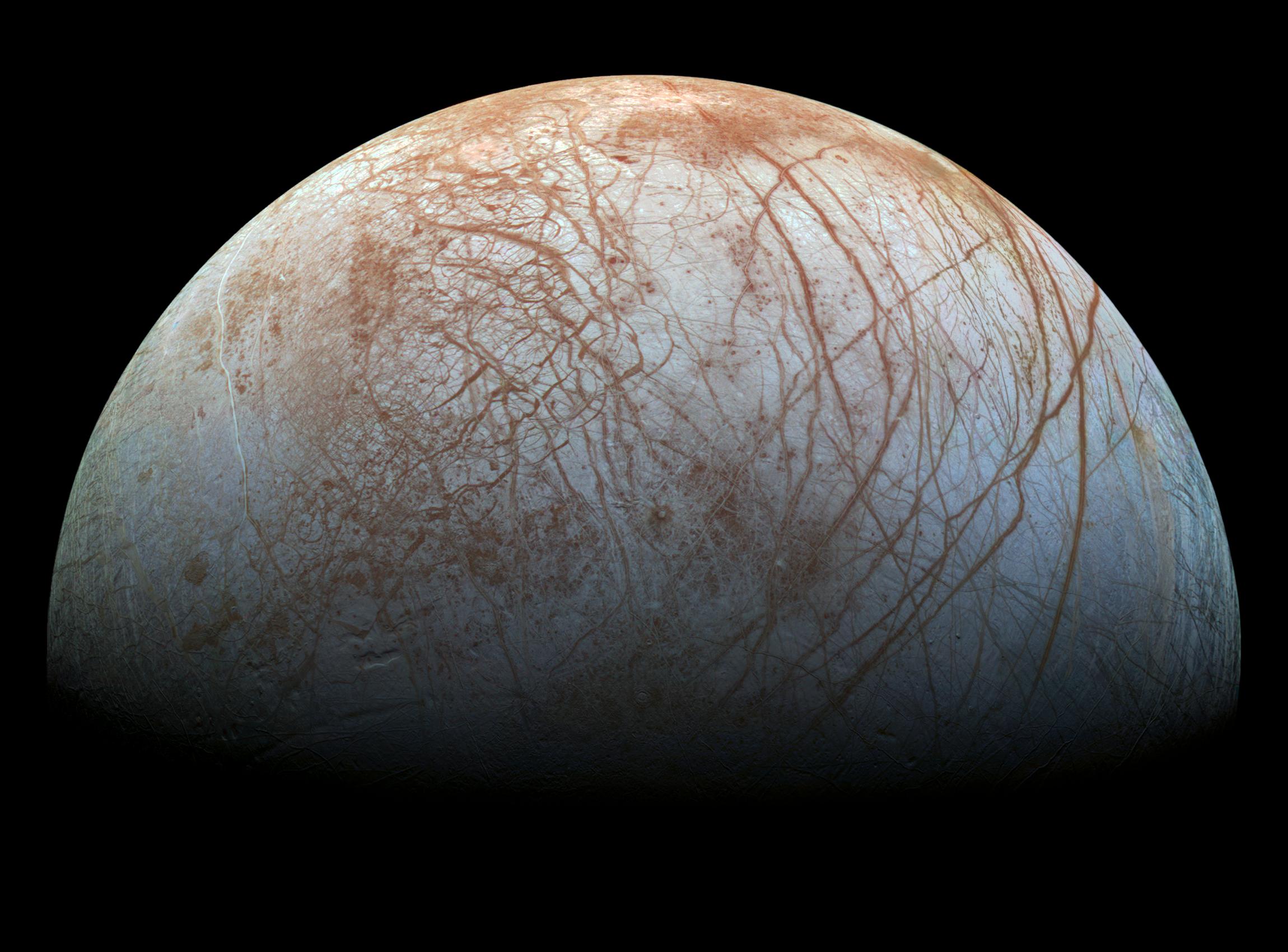
Jupiter's Europa is thought to have an ocean of salty water beneath its icy shell. The vast and unfathomably deep ocean is widely considered the most promising place to look for life beyond our home planet. A new study, led by researchers at The University of Texas at Austin, suggests that comet or asteroid strikes on the Jovian moon could help transport critical ingredients for life found on its surface to its hidden ocean.
Impacts have been proposed as a means to transport oxidants on Europa, but scientists assumed the strikes would have to break through the thick ice.
The research team developed a computer model to observe what happens after a comet or asteroid strikes the ice shell, which is estimated to be 10 to 15 miles (15 to 25 kilometers) thick. The model shows that if a comet or asteroid strike can make it at least halfway through Europa's ice shell, the heated meltwater it generates will sink through the rest of the ice, bringing oxidants - a class of chemicals required for life - from the surface to the ocean, where they could help sustain any potential life in the sheltered waters.
This study found that if an impact reaches the ice shell's midpoint, over 40% of the meltwater will make it to the ocean.
"Once you get enough water, you're just going to sink. It's like the Titanic times 10," lead author and doctoral student Evan Carnahan, said in a statement.
This study is important because it suggests that a much larger range of impacts can do the job, said co-author Marc Hesse, a professor at the UT Jackson School of Geosciences Department of Geological Sciences.
NASA's upcoming Europa Clipper mission will conduct a detailed reconnaissance of Europa and investigate whether the icy moon could have conditions suitable for life. The mission will send a highly capable, radiation-tolerant spacecraft into a long, looping orbit around Jupiter to perform repeated close flybys of the icy moon.
The Europa Clipper mission is scheduled for October 2024 launch.


 Google News