

NASA gets close glimpse of a massive black hole tearing apart a wandering star: Watch video
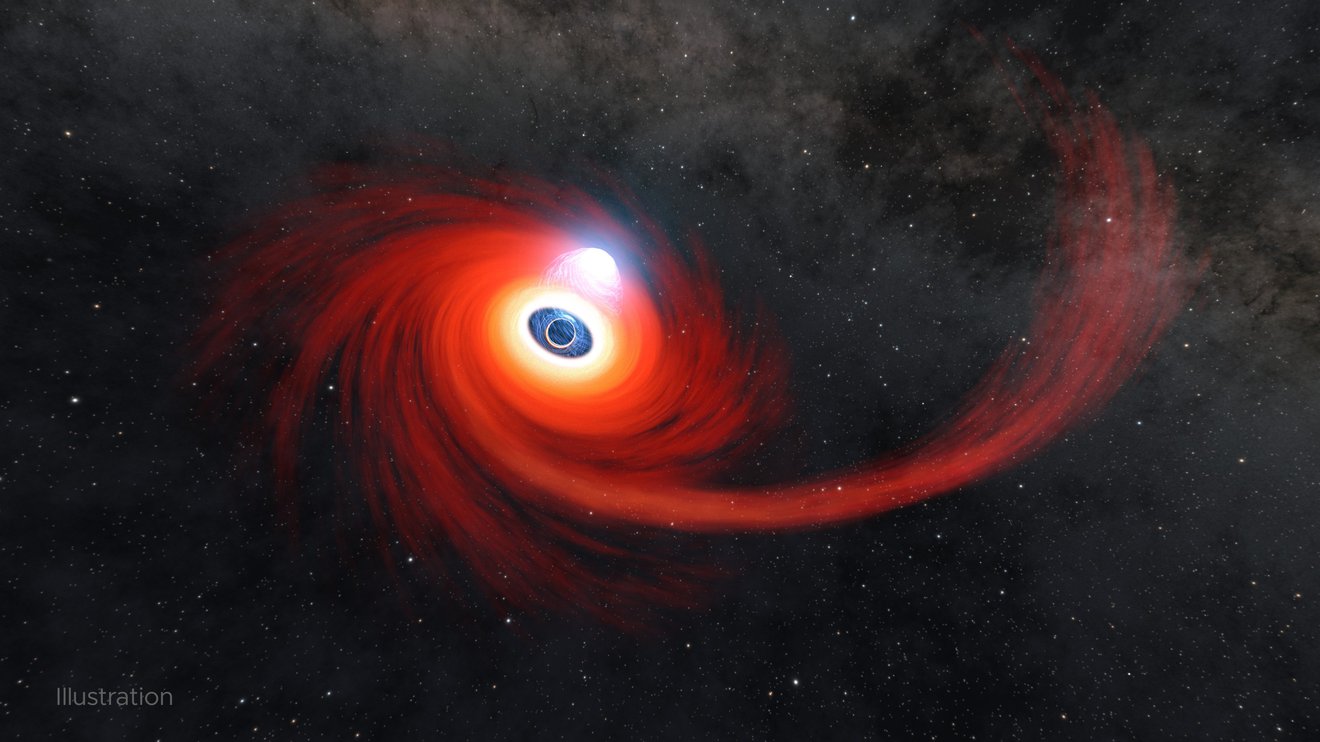
NASA scientists recently observed a massive black hole tearing apart a wandering star about 250 million light-years from Earth - a process formally known as a tidal disruption event. This was the fifth-closest example of a black hole destroying a star ever observed, the agency said on Tuesday.
The black hole's intense gravity thoroughly ruptured the unlucky star, following which astronomers saw a dramatic rise in high-energy X-ray light around the black hole. The event suggested that as the stellar material was pulled toward its doom, it formed an extremely hot structure above the black hole called a corona.
The focus of the new study, published in the Astrophysical Journal, is an event called AT2021ehb, which took place in a galaxy with a central black hole about 10 million times the mass of our Sun. During this tidal disruption event, the side of the star nearest the black hole was pulled harder than the far side of the star, stretching it out and leaving only a long river of hot gas.
Video Credit: Science Communication Lab/DESY
The event was first spotted on March 1, 2021, by the Zwicky Transient Facility (ZTF), located at the Palomar Observatory in Southern California, and was subsequently studied by NASA's Neil Gehrels Swift Observatory and Neutron star Interior Composition Explorer (NICER) telescope.
NASA's NuSTAR (Nuclear Spectroscopic Telescopic Array) began observing the system around 300 days after the event was first spotted. Surprisingly, NuSTAR detected a corona - a cloud of hot plasma, or gas atoms with their electrons stripped away - since coronae usually appear with jets of gas that flow in opposite directions from a black hole. In this tidal event, there were no jets, which made the corona observation unexpected.
"We've never seen a tidal disruption event with X-ray emission like this without a jet present, and that's really spectacular because it means we can potentially disentangle what causes jets and what causes coronae," Yuhan Yao, a graduate student at Caltech in Pasadena, California, and lead author of the new study, said in a statement.


 Google News