

One or more of Uranus’ moons might have hidden oceans, new study suggests
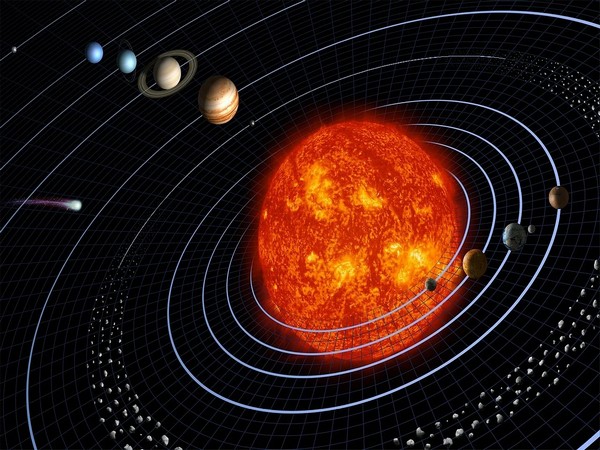
A new study suggests that one or more of Uranus' moons may have oceans beneath their icy surfaces and are actively spewing some of their material into space, possibly through plumes.
For this study, researchers led by the Johns Hopkins Applied Physics Laboratory (APL), leveraged nearly 40-year-old energetic particle and magnetic field data taken by NASA's Voyager 2 - the only spacecraft that has travelled to Uranus so far.
Their results suggest that two of Uranus' 27 moons - Ariel and/or Miranda - are adding plasma into the space environment through an unknown and mysterious mechanism.
"It isn't uncommon that energetic particle measurements are a forerunner to discovering an ocean world," said Ian Cohen, a space scientist at APL and the lead author of the new study. For instance, radiation data provided some of the first evidence that led to the discovery of the solar system's two unequivocal ocean moons - Jupiter's Europa and Saturn's Enceladus.
One or more of Uranus' moons might have oceans hidden beneath their icy surfaces, according to new findings. 🌚 🌊 pic.twitter.com/K2avagbwld
— NASA Sun & Space (@NASASun) March 17, 2023
Cohen and his colleagues revisited the particle data obtained by the Low-Energy Charged Particle (LECP) instrument on Voyager 2, which was developed by APL. They found a population of charged particles trapped around Uranus' magnetic equator.
Initially, scientists attributed these features to Voyager 2 passing through a random plasma stream that was injected from the distant tail of Uranus' magnetosphere.
But that explanation doesn't hold, Cohen said.
The researchers used simple physical models and took advantage of the nearly 40 years of knowledge accumulated since the spacecraft's encounter. They attempted to recreate the Voyager 2 observations and found that the explanation had to involve two key things: a strong and steady source of particles and a specific mechanism to energize them. After considering several possibilities, the team concluded that the most likely source of the particles was a nearby moon.
Cohen and his team suspect that the trapped population of energetic particles originated from two of Uranus' moons, Ariel and/or Miranda, through either a vapour plume - something that's been observed on other moons in the solar system, where the plumes are believed to come from subsurface oceans, or through a process called sputtering where high-energy particles hit a surface, ejecting other particles into space.
Without additional data and observations of the region, it's challenging to determine the source of the particles, Cohen said, adding that right now, it's about 50-50 whether it's just one or the other.
The new findings highlight the importance of further exploration of Uranus and its neighbour, Neptune.


 Google News