

Astronomers discover ultramassive black hole over 30 billion times the mass of our Sun
- Country:
- United Kingdom
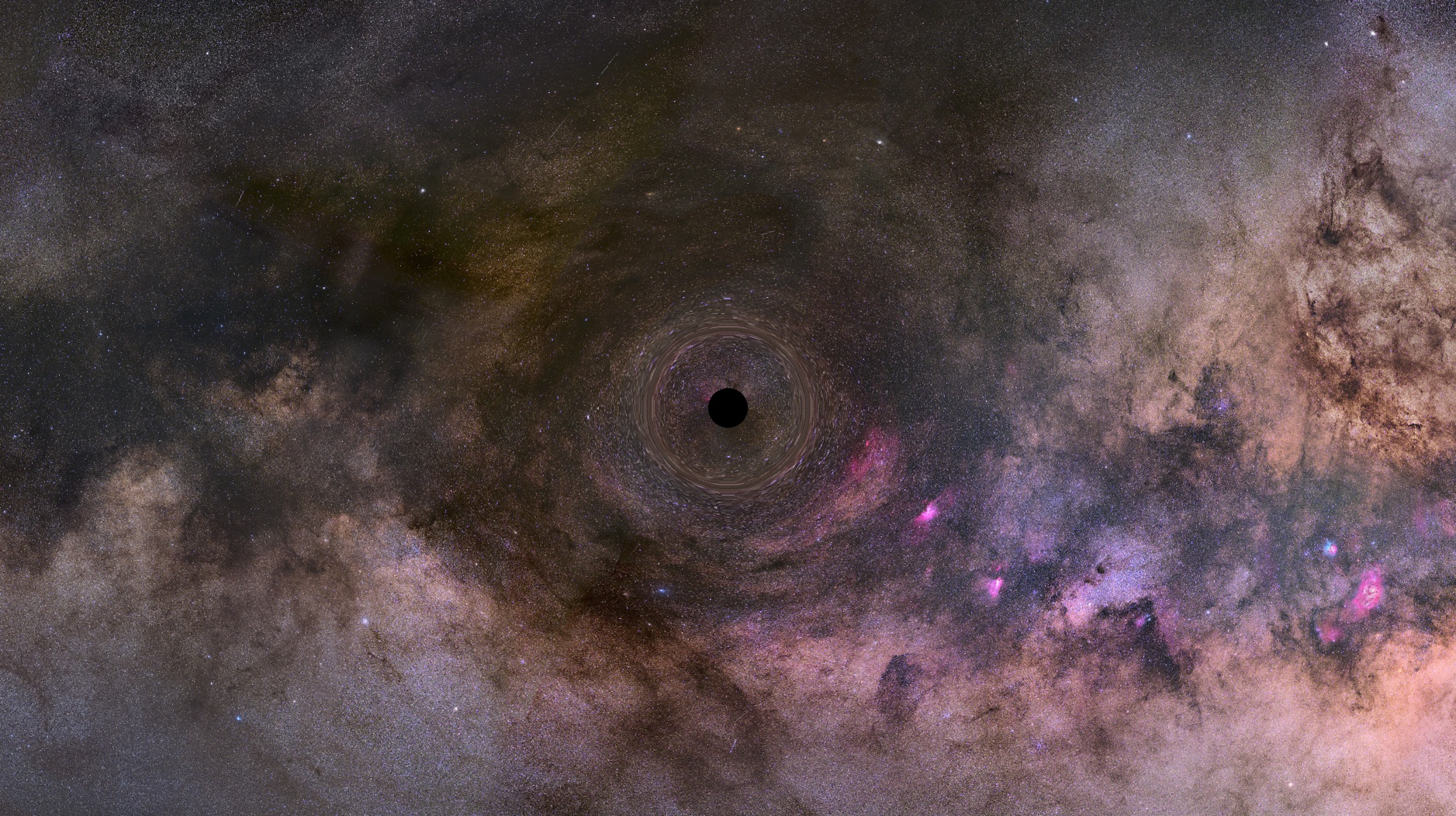
Astronomers have discovered an ultramassive black hole, over 30 billion times the mass of our Sun, making it one of the biggest black holes ever found.
This is the first black hole found using a phenomenon called gravitational lensing - where a massive celestial body causes light from a more distant object to bend. This distortion causes the image of the distant object to be magnified or stretched.
The team led by Dr James Nightingale from Durham University's Department of Physics used supercomputer simulations on the DiRAC HPC facility to closely examine how light is bent by a black hole inside a galaxy hundreds of millions of light-years from Earth.
The researchers ran simulations of light traversing the Universe numerous times, incorporating a different mass black hole in each simulation, which altered the path of light as it travelled towards Earth. Incorporating an ultramassive black hole into their simulations resulted in the path of light from a distant galaxy to Earth being consistent with the path observed in real images captured by the Hubble Space Telescope.
The tale of this discovery began in 2004, when Professor Alastair Edge, a colleague at Durham University, observed a giant gravitational lens arc while examining images of a galaxy survey. Nearly two decades later, using NASA's Hubble telescope's extremely high-resolution images and Durham University's DiRAC COSMA8 supercomputer facilities, Dr Nightingale and his team were able to revisit this and examine it further.
The team's findings have been published in the journal Monthly Notices of the Royal Astronomical Society.
What's next?
The researchers are optimistic that this is the first step in facilitating a more profound investigation into the enigmas surrounding black holes and anticipate that future large-scale telescopes will aid astronomers in scrutinizing even more distant and ultramassive black holes than previously thought, providing additional insights into their size and scale


 Google News