

Milky Way's supermassive black hole woke up about 200 years ago after sudden cosmic snack
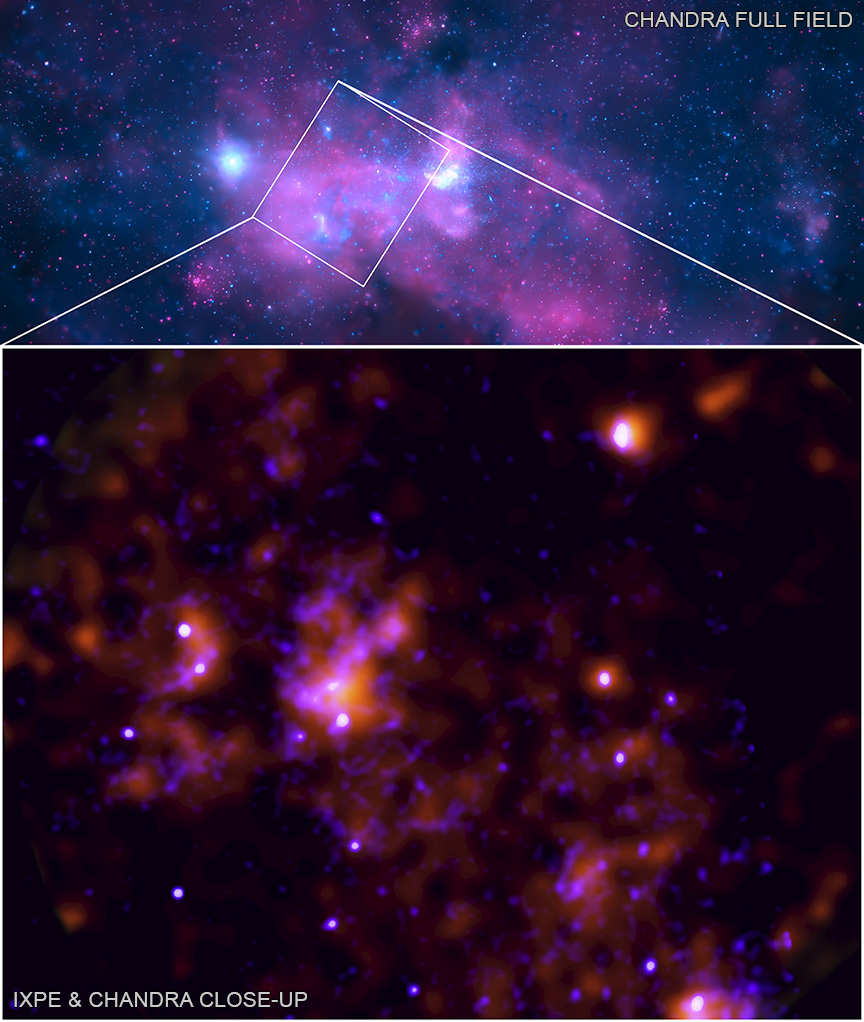
The supermassive black hole at the center of our Milky Way galaxy experienced an outburst approximately 200 years ago after devouring nearby gas and dust, according to new data from NASA's Imaging X-ray Polarimetry Explorer (IXPE).
With about 4 million times the mass of the Sun, this black hole, known as Sagittarius A* (Sgr A*), lies just 26,000 light years from Earth.
In the above image, IXPE data is shown in the bottom panel (orange) and have been combined with other X-ray data from NASA's Chandra X-ray Observatory, represented by blue. The low and high-energy X-rays are represented by blue and purple colors.
The IXPE data, acquired during February and March 2022, focuses on X-ray emission from molecular clouds near Sgr A*. These normally cold and dark gas clouds appeared bright in X-rays, indicating that they were reflecting X-rays generated elsewhere in the past - a phenomenon referred to as a "light echo."
Scientists combined the IXPE data with observations from NASA's Chandra X-ray Observatory and the XMM-Newton X-ray satellite to isolate the reflected X-ray signal and trace its origin. They found that the X-ray light originated either from Sgr A* itself or from a source in close proximity to the black hole during an outburst roughly two centuries ago. The outburst is believed to have been triggered by the sudden consumption of nearby material by the black hole.
What's next?
The IXPE team plans to continue its observations of Sgr A*. Further research and analysis of the black hole's behaviour in the past will provide valuable insights into the activity level of the Milky Way's supermassive black hole. Understanding the history of such outbursts will shed light on whether they are typical occurrences or rare and exceptional events.
Sagittarius A* — our galaxy's supermassive black hole — had an outburst about 200 years ago following a snack on nearby matter. Scientists using NASA's IXPE & Chandra discovered this piece of cosmic history thanks to a phenomenon known as a "light echo": https://t.co/gAGUTYzsuF pic.twitter.com/Q71ECVj1GR
— Chandra Observatory (@chandraxray) June 21, 2023


 Google News