



Astronomers detect mysterious dark spot on Neptune for the first time from Earth
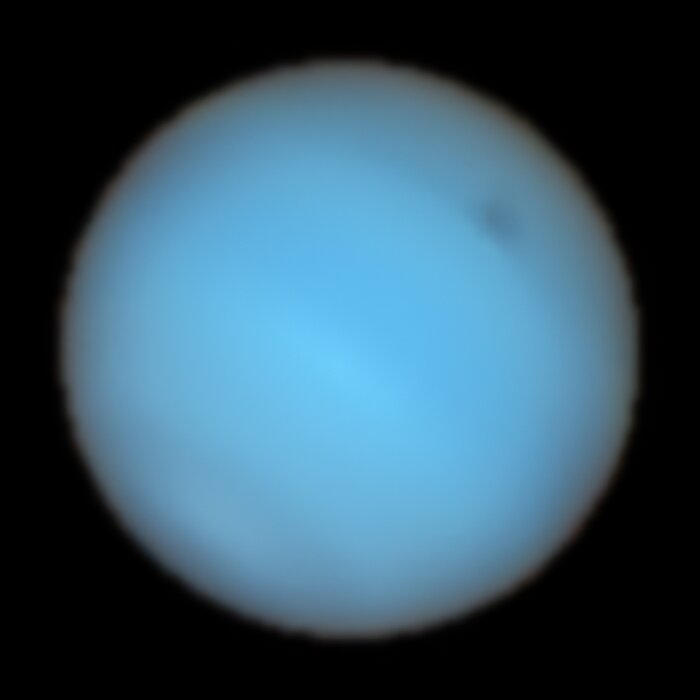
Astronomers using the European Southern Observatory's Very Large Telescope (VLT) have detected a mysterious dark spot in Neptune's atmosphere, marking the first-ever detection of such a feature from a ground-based telescope.
These dark features on Neptune's atmosphere are short-lived and elusive, making it challenging for astronomers to study them in sufficient detail. NASA's Voyager 2 initially spotted one such spot on the planet in 1989, which disappeared a few years later.
The new study provides further clues on their nature and origin. A team, led by Professor Patrick Irwin from the University of Oxford in the UK, leveraged the capabilities of ESO's VLT to debunk the notion that these dark spots are caused by "clearings" in the planet's clouds. Their findings suggest that these spots likely result from air particles darkening in a layer situated beneath the main visible haze layer, a result of the interaction between ice and hazes within Neptune's atmosphere.
The NASA/ESA Hubble Space Telescope identified multiple dark spots in Neptune's atmosphere, including one in the planet's northern hemisphere first spotted in 2018. Irwin and his team seized this opportunity and started studying these enigmatic features from Earth, armed with an instrument ideally suited for this challenging task - the VLT's Multi Unit Spectroscopic Explorer (MUSE), a 3D spectrograph that allows astronomers to observe the entirety of an astronomical object in one go.
Using MUSE, the team split the reflected sunlight from Neptune and its dark spot into its component colors or wavelengths, generating a 3D spectrum of the phenomenon. This approach allowed them to study the dark spot in unprecedented detail.
As various wavelengths probe different depths within Neptune's atmosphere, the spectrum allowed the researchers to better determine the spot's altitude within the planet's atmosphere. The spectrum also provided insights into the chemical composition of the various atmospheric layers, offering clues about the underlying reasons for the spot's dark appearance.
Additionally, the researchers discovered a rare deep bright cloud type that appeared as a bright spot right behind the larger main dark spot. According to the VLT data, the new deep bright cloud was at the same level in the atmosphere as the main dark spot, which means it is a completely new type of feature compared to the small, previously-observed 'companion' clouds of high-altitude methane ice.
"At first, we could only detect these spots by sending a spacecraft there, like Voyager. Then we gained the ability to make them out remotely with Hubble. Finally, technology has advanced to enable this from the ground," stated the study co-author Michael Wong, a researcher at the University of California, Berkeley, USA.
📢 Astronomers observe a mysterious dark spot — and adjacent bright spot — in #Neptune's atmosphere for the first time from Earth 🌍The #VLT observations shed new light on the nature of such spots, which have long puzzled scientists ➡️ https://t.co/f0YYB3gw0J pic.twitter.com/r9YcrkwEz3
— ESO (@ESO) August 24, 2023


 Google News