

Earth's electrons may have aided formation of water on Moon's surface
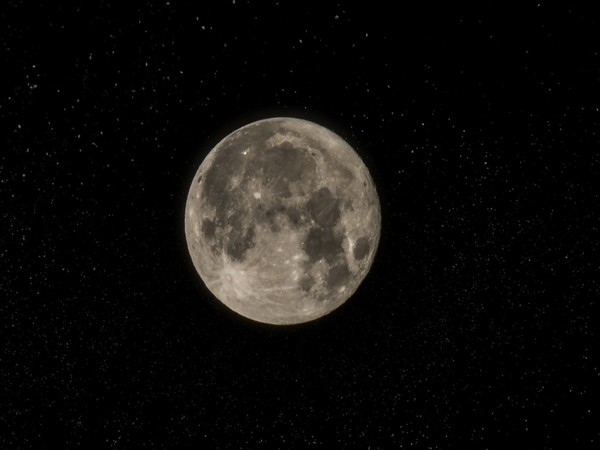
A new study, led by a University of Hawaiʻi at Mānoa planetary scientist Shuai Li, has found that high energy electrons in Earth's plasma sheet are contributing to weathering processes on the Moon's surface and the electrons may have aided the formation of water on the lunar surface.
The formation of water ice on the permanently shadowed regions of the Moon has been a topic of scientific interest for some time. Solar wind, which bombards the lunar surface, is thought to be one of the primary ways in which water forms on the lunar surface.
Based on his previous work, Li, an assistant researcher in the UH Mānoa School of Ocean and Earth Science and Technology, was keen on investigating the changes in surface weathering as the Moon passes through Earth's magnetotail, an area that almost completely shields the Moon from the solar wind but not the Sun's light photons.
"This provides a natural laboratory for studying the formation processes of lunar surface water. When the Moon is outside of the magnetotail, the lunar surface is bombarded with solar wind. Inside the magnetotail, there are almost no solar wind protons and water formation was expected to drop to nearly zero," Li said.
Li and his team members analyzed the remote sensing data collected by the Moon Mineralogy Mapper instrument onboard the Indian Space Research Organisation's Chandrayaan-1 mission between 2008 and 2009. They assessed the changes in water formation as the Moon traversed through Earth's magnetotail, which includes the plasma sheet.
The observations showed that the water formation in Earth's magnetotail is almost identical to the time when the Moon was outside of the Earth's magnetotail.
"This indicates that, in the magnetotail, there may be additional formation processes or new sources of water not directly associated with the implantation of solar wind protons. In particular, radiation by high energy electrons exhibits similar effects as the solar wind protons," Li stated.
Li now aims to work on a lunar mission via NASA's Artemis programs to further study the plasma environment and water content on the lunar polar surface.


 Google News