

Webb detects carbon on Jupiter's moon Europa; likely originated from subsurface ocean
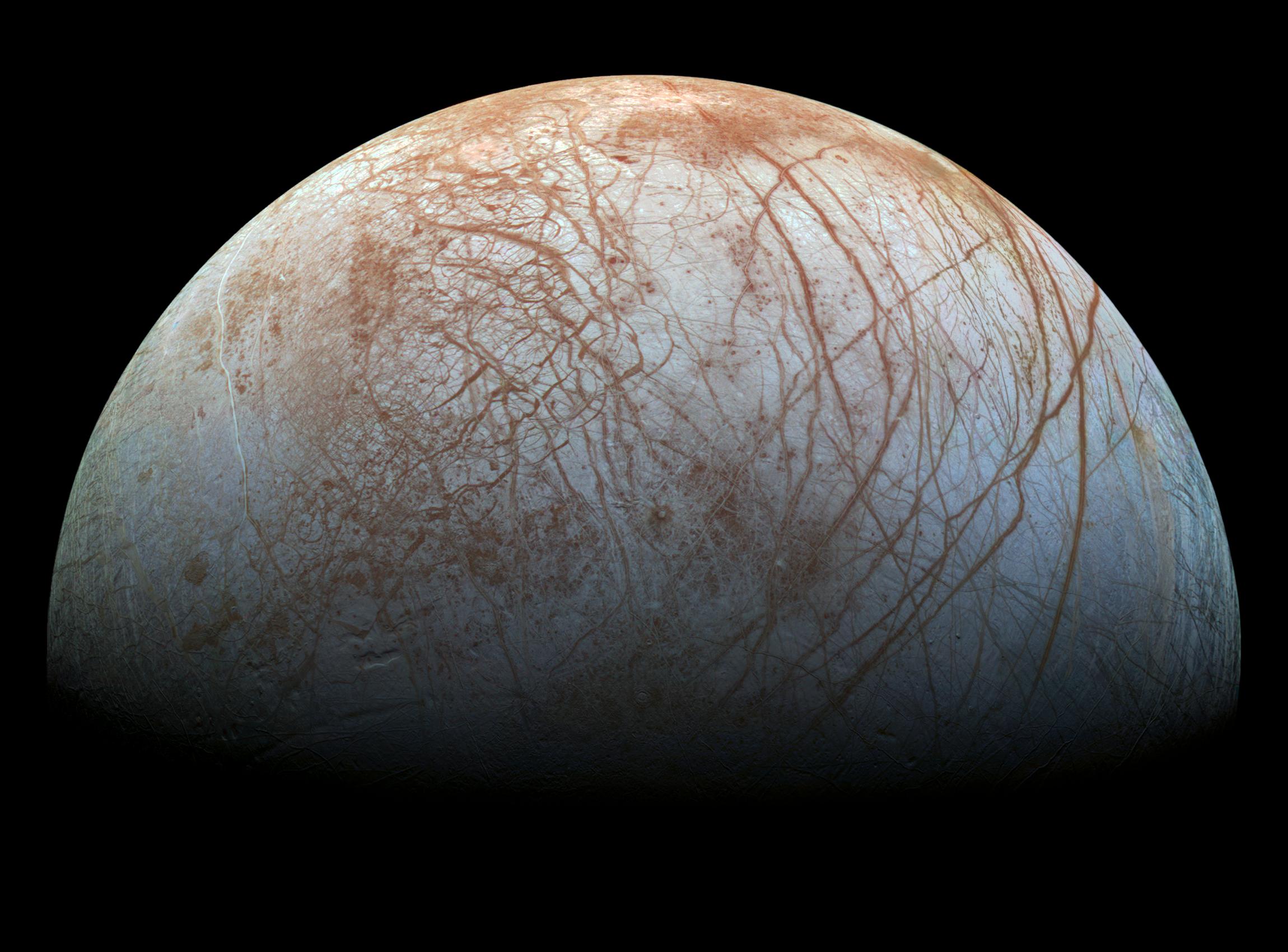
Jupiter's icy Moon Europa is known to harbour a salty ocean of liquid water beneath its water-ice crust. Until now, it wasn't confirmed whether or not the ocean contains the chemicals needed for life, particularly carbon. In a groundbreaking discovery, NASA's James Webb Space Telescope has detected carbon dioxide on the icy surface of the Jovian moon, which likely originated in the subsurface ocean.
The discovery was made using data from the integral field unit of Webb's Near-Infrared Spectrograph (NIRSpec).
Webb's observations have found that carbon dioxide is most abundant in a region called Tara Regio - a geologically young area of generally resurfaced terrain known as "chaos terrain." The surface ice has been disrupted, and there likely has been an exchange of material between the subsurface ocean and the icy surface.
"On Earth, life likes chemical diversity – the more diversity, the better. We're carbon-based life. Understanding the chemistry of Europa's ocean will help us determine whether it's hostile to life as we know it, or if it might be a good place for life," said Geronimo Villanueva of NASA's Goddard Space Flight Center in Greenbelt, Maryland, lead author of one of two independent papers describing the findings.
NASA's upcoming Europa Clipper spacecraft will perform dozens of close flybys of Europa to further investigate whether it could have conditions suitable for life. Scheduled to launch no earlier than October 2024, the mission's key science objective is to determine whether there are places below the surface of Jupiter's icy moon, Europa, that could support life.
On the icy crust of Jupiter's moon Europa, Webb has discovered carbon dioxide that likely originated in the liquid water ocean below. Understanding the chemistry of this ocean could help determine if it is a good place for life as we know it: https://t.co/tGLrJrVsyl pic.twitter.com/4C4JjZMCBw
— NASA Webb Telescope (@NASAWebb) September 21, 2023
Previous studies of Europa conducted using Hubble reported tentative detections of plumes. Villanueva's team also looked for evidence to confirm the same, but Webb's data showed no signs of plume activity. However, the team didn't rule out the phenomenon happening on the moon.


 Google News