

Double bang: NASA telescopes uncover cosmic drama in 30 Dor B supernova remnant
- Country:
- United States
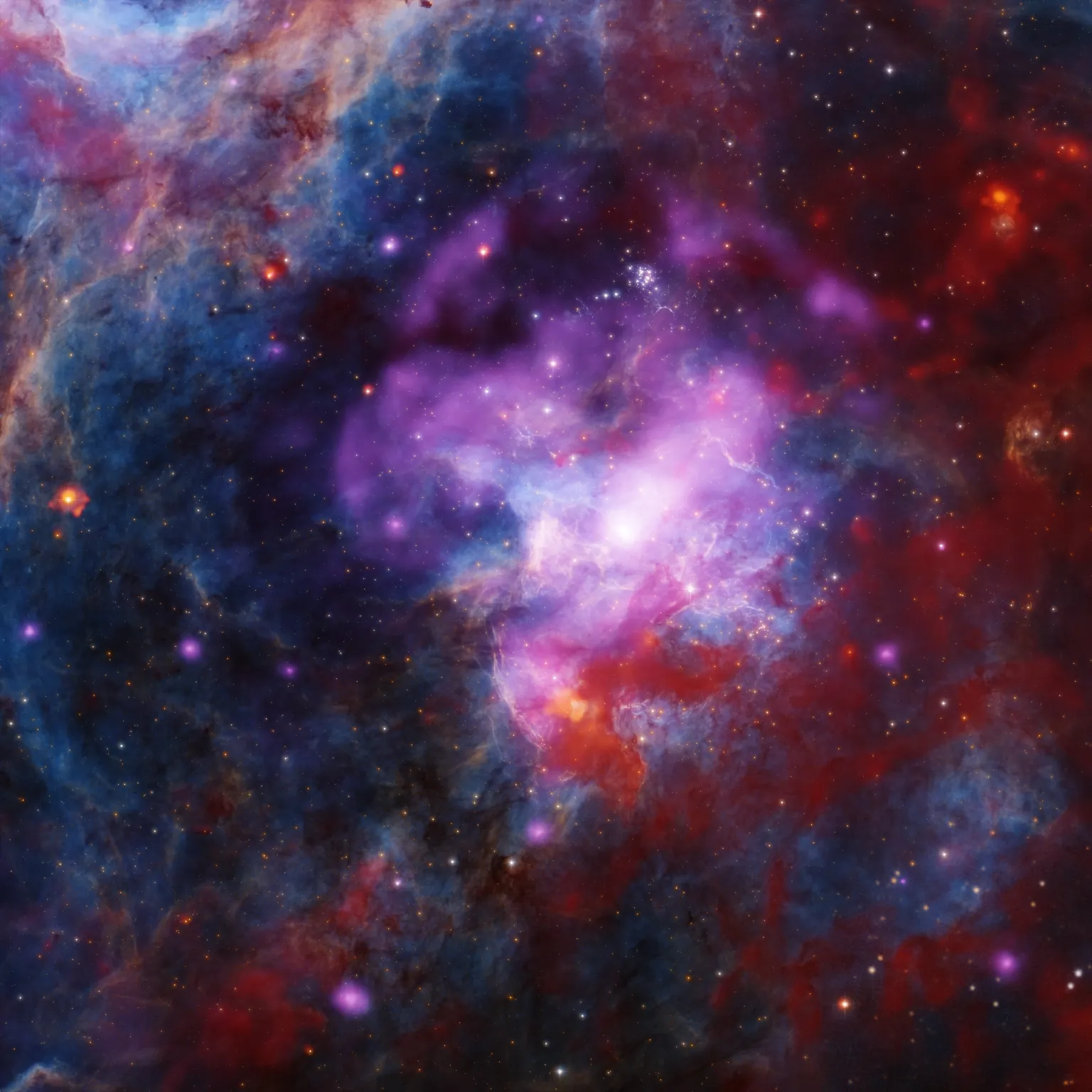
This stunning composite image reveals a cosmic spectacle in the heart of a star-forming region, where a supernova remnant known as 30 Doradus B (30 Dor B for short) holds the secrets of multiple stellar explosions.
The image is a composite of X-ray data from NASA's Chandra X-ray Observatory (purple), optical data from the Blanco 4-meter telescope in Chile (orange and cyan), and infrared data from NASA's Spitzer Space Telescope (red). Optical data from NASA's Hubble Space Telescope.
Located 160,000 light-years away from Earth in the Large Magellanic Cloud, 30 Dor B likely contains the remains of at least two exploded stars.
Led by Wei-An Chen from the National Taiwan University in Taipei, Taiwan, a team of astronomers extensively analyzed 30 Dor B and its surrounding region using over two million seconds of Chandra observing time. The researchers found a faint shell of X-rays stretching approximately 130 light-years across (for context, the nearest star to the Sun is about 4 light-years away). Notably, the Chandra data unveiled winds of particles emanating from a pulsar within 30 Doradus B, forming what astronomers term a pulsar wind nebula.
Combining data from Hubble and other telescopes, the researchers concluded that no single supernova explosion could explain what is being seen. The central pulsar and bright X-rays within 30 Doradus B likely resulted from a supernova that occurred around 5,000 years ago when a massive star collapsed.
Both the pulsar and the bright X-rays seen in the center of 30 Dor B likely resulted from a supernova explosion after the collapse of a massive star about 5,000 years ago. However, the larger, fainter shell of X-rays appears too extensive to be attributed to the same supernova.
The research team thinks that at least two supernova explosions took place in 30 Dor B, with the X-ray shell produced by another supernova more than 5,000 years ago. The possibility of even more complex events in the distant past is not ruled out.
Double-Double in Space? Supernova remnants are usually created by a single supernova, but new research using @ChandraXray data reveals that a pair of explosions are tied to the colorful chaos of 30 Doradus B, located 160,000 light-years away: https://t.co/gznCnZrzAv pic.twitter.com/E36VPLYDMC
— NASA (@NASA) January 3, 2024


 Google News