

UN Member States to vote in allocated time slots in three crucial elections next week
In adherence to the social distancing guidelines due to the COVID-19 pandemic, the 193 UN member states have been allotted different time slots to cast their ballots next week in the General Assembly Hall for three crucial elections, including the non-permanent members of the Security Council for which India is a candidate.
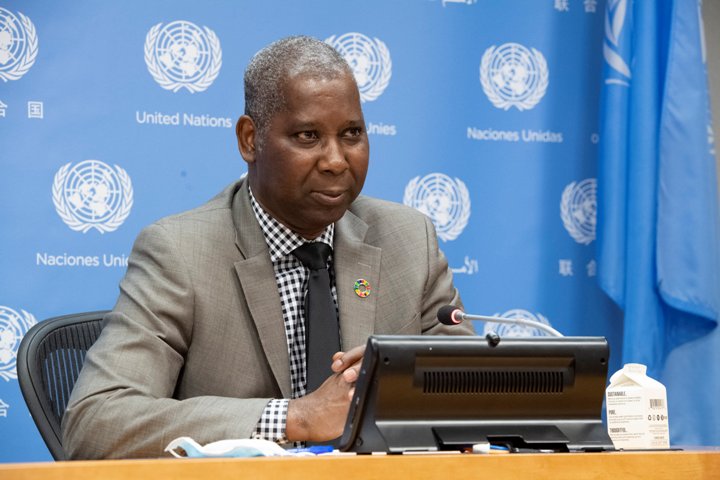
In adherence to the social distancing guidelines due to the COVID-19 pandemic, the 193 UN member states have been allotted different time slots to cast their ballots next week in the General Assembly Hall for three crucial elections, including the non-permanent members of the Security Council for which India is a candidate. General Assembly President Tijjani Muhammad-Bande has informed the member states that the election of his successor, President of the 75th session of UN General Assembly, the election of non-permanent members of the Security Council and the election of members of the Economic and Social Council will be held simultaneously on June 17 from 9:00 am in the General Assembly Hall.
Eight-time slots have been allocated to the Member States to cast their ballots in the General Assembly Hall starting at 9 am, in adherence to social distancing guidelines. The voting will continue till 1 pm with an additional 30-minute time slot for voters who are unable to visit the GA hall during the specific time slot communicated to them.
The time slot for India to cast its ballot is 11:30 am-12noon. Muhammad-Bande will oversee the proceedings in the General Assembly Hall and the tellers will also be observing the whole process. A letter will be circulated to all Member States at least one working day prior to the round of secret balloting for the elections to notify them of the names of candidates for the elections, communicated to the UN Secretariat at least 48 hours prior to the elections.
The special voting arrangements have been as large in-person meetings at the UN Headquarters remain suspended due to COVID-19 related restrictions. India is a candidate for a non-permanent seat from the Asia-Pacific category for the 2021-22 term. Its victory is a given since it is the sole candidate vying for the lone seat from the grouping. New Delhi's candidature was unanimously endorsed by the 55-member Asia-Pacific grouping, including China and Pakistan, in June last year.
Canada, Ireland, and Norway are vying for two seats in Western Europe and Other countries category, Mexico is the only candidate for the one Latin America and Caribbean seat and Kenya and Djibouti will contest the seat available for the African group. Previously, India has been elected as a non-permanent member of the Council for the years 1950-1951, 1967-1968, 1972-1973, 1977-1978, 1984-1985, 1991-1992, and most recently in 2011-2012. India has been at the forefront of the years-long efforts to reform the Security Council saying it rightly deserves a place as a permanent member of the Council, which in its current form does not represent the geo-political realities of the 21st Century.
Each year, the General Assembly elects five non-permanent members (out of 10 in total) for a two-year term. The 10 non-permanent seats are distributed on a regional basis - five for African and Asian states; one for the Eastern European States; two for the Latin American and Caribbean States; and two for Western European and other States.
ALSO READ
-
Japanese Lawmakers Visit India to See Worker Protection and Skills Projects in Action
-
Indian Unions Push for Fair Recruitment and Rights for Care Workers in Germany
-
Cleaner Kitchens, Polluted Skies: Hidden Health Cost of India’s Electricity Boom
-
Japan-Backed ILO Projects Help 23,000 Workers Gain Rights and Fight Child Labour
-
India's Delicate Balancing Act: Navigating Energy Security Amid Middle Eastern Tensions


 Google News