

Strengthening the Cooperative Sector: National Review Meeting Highlights Vision of Growth and Inclusivity
In his speech at the inaugural session, Dr. Bhutani emphasized the Ministry’s firm commitment to cooperative-led economic growth, facilitated by strong inter-state cooperation.
- Country:
- India
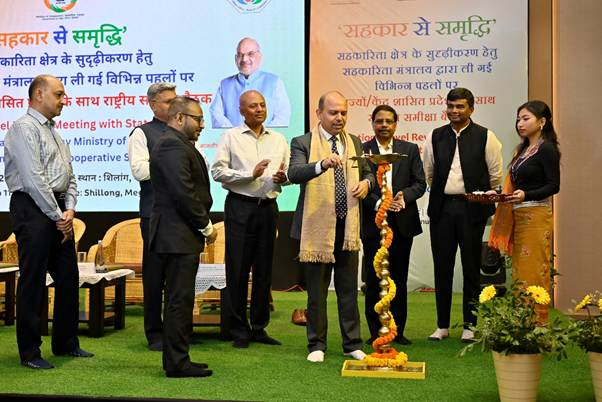
Dr. Ashish Kumar Bhutani, the Secretary of the Ministry of Cooperation, addressed the inaugural session of the two-day National Level Review Meeting, held in Shillong, Meghalaya, on April 10-11, 2025. This important review session focused on discussing various initiatives and strategies to further modernize and strengthen the Cooperative Sector across the nation.
In his speech at the inaugural session, Dr. Bhutani emphasized the Ministry's firm commitment to cooperative-led economic growth, facilitated by strong inter-state cooperation. He highlighted the Government's vision of "Sahakar Se Samriddhi" (Prosperity through Cooperation), a guiding principle that aims to uplift rural communities and empower local economies. Under the leadership of Prime Minister Narendra Modi and the guidance of Union Home Minister and Minister of Cooperation Amit Shah, the Ministry is focused on bringing about transformative changes in the cooperative sector.
One of the key points raised by Dr. Bhutani was the importance of collecting PAN numbers from all cooperative societies across the country. This initiative is aimed at ensuring a more accurate and comprehensive representation of the cooperative sector in the national GDP. The Secretary reaffirmed the Government's unwavering commitment to supporting and advancing the cooperative ecosystem in India, which he stated is crucial for the country's socio-economic development.
Dr. Bhutani also shed light on the Ministry's flagship initiative, the White Revolution 2.0, which focuses on rural upliftment through the dairy sector. The initiative aims to empower women and enhance child nutrition through the expansion of dairy infrastructure. He pointed to institutions such as Amul and the National Dairy Development Board (NDDB) as key partners in the mission to support states like Assam, Jharkhand, and Uttar Pradesh in boosting their dairy sectors. Dr. Bhutani stressed that the economic potential of animal husbandry now surpasses that of traditional crop cultivation, making it a critical area for rural economic development.
Another significant announcement during the session was the passing of the bill to establish India's first Tribhuvan Sahkari University. This landmark initiative aims to standardize cooperative education across the country and uplift over 250 existing cooperative institutions. Dr. Bhutani stated that this university would play a pivotal role in shaping the future of cooperative education and research, ultimately contributing to the development of a skilled workforce for the cooperative sector.
As part of the two-day event, a tree plantation drive under the initiative "Ek Ped Maa Ke Naam" (One Tree in the Name of Mother) was conducted in celebration of the International Year of Cooperatives. This initiative was led by Dr. Bhutani, the Chief Secretary of Meghalaya, and senior officials from the Ministry of Cooperation, underscoring the Ministry's commitment to environmental sustainability alongside its focus on cooperative growth.
The meeting brought together a wide range of key stakeholders, including representatives from various States and Union Territories, officials from cooperative federations, financial institutions, and policymakers. This collaborative platform provided an opportunity for knowledge exchange and strategic alignment in the development of the cooperative sector.
One of the key sessions during the meeting focused on the role of national-level cooperative institutions such as NCEL, NCOL, BBSSL, NCCF, and NAFED. These organizations play a crucial role in enhancing the cooperative ecosystem and driving innovation and inclusivity. The discussions also explored the impact of these institutions on national growth and their ability to support regional development.
A highlight of the meeting was the session led by the Director of the Institute of Rural Management Anand (IRMA), Gujarat, who outlined the vision for the Tribhuvan Sahkari University. The proposed university will have strategic objectives aimed at fostering world-class cooperative education and research, with a clear institutional structure to support its mission.
Additionally, a dedicated workshop was held on the International Year of Cooperatives 2025, focusing on strategic priorities for the coming year. These included benchmarking cooperative societies, impact assessment, and the formulation of a Business Reform Action Plan. Delegations from Maharashtra, Gujarat, and Uttarakhand shared best practices and innovations in cooperative development, contributing to a broader understanding of how to foster a more robust cooperative ecosystem across India.
One of the central themes of the two-day review meeting was the expansion of banking services for cooperative societies. Key discussions were held on ensuring that doorstep banking services are made available through micro-ATMs. The Ministry also emphasized the provision of zero-interest loans via RuPay Kisan Credit Cards to members of Primary Agriculture Credit Societies (PACS), Dairy Cooperative Societies, and other cooperative institutions. These measures are expected to significantly strengthen rural cooperative banking and enhance financial inclusion.
Another focus area was the time-bound establishment of Multi-Purpose Agriculture Cooperative Societies (MPACS), dairy and fishery cooperatives, and a Grain Storage Plan. The government is also prioritizing the digital transformation of PACS and Agriculture and Rural Development Banks (ARDBs), aiming to improve transparency, operational efficiency, and service accessibility in rural areas.
An analytical session was conducted to evaluate the impact of the National Cooperative Development Corporation's (NCDC) schemes. This session examined the realignment of the NCDC's strategic direction to better align with broader national development priorities.
The National Level Review Meeting in Shillong served as a platform for formulating strategies to expand the reach and effectiveness of the cooperative sector in India. The collaborative efforts between the Ministry of Cooperation, state governments, cooperative institutions, and financial partners are set to drive transformative growth in the cooperative ecosystem, contributing significantly to the nation's rural development and economic prosperity.


 Google News