

SDG 4: How Mohini of Meerut and her siblings were uncaged and now soaring high
To end child labour the need of the hour is strict enforcement of the law, more so in the most unlikely, yet, calling-for places – informal child labour.
 Mridula Narayan
- Country:
- India
The United Nations in 2015 adopted 17 Global Goals for the years 2030. This story of a teenage girl child, eldest among four siblings, whose father was an alcoholic is thought-provoking for all those who are concerned and working for India to excel and achieve the targets of Global Goal 4 - Quality Education for India.
Walking through the streets of this small city in India, one cannot help but notice little hands picking rags, fixing screws, sharpening metal, selling utensils and many other things. It is hard to fathom children working over twelve hours and doing things that adults are supposed to be doing. Here in Meerut – a city in Uttar Pradesh – which is home to eight lakh child workers, the highest number of child labourers in the country; this seems to have become a norm.
In a small slum community in Meerut, children like Mohini earn INR 10 for stitching a single football over two days; a job that adults can complete in two hours. In the process of using two needles, to stitch the ball quickly, children also pierce their fingers repeatedly.
Mohini's father, Devraj (40) has been consuming alcohol habitually for many years now. Due to which, he never supported his family financially. His wife, Sudhesh (34) has been forced to become the breadwinner of the family ever since and so she took up the business of stitching footballs.
When Mohini was very young, only eight years old, she began helping her mother stitch footballs. When she turned nine in class five, her mother asked her to stop going to school and help her earn a little more income for the family. This was also because three of her younger siblings never had the opportunity to go to school because their mother could not afford.
"When we didn't go to school, we didn't have any friends," said Mohini, looking at her younger sister Ritika. When asked why, she said, "We sat at home working all day, we couldn't afford wasting time playing outside with friends."
When Mohini turned 11, she pleaded with her mother to send her younger siblings to school but her mother helplessly had to say no. Her income was only sufficient to feed the family two square meals a day.
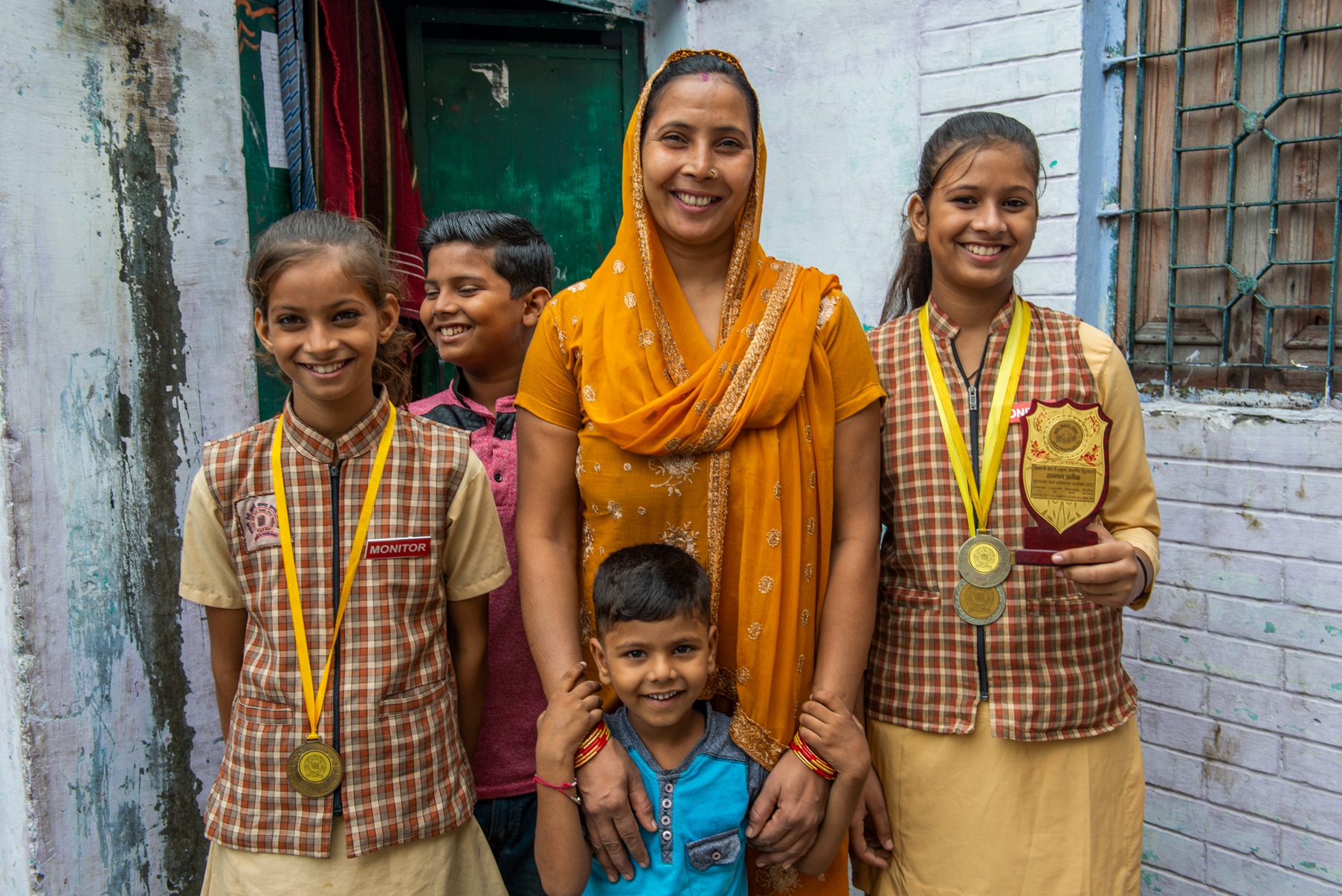
Today, Mohini is 14 years old and she is going to school. Not only her but also her younger siblings are school-going children.
Two years ago, Mamtesh, a teacher at World Vision India's Remedial Education Centre (REC) in the community visited Mohini's home and spent time counselling her mother about the importance of education and ill effects of child labour. She persuaded their mother to send her children to the REC for two hours every day, where everything including books will be given to children free of cost.
Having been convinced, Sudhesh sent her children to the REC. In one year, Mohini (14), her younger siblings Ritika (11) and Rohan (13) picked up their basic education so well that Mamtesh immediately met Sudhesh and told her how well her children were studying. After much counselling, Sudhesh agreed to send her children to school. Mamtesh helped them fill application forms in a government school closest to their community and got them admitted in school.
Mohini topped her class in her eight grade and won three medals and a shield. She is now in her ninth grade. Ritika also won a medal in a drawing competition at school. Rohan too is excelling in his studies. The youngest sibling, Tanishk, is 5 years old and attends the REC for now.
Mohini's mother, Sudhesh, now says, "Though six of us live under the roof of this small room, I'm working hard to send my children to school. I want them to grow up and become something. I don't want them to go through the struggles that I'm facing because my parents couldn't educate me"
Section 3 (2) (a) of the Child Labour (Prohibition And Regulation) Amendment Act, 2016, states that, 'No child shall be employed or permitted to work in any occupation or process, except if he/she helps his family or family enterprise, which is other than any hazardous occupations or processes, after his school hours or during vacations'. Despite the law clearly stating that children are permitted to work in their families only after school hours or during vacations, thousands and lakhs of children like Mohini and her siblings are employed within their families (if I must say, informal labour) at the expense of their education, their dreams.
According to Credit Suisse estimates, most child labour is concentrated away from the skilled economy, in the informal sector that makes up about 90 percent of India's workforce and half of its GDP. Here, children are not subject to government inspections, legal protections or minimum wage requirements. Such industries include agriculture, small factories for carpets and clothing, brick kilns and domestic staffing.
Thus in a country like India, to help children get off the field and work on dreams, the need of the hour is enforcement of the law. Moreover, the enforcement has to be in the most unlikely, yet, calling-for places – informal child labour.
(Mridula Narayan is a Communications Associate at World Vision India. She has previously worked in Times Now. Mridula studied TV journalism from Asian School of Journalism, Chennai)
(Disclaimer: The opinions expressed are the personal views of the author. The facts and opinions appearing in the article do not reflect the views of Devdiscourse and Devdiscourse does not claim any responsibility for the same.)
- FIRST PUBLISHED IN:
- Devdiscourse


 Google News