

NASA's Perseverance Mars rover uses AI to select rock targets to zap
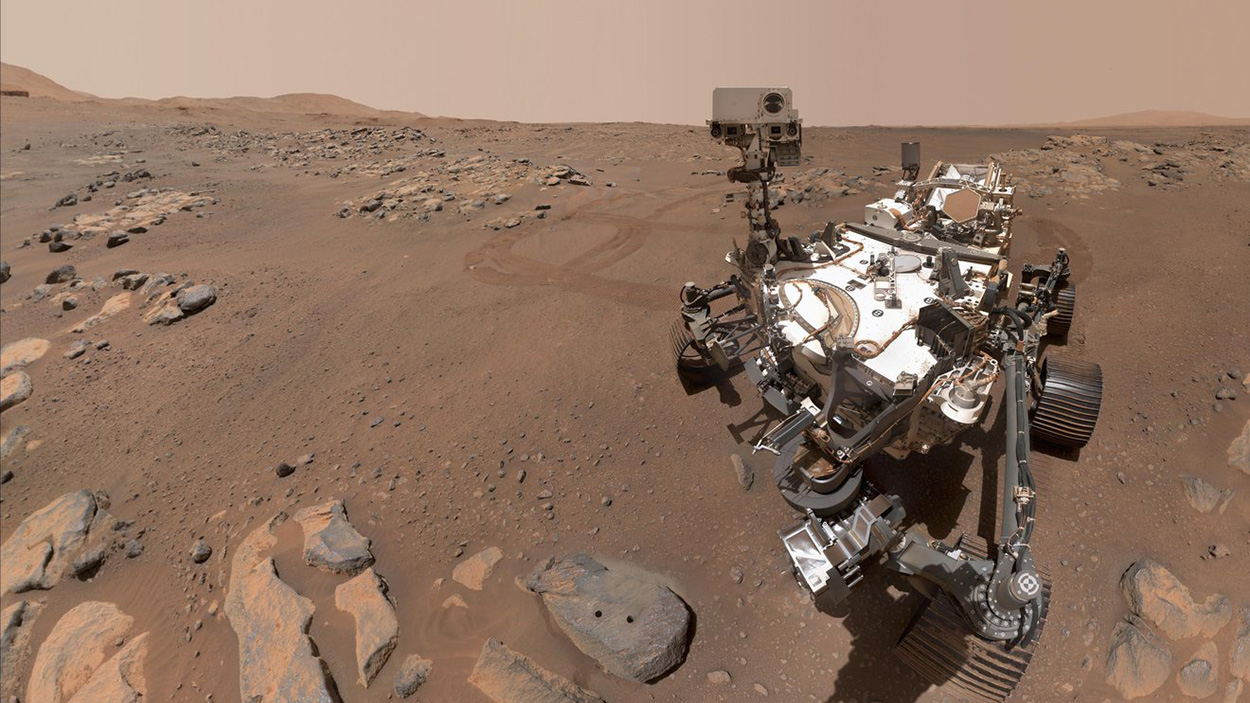
For the first time, the SuperCam onboard NASA's Perseverance Mars rover recently used the Autonomous Exploration for Gathering Increased Science, or AEGIS, an AI-based software that enables target selection for chemical analysis.
AEGIS testing on the Perseverance Mars rover started in March and after tweaking several parameters on successive tests, the SuperCam laser was used by AEGIS for the first time last week. The mission team plans to use the software frequently from now on to provide more rapid data on the composition of rocks around the rover's path.
Developed at NASA's Jet Propulsion Laboratory (JPL) for previous rover missions, AEGIS was adapted for SuperCam on the Perseverance Mars rover. The rover selected two targets on Sol 442 and shot them with the SuperCam laser to determine their elemental compositions.
Usually, when the operations team on Earth picks the target, the observations are not made until the following day. But, if the rover selects its own targets, it can shoot them right after a drive, many hours before the rover team has time to receive and analyze the Navcam (navigation camera) images from the rover's new location and select targets.
According to NASA, the artificial intelligence-based software requests Navcam images to be taken, and it then analyzes the images to find rocks and prioritize them for analysis based on size, brightness, and several other features. It subsequently initiates a sequence in which SuperCam fires its laser to determine the chemical makeup of one or two top priority targets selected from the Navcam images.
How to get more science from our days on Mars? Delegate some of the work to artificial intelligence! AEGIS is an AI-based software that capitalizes on rover "downtime" by autotargeting rocks to be zapped by a rover's laser and then analyzed later by scientists. pic.twitter.com/zwSTw35Ohr
— NASA JPL (@NASAJPL) May 31, 2022


 Google News