

Cloud surfing on Jupiter: NASA spacecraft captures breathtaking close-up video of the gas giant
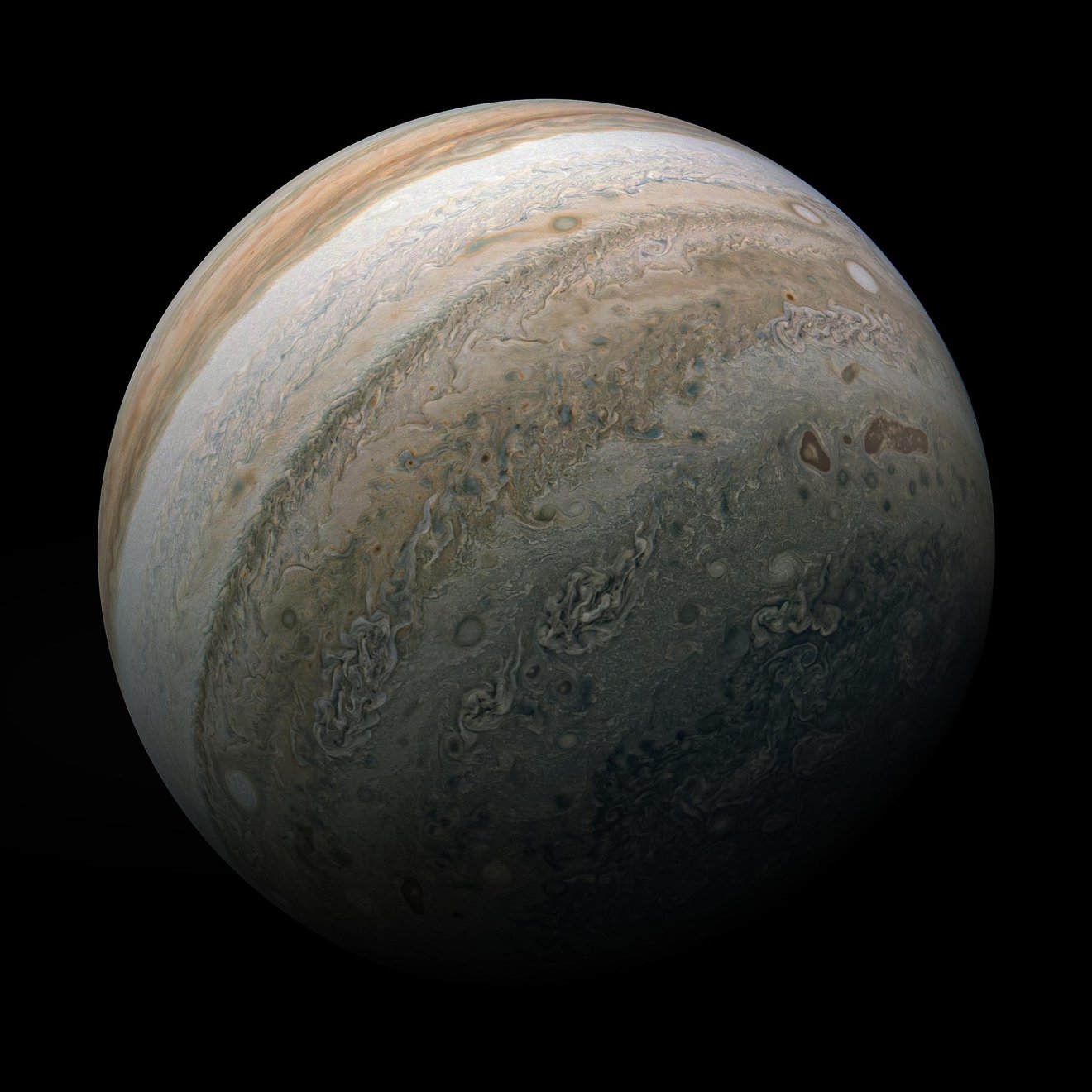
The JunoCam instrument onboard NASA's Juno has captured what it would look like to take a ride with the spacecraft. The close-up video was captured on April 9, 2022, as the mission completed its 41st close flyby of the gas giant.
During the closest approach on April 9, the spacecraft was just over 2,050 miles (3,300 kilometres) above Jupiter's colourful cloud tops, travelling at about 131,000 MPH (210,000 kilometres per hour) relative to the planet.
Using raw JunoCam image data, citizen scientist Andrea Luck created an animated sequence, which was recently shared by the agency. The sequence combines 41 JunoCam still images digitally projected onto a sphere, with a virtual "camera" providing views of Jupiter from different angles as the spacecraft speeds by.
Watch the NASA spacecraft skimming the cloud tops of Jupiter here.
Take a ride with #JunoMission.@NASA's Juno spacecraft used its JunoCam instrument to capture what it would look like to skim the cloud tops of Jupiter. Citizen scientist Andrea Luck created this animated sequence using raw image data. https://t.co/tEIu9KT2ME pic.twitter.com/aQ2BaoPrUO
— NASA JPL (@NASAJPL) June 2, 2022
NASA's Juno spacecraft was launched in August 2011 to probe beneath Jupiter's dense clouds and answer questions about the origin and evolution of the gas giant, our solar system, and giant planets in general across the cosmos. It is the agency's most distant planetary orbiter.
Now in an extended mission, Juno will continue its investigation of the solar system's largest planet through September 2025. During this period, the spacecraft will explore the full Jovian system – not just the planet, but its rings and moons too.
Discoveries made by the Juno mission during the primary mission have revolutionized the scientific community's view of Jupiter's atmosphere and interior. Data the spacecraft collects during its extended mission may further unravel the mysteries of the largest planet in our solar system.
Juno is part of NASA's New Frontiers Program.


 Google News