

Brightest stars likely strip giant Neptune-sized planets of their gas
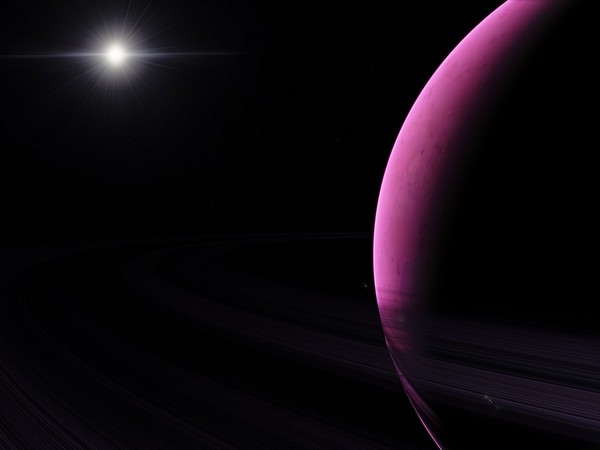
Astronomers at the University of California, Berkeley, have discovered a new gas giant planet - named HD 56414 b - around a bright blue star - twice as large as the sun - right at the edge of the hot Neptune desert where the star's strong radiation likely strips any giant planet of its gas.
The researchers suggest that an easier-to-find Neptune-sized planet sitting closer to a bright A-type star would be rapidly stripped of its gas by the harsh stellar radiation and reduced to an undetectable core.
The discovery suggests that bright, A-type stars may have numerous unseen cores within the hot Neptune zone that are waiting to be discovered through more sensitive techniques.
HD 56414 b was detected by NASA's exoplanet-hunter TESS (short for Transiting Exoplanet Survey Satellite) as it transited its star, HD 56414. Steven Giacalone, a UC Berkeley graduate student, and Courtney Dressing, UC Berkeley assistant professor of astronomy, confirmed that HD 56414 was an A-type star by obtaining spectra with the 1.5-meter telescope operated by the Small and Moderate Aperture Research Telescope System (SMARTS) Consortium at Cerro Tololo in Chile.
According to the researchers, the newly found planet has a longer orbital period than most discovered to date. With a radius 3.7 times that of Earth, the planet orbits the star every 29 days at a distance equal to about one-quarter the distance between Earth and the sun. The system is roughly 420 million years old, much younger than our sun which is 4.5-billion-year old.
The researchers continue to search for more Neptune-sized exoplanets around bright A-type stars, in hopes of finding others in or near the hot Neptune desert, to understand where these planets form in the accretion disk during star formation, whether they move inward or outward over time, and how their atmospheres evolve.
"We might expect to see a pileup of remnant Neptunian cores at short orbital periods" around such stars, the researchers concluded in their paper accepted by The Astrophysical Journal Letters and posted online on August 12.


 Google News