

ESA/NASA Solar Orbiter will flyby Venus this week: Details Inside
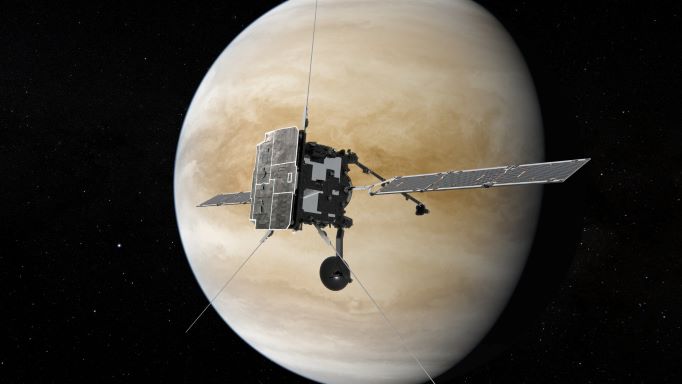
Solar Orbiter, a space mission of international collaboration between the European Space Agency (ESA) and NASA, will fly by Venus on 4 September with a closest approach of 6420km at 01:26UTC.
Solar Orbiter is the most complex scientific laboratory ever to have been sent to the Sun. The spacecraft will make numerous gravity-assist flybys of Venus over the course of its mission to adjust its orbit, bringing it closer to the Sun and also out of the plane of the Solar System to observe the Sun from progressively higher inclinations.
The upcoming Venus flyby will be the third for the spacecraft and subsequent flybys will increase its inclination to see more of the solar poles, which are key to understanding the star's magnetic field that drives the generation of space weather. Solar Orbiter's next Venus flyby is scheduled for 18 February 2025.
It's only Monday but we're thinking about the weekend for #SolarOrbiter's next #VenusFlyby! 🛰🟠⤴️Close approach on 4 Sept is ~01:26UTC at an altitude of ~6420km to adjust its orbit around the Sun; subsequent flybys will raise inclination to see more of the Sun's polar regions. pic.twitter.com/Jo0QWp8kec
— ESA's Solar Orbiter (@ESASolarOrbiter) August 29, 2022
Launched in 2020, Solar Orbiter's mission is to perform unprecedented close-up observations of the Sun and from high latitudes, providing the first images of the uncharted polar regions of the Sun, and investigating the Sun-Earth connection. The mission was designed to operate for ten years, but the mission could continue its scientific exploration for much longer, according to ESA.
The ESA/NASA Solar Orbiter spacecraft carries six remote-sensing instruments that image the Sun and its surroundings and four in situ instruments that monitor the environment around the spacecraft. By combining observations from these instruments, scientists hope to find answers to some profound questions about the Sun and transform our understanding of our nearest.


 Google News