

New research provides clearer picture of how our universe grows
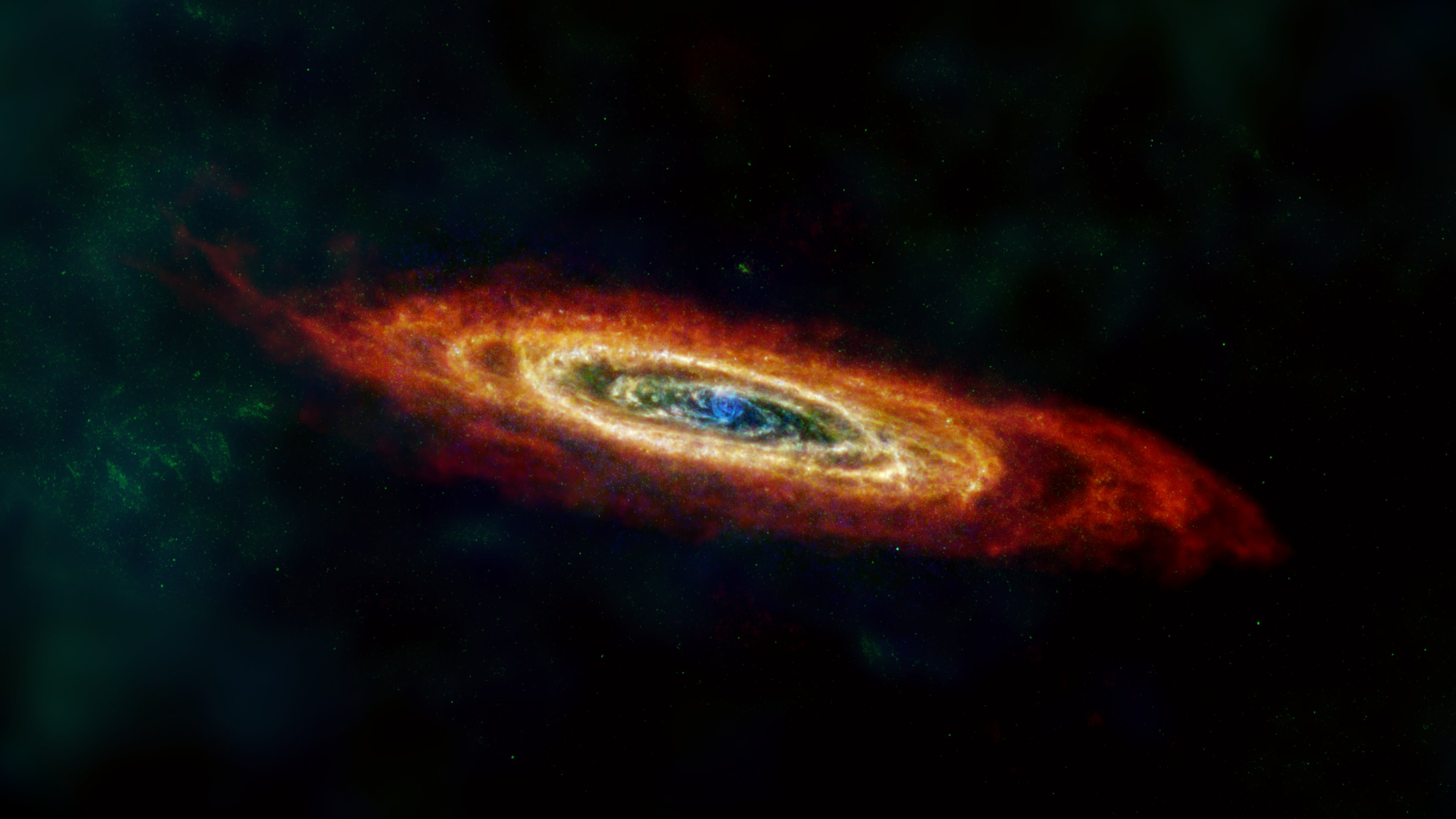
Researchers, led by a University of Sydney astrophysicist, have discovered evidence the Andromeda galaxy, our nearest major galactic neighbor, is a cannibal growing through colossal intermittent feasts. The findings provide a clearer picture of how our local universe grows.
Andromeda, also known as Messier 31, has the signatures of two major feeding events, with rough timescales indicating that the 'recent' feast took place sometime in the last 5 billion years, while the older feed was closer to 8-10 billion years ago.
The universe itself is 13.8 billion years old, which means the two separate feeding events may have happened while matter in the universe was in closer proximity and more densely concentrated.
It is unclear how the Milky Way itself has fed, but a picture is emerging in Andromeda with a clear signature – large feasts and growth spurts. Given the Milky Way is a spiral galaxy of similar size, the research may be painting a picture of what our galaxy has done to reach its enormous size, the researchers said in a statement.
"What this new result does is provide a clearer picture of how our local universe has come together – it is telling us that at least in one of the large galaxies, that there has been this sporadic feeding of small galaxies," said lead author Professor Geraint Lewis from the University of Sydney.
The findings are based on the discovery of a structure of stars, called globular clusters, in the Andromeda galaxy that originated outside the galaxy. Professor Lewis named this the Dulais Structure, drawn from the Welsh for black stream.
Professor Lewis and colleagues analysed data covering the speeds and chemistry of the globular clusters forming the Dulais Structure, providing a two-dimensional view. The next step is to understand distances, which will allow researchers to construct the history in three dimensions.
The study will be published in the Monthly Notices of the Royal Astronomical Society.


 Google News