

Watch this time-lapse movie of the aftermath of DART asteroid impact captured by Hubble
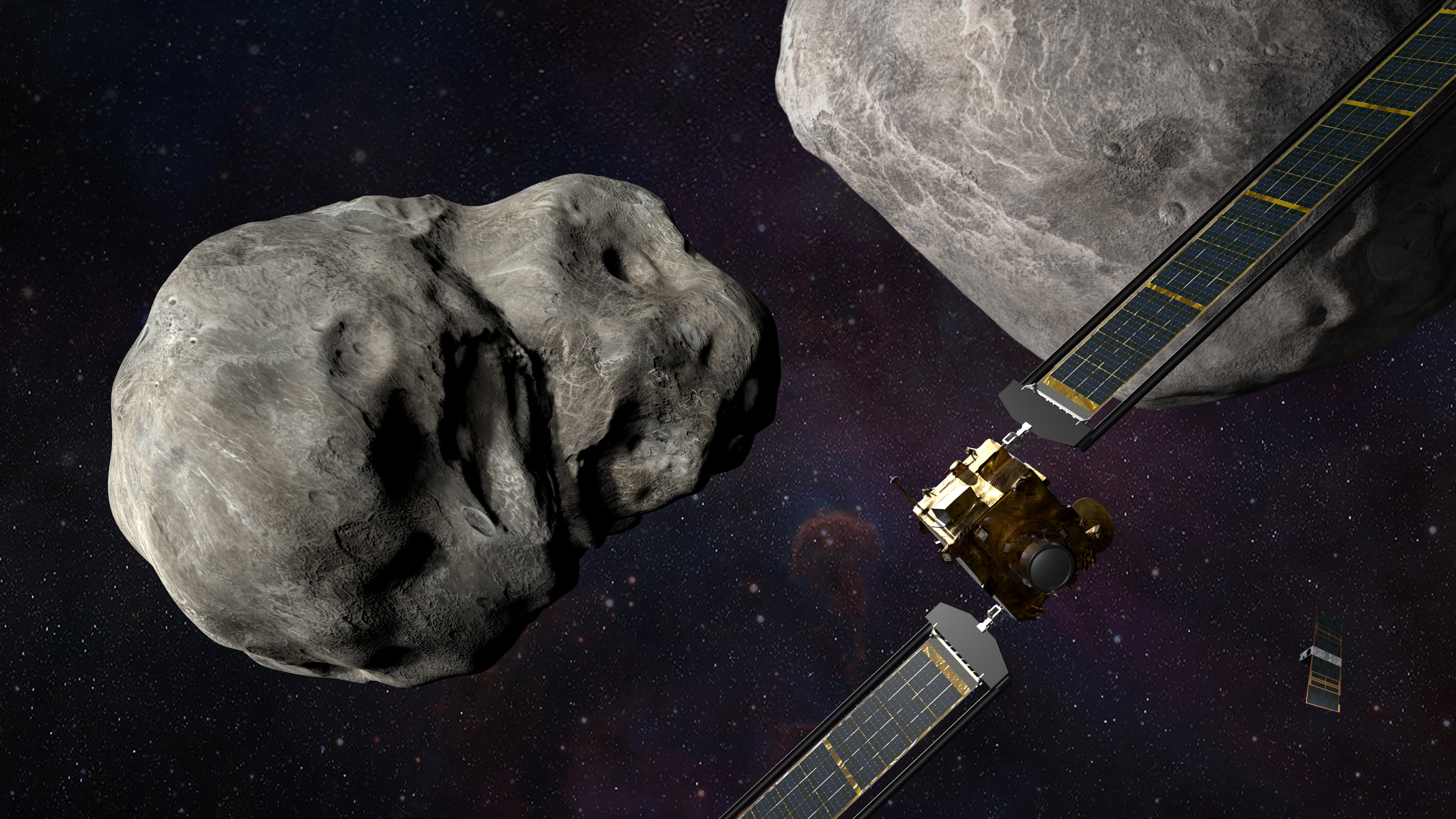
On 26 September 2022, NASA's DART spacecraft deliberately collided with a target asteroid in order to alter its trajectory. The Hubble Space Telescope captured a series of photos of rapid changes as dust and chunks of debris were flung into space from the wounded asteroid Dimorphos.
Check out this Hubble movie of the DART asteroid impact:
Video Credit:NASA, ESA, J. Li (PSI), J. DePasquale (STScI)
This time-lapse movie shows three overlapping stages of the aftermath of the DART collision:
- In the first post-impact snapshot, captured two hours after the event, debris flies away from the asteroid. The ejecta forms a largely hollow cone with long, stringy filaments.
- At about 17 hours post-impact the debris pattern entered a second stage. The spiral swirl of debris caught up along the asteroid's orbit about its companion asteroid, Didymos, started distorting the cone shape of the ejecta pattern. The most prominent structures are rotating, pinwheel-shaped features tied to the gravitational pull of Didymos.
- Next, Hubble captures the debris being swept back into a comet-like tail by the pressure of sunlight on the tiny dust particles. This stretches out into a debris train where the lightest particles travel the fastest and farthest from the asteroid.
📢 Hubble captures a movie showing rapid changes to the asteroid #Dimorphos when it was deliberately hit by the 545-kilogram #DART spacecraft on 26 September 2022. Read more here: https://t.co/9VadxD4QjN and 🧵👇 pic.twitter.com/ZxKouV0dgl
— HUBBLE (@HUBBLE_space) March 1, 2023
The European Space Agency's upcoming Hera mission will perform a detailed post-impact survey and turn this grand-scale experiment into a realistic planetary defence technique. Due to launch in October 2024, Hera will be humankind's first probe to rendezvous with a binary asteroid system.
"Just like Hubble and the NASA/ESA/CSA James Webb Space Telescope, NASA's DART and ESA's Hera missions are great examples of what international collaboration can achieve; the two missions are supported by the same teams of scientists and astronomers, and operate via an international collaboration called AIDA — the Asteroid Impact and Deflection Assessment," the agencies said in a statement.


 Google News