

Rare and fascinating phenomenon observed in binary star system
- Country:
- United Kingdom
A major international collaboration, including researchers from the University of Oxford, has captured a rare and fascinating space phenomenon in a binary star system.
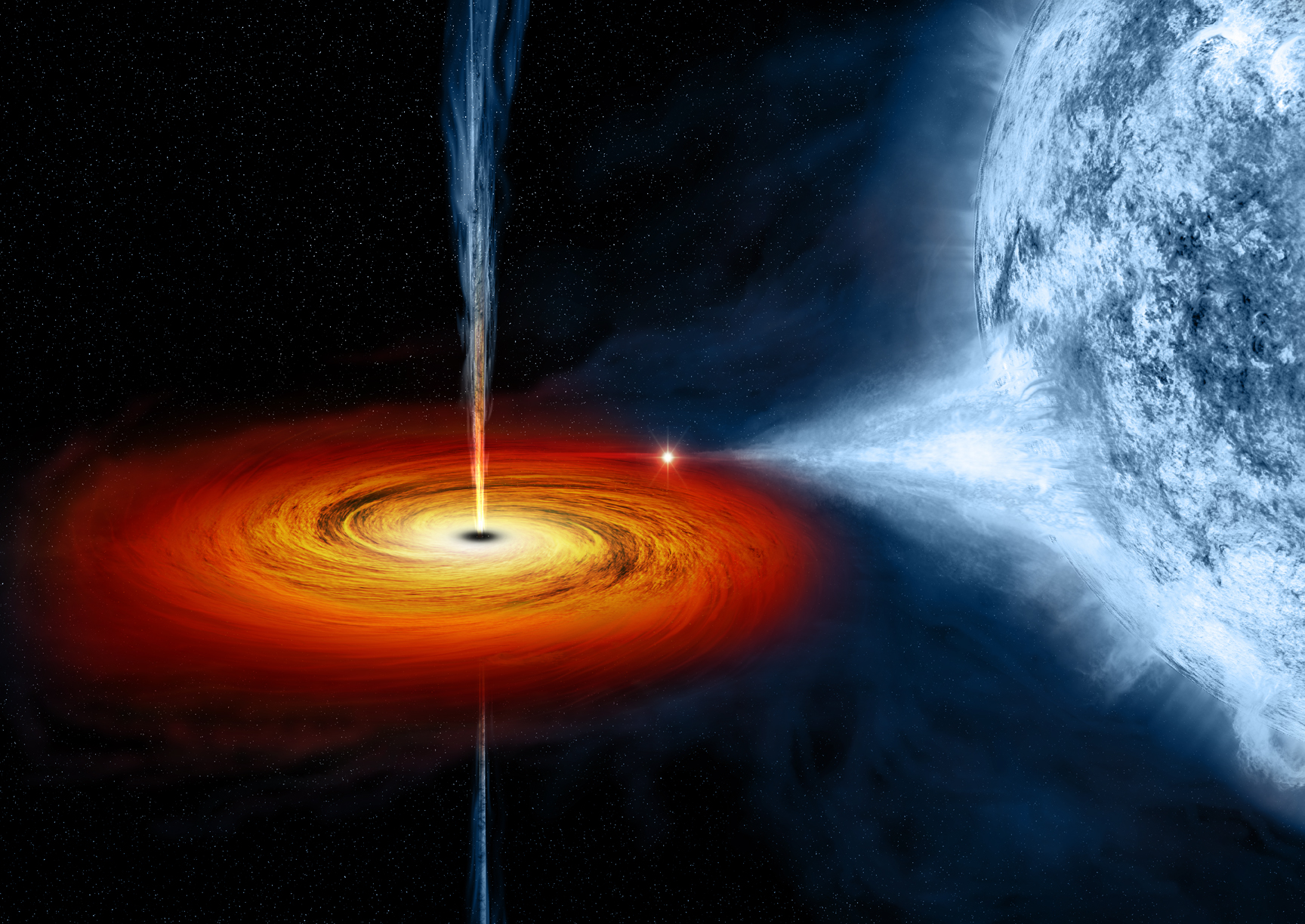
X-ray binary star systems, a type of binary star system in which one of the stars is either a neutron star or a black hole, have been a topic of fascination for scientists for many years. Both black holes and neutron stars are formed in supernova explosions and are very dense, therefore possess immense gravitational pull. They can capture the outer layers of their companion star in a binary system, which forms a rotating disc of matter around the black hole or neutron star.
Theoretical calculations suggest that these rotating discs of matter should exhibit a dynamic instability - about once an hour, the inner parts of the disc rapidly fall onto the black hole/neutron star, after which these inner regions re-fill and the process repeats.
Until now, this violent and extreme process has only been directly observed once in a binary system with a black hole. Now, an international collaboration of astronomers led by the Instituto de Astrofísica de Canarias, has seen this process in a neutron star binary system, called Swift J1858.6-0814.
The phenomenon was captured by combining data from five ground and space-based telescopes, including the Karl G. Jansky Very Large Array in New Mexico.
"This discovery, only the second example of these instabilities, also highlights the rarity of this behaviour. Therefore, finding more examples across different types of binary systems is a first priority. Due to the transient nature of this process, it is unpredictable when we will get another chance. By then, we will need to be prepared to repeat our international observing efforts," said Dr Jakob van den Eijnden, from the University of Oxford's Department of Physics, who led the analysis of the data from the Karl G. Jansky Very Large Array.
The study has been published in the journal Nature.


 Google News