

New detailed images show changing weather and seasons on Jupiter and Uranus
The NASA/ESA Hubble Space Telescope, one of the most powerful telescopes ever built, is designed to study the universe. The telescope also keeps an eye on the outer planets in our solar system to monitor changes in their seasons and atmospheres.
Hubble's Outer Planet Atmospheres Legacy (OPAL) Program provides yearly views of the giant planets including Jupiter and Uranus. New detailed images of the two planets show winds, storms, cloudy bands and more changes in their weather and seasons.
Jupiter looms large in this image taken on 12 November 2022. A wave pattern of nested cyclones and anticyclones, locked together like the alternating gears of a machine moving clockwise and counterclockwise, is visible. If the storms merge together, they could build an even larger storm, potentially rivalling the Great Red Spot.
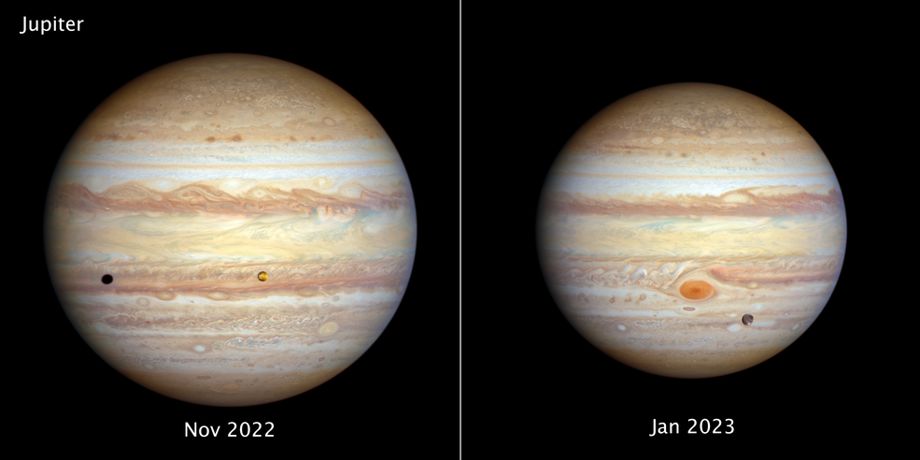
Image Credits: NASA, ESA, STScI, Amy Simon (NASA-GSFC), and Michael H. Wong (UC Berkeley); Image Processing: Joseph DePasquale (STScI)
A more recent image of Jupiter shows its iconic Great Red Spot, a giant storm that has been observed on the gas giant for hundreds of years. This vortex is large enough to engulf Earth, however, records of observations dating back 150 years reveal that this storm has actually shrunken and is now at its smallest observed size ever.
Jupiter's icy moon Ganymede appears as a gray, mottled orb crossing the face of the planet at the lower right of this Hubble image, which was taken on January 6, 2023.
We've got an outer planet weather report!Hubble regularly checks in on the outer planets in our solar system to monitor changes in seasons and atmospheres. New images of Jupiter and Uranus show storms, cloudy bands, and more: https://t.co/v7WEfcFtV1 pic.twitter.com/xnl6NpVdA5
— Hubble (@NASAHubble) March 23, 2023
A view of Uranus captured by Hubble in 2014 shows multiple storms with methane ice-crystal clouds appearing at mid-northern latitudes above the planet's cyan-tinted lower atmosphere.
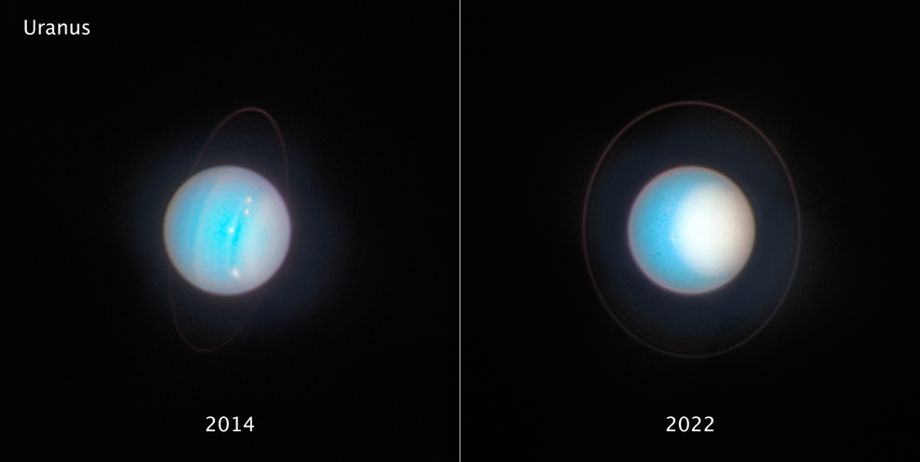
Image Credits: NASA, ESA, STScI, Amy Simon (NASA-GSFC), and Michael H. Wong (UC Berkeley); Image Processing: Joseph DePasquale (STScI)
Another Hubble view of Uranus taken in November 2022 shows a dense photochemical haze enveloping the planet's north pole, akin to the smog that hovers over our cities. Additionally, the image shows several little storms at the periphery of the polar haze's boundary. A faint, pink ring encircles the planet nearly vertically.


 Google News