



Webb revisits Hubble Ultra Deep Field; captures nearly 10,000 galaxies in just 20 hours
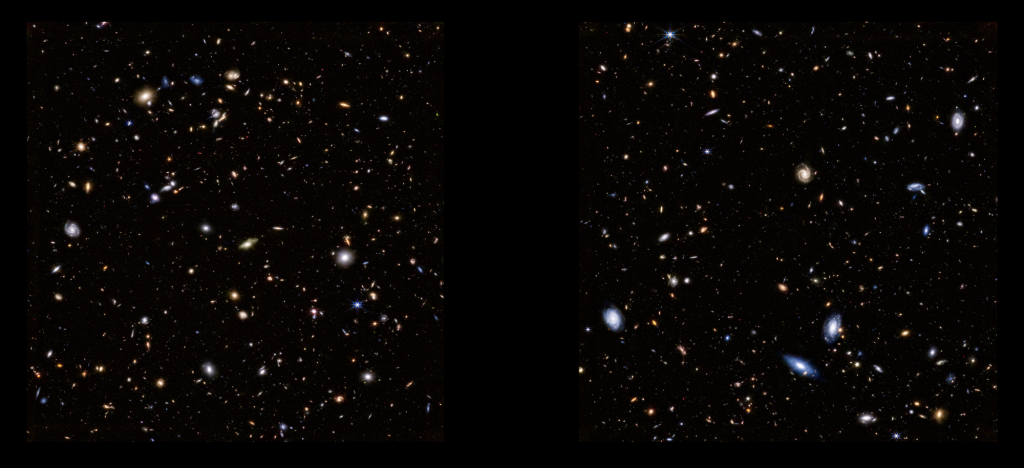
The Hubble Ultra Deep Field - a view of nearly 10,000 galaxies - is one of the most iconic images ever taken by the NASA/ESA Hubble Space Telescope. In October 2022, the James Webb Space Telescope revisited the same field for the first time and captured it in just 20 hours - an incredible feat considering that the Hubble took over 11.3 days to achieve the same result. Additionally, Webb's advanced capabilities enabled it to capture the same field in much higher resolution than the Hubble telescope.
The Webb image has observed the Hubble Ultra Deep Field at depths comparable to the Hubble, revealing galaxies of similar faintness, in just one-tenth of the observing time.
The image was taken using Webb's Near Infrared Camera (NIRCam) - one of the key scientific instruments aboard the telescope. NIRCam is designed to acquire some of the deepest near-infrared images ever obtained.
"We proposed to image the Ultra Deep Field using some of Webb's NIRCam's medium-band image filters, which allowed us to take images of spectral features more accurately than we could with broadband filters because medium-band filters span a shorter wavelength range. This gives us more sensitivity in measuring colors, which helps us understand the history of star formation and ionization properties of galaxies during the first billion years of the universe, like in the Reionization Era," said Christina Williams, an assistant astronomer at the National Optical Infrared Astronomy Research Lab (NOIRLab) in Tucson, Arizona.
Between 2003 and 2004, @NASAHubble spent more than 11 days taking the Hubble Ultra Deep Field, a view of nearly 10,000 galaxies. In 2022, Webb took only about 20 hours to observe that same field in high-resolution: https://t.co/Fk8AFZQL2T pic.twitter.com/kGxtj3S6t2
— NASA Webb Telescope (@NASAWebb) April 12, 2023
The James Webb Space Telescope's sensitivity is allowing astronomers to study the earliest galaxies in the universe in unprecedented detail and better understand star formation and other galactic properties in the early universe.


 Google News