

Long-running mystery behind Jupiter's changing bands and stripes solved
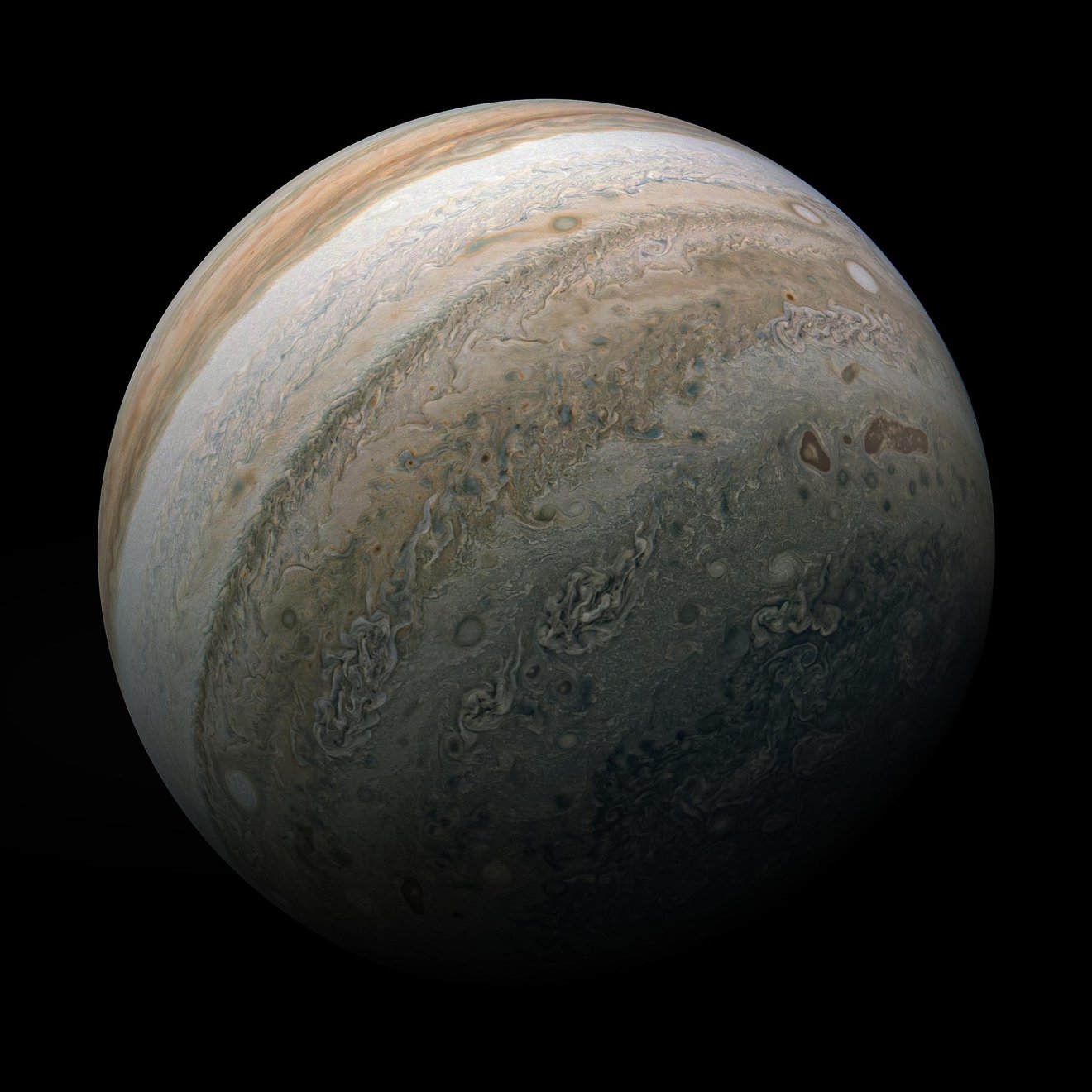
Jupiter's famous light and dark "stripes" have puzzled scientists for decades, leaving them eager to decode the mechanisms driving this mesmerizing phenomenon. Now, researchers at the University of Leeds believe they have finally unravelled the long-running mystery surrounding the stripes, thanks to the invaluable data gathered by NASA's Juno mission that provided incredible new information about the gas giant's magnetic field.
"Every four or five years, things change. The colours of the belts can change and sometimes you see global upheavals when the whole weather pattern goes slightly crazy for a bit, and it has been a mystery as to why that happens," said Professor Chris Jones, University of Leeds School of Maths.
Scientists have long found that the planet's changing appearance is closely tied to variations in infrared radiation emanating from approximately 50 kilometers beneath the planet's surface. The new study reveals that these variations could in turn be caused by waves produced by the planet's magnetic field, deep within its interior.
By meticulously analysing Jupiter's magnetic field spanning multiple years, the researchers were able to track the waves and oscillations coursing through this colossal gas giant. They closely examined a particular feature known as the Great Blue Spot, a distinct magnetic field region on Jupiter. Past observations reveal that this spot has been gradually shifting eastwards, however, the latest data presents a significant twist - the spot's movement is decelerating, leading the Juno team to speculate that it signifies the onset of an oscillation, with the movement slowing before it reverses and starts going westwards.
"There remain uncertainties and questions, particularly how exactly the torsional oscillation produces the observed infrared variation, which likely reflects the complex dynamics and cloud/aerosol reactions. Those need more research. Nonetheless, I hope our paper could also open a window to probe the hidden deep interior of Jupiter, just like seismology does for the Earth and helioseismology does for the Sun," said Dr Kumiko Hori, Kobe University, Japan.
This work, led by Dr Hori, has been published in Nature Astronomy.


 Google News