

Study answers longstanding questions about black hole jets
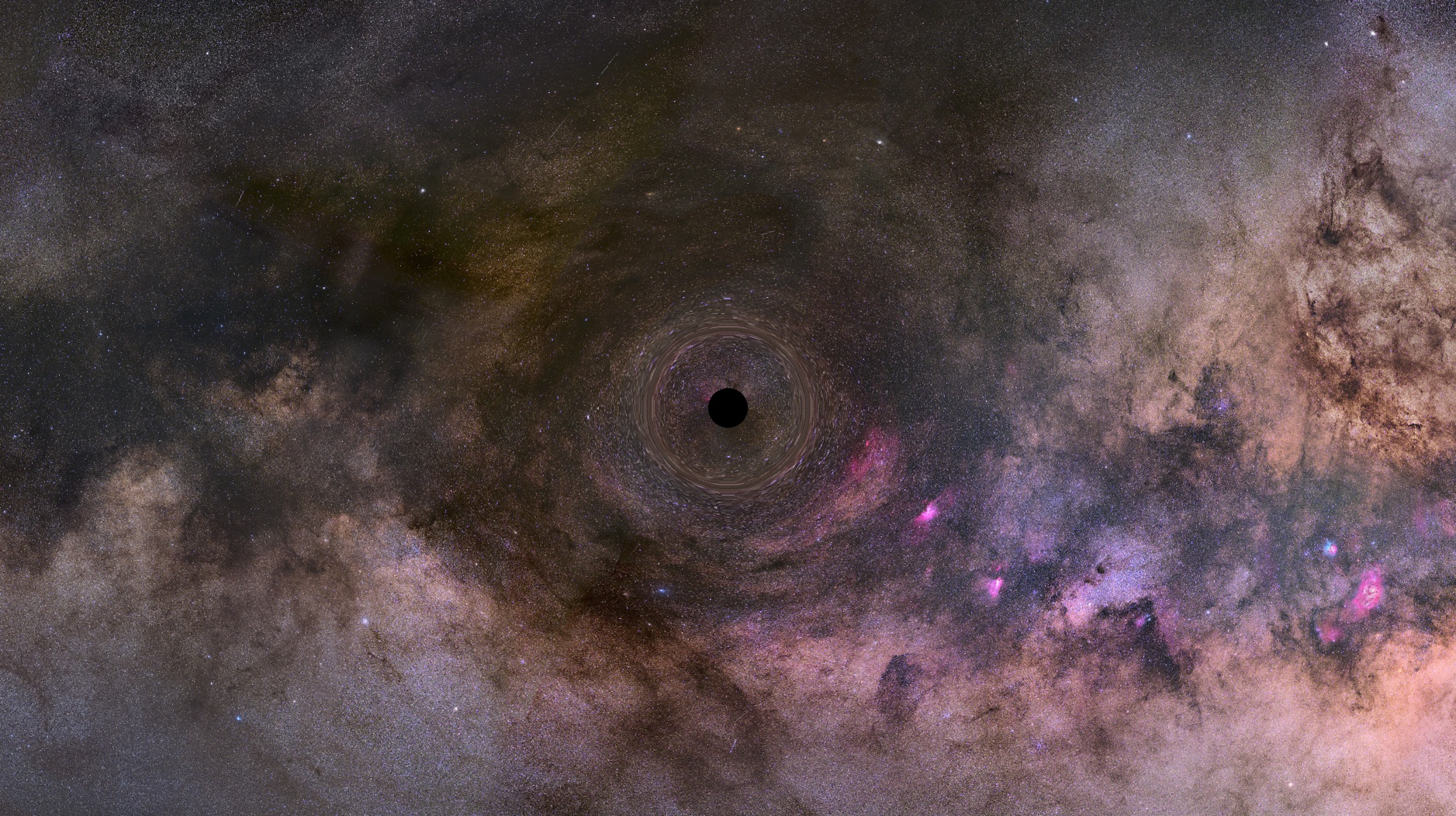
Black holes are known for sucking absolutely everything around them. However, a team of astrophysicists at Princeton University has now determined conclusively that energy close to the event horizon of M87* - a black hole at the centre of Messier 87 - is pushing outward, not inward.
"Even though black holes are defined as objects from which nothing can escape, one of the astonishing predictions of Einstein's theory of relativity is that black holes can actually lose energy. They can rotate, and just like a spinning top slows down over time and loses that energy in its rotation, a rotating black hole can also lose energy to its surroundings," says astrophysicist Eliot Quataert, Princeton's Charles A. Young Professor of Astronomy on the Class of 1897 Foundation.
The black hole M87* was first detected by the Event Horizon Telescope. While the energy flow close to this supermassive black hole's event horizon is streaming outwards, the Princeton team said that the energy flow could theoretically go inward in a different black hole. They are confident in their link between energy flow and the direction of the magnetic field lines, and their prediction that the energy flow comes from the black hole will be tested with the launch of the still-theoretical next-generation Event Horizon Telescope (EHT).
In their paper, the researchers have stressed that they haven't conclusively shown that the black hole's spin "truly powers the extragalactic jet," though the evidence certainly leans in that direction.
Their findings are published in a paper in the Astrophysical Journal. Andrew Chael, an associate research scholar in astrophysics, is the first author on the paper and George Wong is the co-author. Both are members of the Event Horizon Telescope.
The team also included Alexandru Lupsasca, a former associate research scholar at Princeton who is now an assistant professor of physics and mathematics at Vanderbilt University. Lupsasca won the 2024 New Horizons in Physics Prize from the Breakthrough Prize Foundation for his black hole research.
More details can be found here.


 Google News