

Webb detects methane and water vapor in exoplanet atmosphere
- Country:
- United States
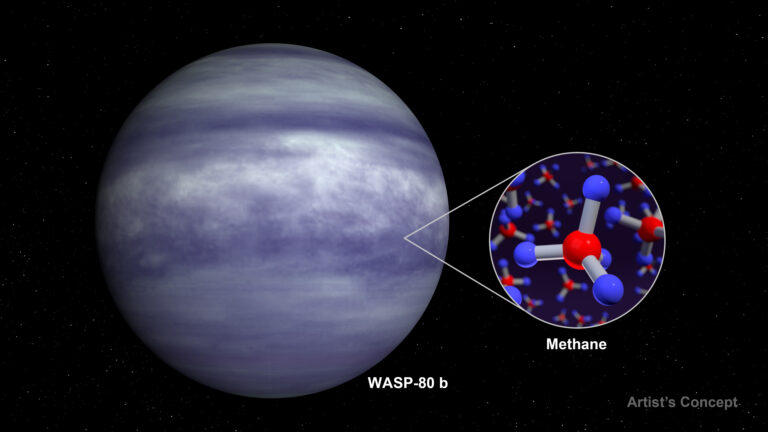
NASA's most powerful space-based observatory, the James Webb Space Telescope, has discovered methane gas and water vapors in the atmosphere of the exoplanet WASP-80 b as it passed in front of and behind its host star.
This is not the first time that water vapor has been detected in an exoplanet. However, methane has remained elusive in the atmospheres of transiting exoplanets when studied with space-based spectroscopy, the agency said.
Located 163 light-years away in the constellation Aquila, the exoplanet WASP-80 b goes around its red dwarf star once every three days. The planet can't be seen directly with even the most advanced telescopes like Webb because it is too close to its star and both are so far away from Earth. Researchers study the combined light from the star and planet using the transit method and the eclipse method to observe it.
They used the transit method to observe the system when the planet moved in front of its star from our perspective, causing the starlight we see to dim a bit. This method helps scientists understand what the planet's atmosphere is made of by seeing which colors of light are being blocked, explained Taylor Bell from the Bay Area Environmental Research Institute (BAERI), working at NASA's Ames Research Center in California's Silicon Valley, and Luis Welbanks from Arizona State University.
In the eclipse method, the researchers observed the system as WASP-80 b passed behind its star, causing another small dip in the total light the researchers received. By measuring the dip in light during the eclipse, they successfully measured the infrared light emitted by the planet.
In addition to finding a very elusive molecule, the team can now start exploring what this chemical composition reveals about the planet's birth, growth, and evolution. For example, by measuring the amount of methane and water in the planet, the researchers can infer the ratio of carbon atoms to oxygen atoms, which can further offer clues as to whether the planet formed close to its star or farther away before gradually moving inward.
"Another thing that has us excited about this discovery is the opportunity to finally compare planets outside of our solar system to those in it. NASA has a history of sending spacecraft to the gas giants in our solar system to measure the amount of methane and other molecules in their atmospheres. Now, by having a measurement of the same gas in an exoplanet, we can start to perform an "apples-to-apples" comparison and see if the expectations from the solar system match what we see outside of it," the researchers said.
They now plan to probe the properties of WASP-80 b's atmosphere at different wavelengths of light using Webb's MIRI and NIRCam instruments.
Catch a whiff of this.Webb made a definitive detection of methane gas in the atmosphere of "warm Jupiter" WASP-80 b. (The planet is similar in size to Jupiter, but with much warmer temperatures.) Hear directly from the research team on their discovery: https://t.co/0m2MzEelQ2 pic.twitter.com/pVHHfCzI99
— NASA Webb Telescope (@NASAWebb) November 22, 2023


 Google News