

Global Assessment Reveals Unprecedented Atmospheric Impacts of 2022 Hunga Eruption
“This assessment shows how Hunga’s water-rich plume reshaped the stratosphere in ways not seen before,” said Tim Naish, Chair of the WCRP Joint Scientific Committee.
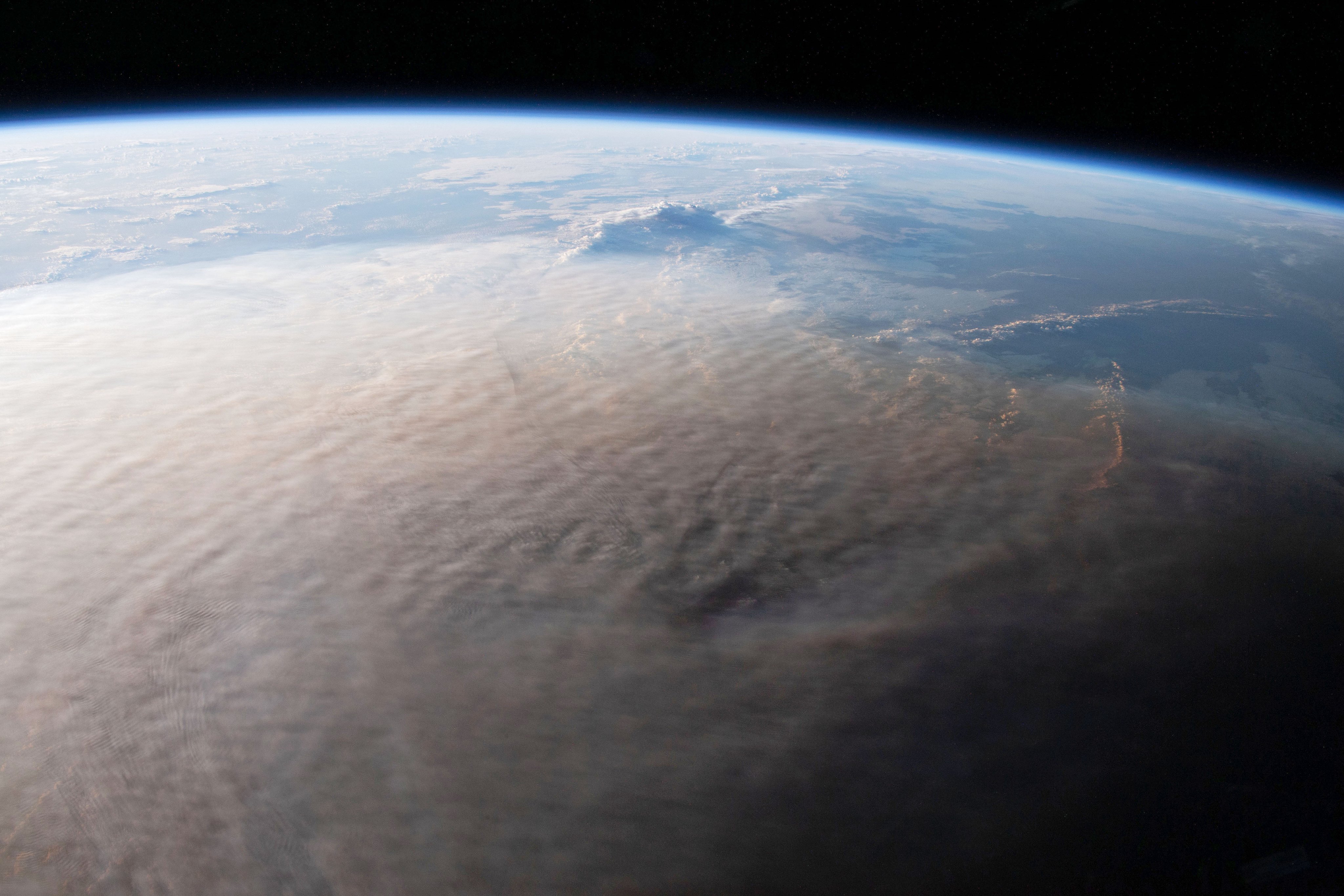
A new international scientific assessment has delivered the most detailed analysis to date of the atmospheric impacts of the 2022 Hunga Tonga–Hunga Haʻapai volcanic eruption—the most explosive natural event observed since the dawn of the satellite era.
Drawing on extensive satellite, balloon and ground-based observations, combined with advanced global modelling, the report provides a comprehensive understanding of how the eruption reshaped the stratosphere and what it means for climate and ozone chemistry.
The Hunga Volcanic Eruption Atmospheric Impacts Report was released under the Atmospheric Processes and their Role in Climate (APARC) project of the World Climate Research Programme (WCRP), co-sponsored by the World Meteorological Organization (WMO).
"This assessment shows how Hunga's water-rich plume reshaped the stratosphere in ways not seen before," said Tim Naish, Chair of the WCRP Joint Scientific Committee. "It highlights the essential role of sustained global observations, advanced modelling, and international collaboration."
Key Scientific Findings
A Record-Breaking Underwater Explosion
The 15 January 2022 eruption—triggered by the collapse of an underwater caldera in the South Pacific—was the largest underwater explosion ever recorded by modern instruments. Its extraordinary force propelled a vast, water-rich plume into the stratosphere, injecting so much water vapour that global stratospheric moisture increased by about 10%, a perturbation still detectable three years later.
Minor Effects on Climate and Ozone
Despite early concerns, the eruption's effects on global surface climate were limited. Model simulations show the eruption produced a small cooling influence of around 0.05°C, indistinguishable from natural variability.
Similarly, while the eruption temporarily affected Southern Hemisphere stratospheric ozone, its overall impact on the Antarctic ozone hole was minor.
The report also confirms that the record global temperatures of 2023–2024 were not caused by the eruption.
A Major International Scientific Effort
The seven-chapter report synthesises the findings of an unprecedented global research effort, including contributions from the Hunga Tonga–Hunga Haʻapai Impact Model Observation Comparison (HTHH-MOC) project, which involved more than ten global climate models.
The assessment covers:
-
Eruption chronology and plume dynamics
-
Short- and long-term evolution of the volcanic cloud
-
Impacts on stratospheric chemistry and circulation
-
Effects on ozone and upper-atmosphere processes
-
Radiative forcing and temperature impacts at Earth's surface
Launched in late 2022, the assessment brought together 159 scientists from 21 countries. The effort was coordinated by Yunqian Zhu, William Randel, Graham Mann, and Paul A. Newman—leaders from NOAA, NCAR, the University of Leeds and the University of Maryland-Baltimore County.
"The Hunga eruption was unlike anything observed before," said Co-Chair Yunqian Zhu. "It showed how profoundly water-rich eruptions can alter the stratosphere and how essential global cooperation is to capture and understand such rare events."
The Importance of Sustained Global Observation
The report underscores the extraordinary value of decades of investment in atmospheric observation networks—from satellites to balloon campaigns and ground-based sensors. These systems enabled scientists to track the Hunga plume within minutes of the eruption and continue monitoring its evolution years later.
However, the assessment warns that future observational gaps, whether due to satellite mission cancellations or aging monitoring infrastructure, could severely hinder scientific ability to analyze similar large-scale events.
"This report reflects an extraordinary effort by the global scientific community," said Graham Mann. "It not only documents Hunga's impacts but also highlights why we must maintain and expand our ability to observe the atmosphere."
Supporting datasets, including HTHH-MOC simulations, will be made publicly available through the Centre for Environmental Data Analysis (CEDA), ensuring long-term access for researchers and modelers worldwide.


 Google News