

G20 summit: UN chief spotlights urgency of addressing climate change
In the UN chief’s view, it “will be very difficult to have a breakthrough in relation to some of the most difficult challenges that the international community is facing”.
- Country:
- Japan
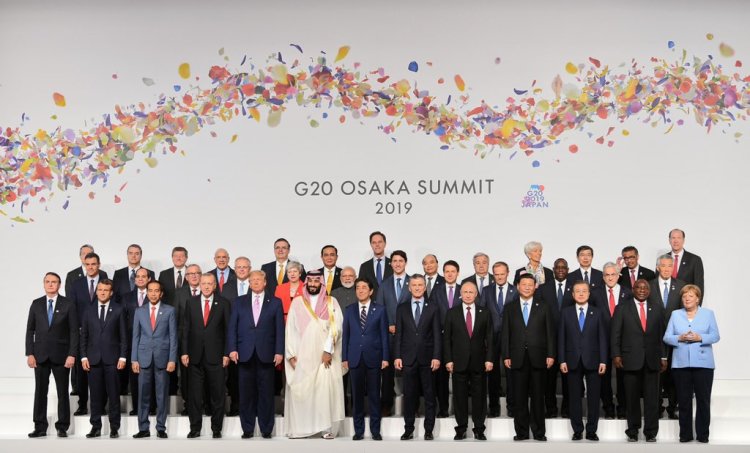
The annual G20 summit of leaders from the largest and fastest-growing economies got underway on Friday in Osaka, Japan, against a backdrop of what UN Secretary-General António Guterres described as "a moment of high political tension".
"We have global warming, but we have also global political warming, and this can be seen in relation to trade and technology conflicts, it can be seen in relation to situations in several parts of the world, namely the Gulf", he told reporters before addressing the summit, referring to recent attacks on oil tankers around the Strait of Hormuz and the Gulf of Oman.
Turning to "uncertainties about the global economy", he pointed to trade conflicts, high debt levels, potentially unstable financial markets and the risk of a global growth slowdown.
In the UN chief's view, it "will be very difficult to have a breakthrough in relation to some of the most difficult challenges that the international community is facing".
Although the UN is not part of the G20, Mr Guterres was pleased for the opportunity to "address the leaders and to convey to them our concerns".
'Rescue the planet'
The Secretary-General spotlighted the urgency of addressing climate change as a main priority.
Painting a picture of "heat waves in Europe, drought in Africa, storms happening also in Africa and the Caribbean" and a "multiplication" more intense, more frequent natural disasters "with worsening humanitarian consequences" as well as "glaciers melting, corals bleaching, the Arctic with the lowest levels ever in relation to the parts covered by ice" he said: "Climate change is running faster than what we are".
"All the analyses that can be made show the situation, in practical terms, is worse than what we could have forecasted, and the political will has been failing", he said, calling it "a paradox that needs to be addressed".
Avowing his belief in science, Mr Guterres cited the Intergovernmental Panel on Climate Change (IPCC) report, which spells out that by the end of the 21st-century temperatures must not exceed 1.5 degrees Celsius.
This translates to carbon neutrality by 2050, which requires more ambition by governments and others.
He spoke about the UN's September climate summit in New York where he will appeal to world leaders for a stronger commitment for climate action, including by "putting a price on carbon, ending subsidies to fossil fuels, [and] not accepting the idea that we still have an acceleration of the construction of coal power plants", all of which are "absolutely essential to rescue the planet".
2030 Agenda
The 2030 Agenda for Sustainable Development is another main challenge where "we are lagging behind", according to the UN chief.
"If we project the different Sustainable Development Goals(SDGs), the evolution since the beginning until now to 2030, we will be more or less at the midway of what the international community has determined when the Agenda 2030 was approved", he said, arguing the need to accelerate resource mobilization. "Countries need to do more, mobilizing their own internal resources, improving their governance, reducing corruption, implementing the rule of law".
Mr Guterres highlighted that G20 nations represent 80 per cent of climate change emissions and appealed for a stronger commitment to international financial and economic cooperation.
Iran, China, US and the digital economy
After addressing the press, the UN chief took questions a variety of questions, such as on rising tensions between the United States and Iran, where he reiterated his support of the Joint Comprehensive Plan of Action (JCPOA), aimed at curbing Tehran's attainment of nuclear weapons.
"I have always believed and will go on believing that the JCPOA is a very important instrument that was achieved and it was a factor of stability and that it will be very important to preserve it", he stated. "Obviously, it is essential to de-escalate the situation in the Gulf" to avoid a confrontation that "the world couldn't afford".
When asked to what extent the UN chief held President Trump responsible for disagreements among the G20 leaders, he stressed the importance of dialogue between the presidents of China and the US, saying theirs was "probably the most relevant bilateral meeting that will take place in the G20".
On the digital economy, the UN chief spoke of the recently concluded high-level panel on the digital cooperation, noting the "huge impact" that it – along with artificial intelligence – will have on the global economy.
"We will see a massive destruction of jobs and the massive creation of jobs, but the jobs will be different," he said, adding that there must be "a strong commitment" by countries to guarantee the education, social protection and job creation needed to "minimize the negative impacts" and "optimize the positive contributions of the fourth industrial revolution".
"The G20 can play a very important role" in that he asserted.
ALSO READ
-
Better Heat Planning Can Protect Crowds and Ease Pressure on Hospitals, WHO Says
-
Hotter Years, More Cavities? Understanding Link Between Climate and Dental Health
-
Mozambique Shapes New Climate Strategy to Protect Communities From Extreme Weather
-
Climate Change Is Deepening the Crisis for Millions Living Without a Nationality Today
-
Tunisia’s Water Crisis Puts Jobs and Growth at Risk as Economic Recovery Loses Speed


 Google News