

Bharat Stage Six revolutionary step in fuel transformation: Prakash Javadekar
The Minister highlighted that out of 273 days till 30th September in 2019, a number of ‘Good’, ‘Satisfactory’ and ‘Moderate’ days were 165 as against 104 in 2016.
- Country:
- India
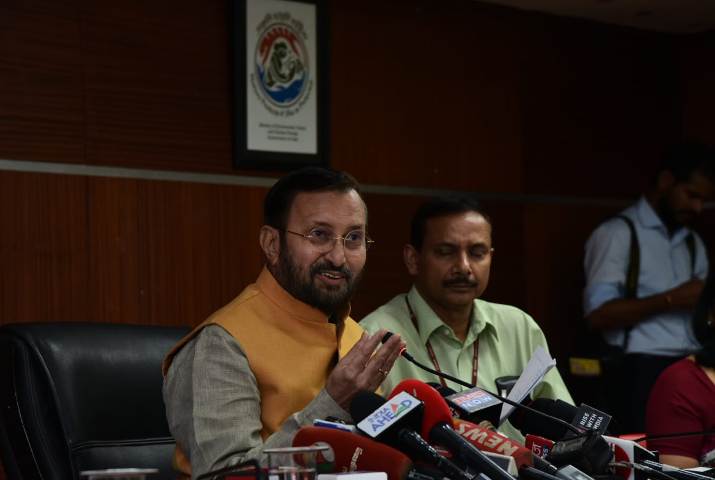
Efforts of the Central Pollution Control Board are resulting in more 'good days' in terms of the environment in the National Capital Region of Delhi. Giving details at a Press Conference in New Delhi today, Union Minister for Environment, Forest and Climate Change, Shri Prakash Javadekar, said that a high-level meeting of the five States to address the problem of air pollution in Delhi, due to stubble burning will be held soon. To control stubble burning, the government has given more than 20 thousand machines to farmers in Punjab and Haryana at a cost of about Rs.1150 crore, the Minister said.
Shri Javadekar said "Recognition of the existence of a problem is the beginning of the solution of the problem. The pollution problem of Delhi-NCR started aggravating since 2006 and was not recognized until 2014. In 2015, under the supervision of Prime Minister Shri Narendra Modi, Air Quality Index (AQI) was launched. Today, 113 AQI monitoring stations are present in Delhi-NCR and 29 more are to be installed soon". The Minister highlighted that out of 273 days till 30th September in 2019, a number of 'Good', 'Satisfactory' and 'Moderate' days were 165 as against 104 in 2016.
The Minister further informed that Bharat Stage Six (BS-VI), is a revolutionary step in the transformation of fuels. He added that there has been an 80% reduction in Particulate Matter emissions and a 30% reduction in Nitrogen Oxide emissions in BS-IV heavy-duty diesel vehicles compared with BS III norms. Nearly ₹60,000 Cr were spent on switching over to BS-VI fuels. "The Country will shift to BS-VI vehicular emission norms from BS-IV by April 2020. BS-VI petrol/diesel is already available in Delhi/NCR", said Shri Javadekar.
Terming the launch of green firecrackers with green logo and QR coding system on Saturday, a historic initiative, the Minister advised not to burst crackers this Diwali. However if one chooses to, then opt for the green crackers which are aimed at reducing pollution and health risks, Shri Javadekar said.
Pointing out various efforts undertaken to control pollution, Shri Javadekar stated: "From today onwards, 46 teams of Central Pollution Control Board (CPCB) are taking stock of pollution levels in Delhi-NCR and will take appropriate action wherever needed".
The Minister highlighted that the creation of Eastern and Western Peripheral Expressways, completed at cost of about ₹17000 Cr, has now led to 40000 goods vehicles, which are not destined for Delhi, to be diverted away from the national capital, leading to a great positive impact on pollution.
Talking of initiatives relating to e-mobility and Delhi Metro Rail Corporation network, Shri Javadekar said, 377 Km of metro lines with 274 stations, is catering to more than 30 lakh passengers daily in an environmentally friendly manner. He termed it has one of the best systems of public transport in the world because of which more than 4 lakh vehicles are avoided on roads, thereby, reducing pollution.
The Minister also called upon other States to work unitedly in curbing pollution. It was informed that Delhi alone gets 52MW energy from solid waste management and waste compost plant is operational. The closure of Badarpur Thermal Plant, banning of pet coke and conversion of 2789 Brick kilns in NCR to Zig-Zag technology has also led to a reduction of pollution.
Underlining the various actions undertaken by the Government to control road and construction and demolition (C&D) dust, the Minister said emulating the best dust management practices from Delhi Metro has led to pollution reduction and presently there is nearly 5 lakh MT waste which is being processed as Recycled Aggregate/Brick base.
(With Inputs from PIB)


 Google News