

Chandrayaan-2 historical feat : Duari
- Country:
- India
Describing Chandrayaan-2 as a historical feat for the country's scientists as well as for everybody who worked to make it a success, director of MP Birla Planetarium here, Debiprasad Duari Monday said the data collected by it will help in understanding the early chemistry of the solar system. The expedition will also help the scientists in understanding the presence of water ice in the Earth's satellite.
The launching of the country's second lunar mission is "a historical moment for the scientists and for everybody who is involved with Chandrayaan-2," he said. "It was a great experience of 1000 of scientists who worked hard for the last couple of years. This is only the beginning and we hope that this will be a successful long journey and after 48 days Chandrayan-2 will land on the uncharted Lunar South Pole," Duari told PTI.
"From the data to be sent by the Chandrayaan-2, scientists will get a huge amout of information about the Moon including its formation. It will also give us information about the early chemistry of our solar system," he said. Talking about the importance of findings on the astronomical body, he said, "The presence of water is extremely important since the global scientific community has realized that soon human settlements are going to come upon the Moon." Asked about the possible outcome of the mission, Duari said, "Once lander (Vikram) and rover (Pragyan) are on the lunar surface on September 7, we can expect a huge amount of data making a detailed map about the presence of minerals and water and ice in the South Pole of the Moon.
"The scientists believe there are certain regions in the Moon where sunlight never reach and there could be a huge reservoir of water and ice. Chandrayaan I had sent information about the existence of 60000 crore liters of water ice near its the North Pole." The most important find will be by the SAR (Synthetic Aperture Radar) which can tell us about the presence of water and ice on the crater and also about the presence of hydroxyl ion on the surface, he added. Instruments will also perform experiments to collect information about minerals and the atmospheric temperature near the Moon's surface and try to find out the effect solar particles in the Moon's atmosphere, he said.
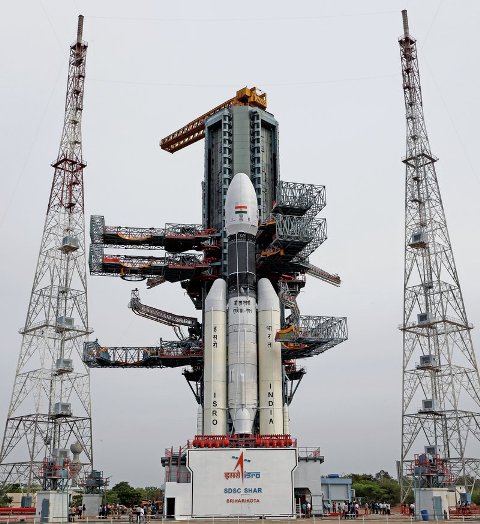
India Monday successfully launched its second lunar mission Chandrayaan-2 onboard its powerful rocket GSLV-MkIII- M1 from the spaceport at Sriharikota to explore the unchartered south pole of the celestial body by landing a rover. The geosynchronous satellite launch vehicle lifted-off from the Satish Dhawan Space Centre into the cloudy sky at 2.43 pm and successfully placed the 3,850-kg Chandrayaan-2 into the earth orbit about 16 minutes later.
The mission's success brought in huge relief for ISRO scientists after the July 15 launch was called off just about an hour left following a technical glitch in the rocket. The Rs 978 crore mission, that will mark a giant leap in India's space research and make it only the fourth country to have landed a rover on Moon, was rescheduled to Monday after scientists corrected a technical glitch in the three-stage rocket.


 Google News