

Bengali New Year 2019: Know how Poila Baisakh is celebrated, how it originated
The Bangabandhu Council of Australia also hosts a Poila Baisakh event at the Sydney Olympic Park.

- Country:
- Bangladesh
- India
Bengali New Year (or Poila Baisakh) is the first day of the Bengali calendar. Today, on April 15, the people living in the Indian states of West Bengal, Tripura and Odisha and some parts of Assam, and even Bangladesh are celebrating Poila Baisakh irrespective of their religious faith.
Bengali New Year is an occasion for the Bengalis spread across the world to celebrate and pray for a prosperous Nabo Barsho (New Year) ahead. On the occasion of Poila Baisakh, Bengali people invest in well-grooming their house (mainly cleaning), paint alpana (rangoli) in various traditional designs and also place the earthen pot with water capped with mango leaves with a red and white swastika sign.
The worshipping of Lord Ganesh (the god of auspicious beginnings) and Goddess Lakshmi (the goddess of prosperity and wealth) are considered mandatory during Poila Baisakh as this is the start of Bengali New Year. Many people visit the nearby river to say their prayers and take a ritual bath. In West Bengal, the early morning cultural processions called Prabhat Pheri is highly noticeable. The processions include dance troupes including children dressed up with floats, displaying their performance arts to songs of Nobel Laureate Rabindranath Tagore. Festive foods such as confectionery and sweets are purchased and distributed as gifts to friends and family members. Every family cook varied traditional, authentic veg and non-veg cuisines.
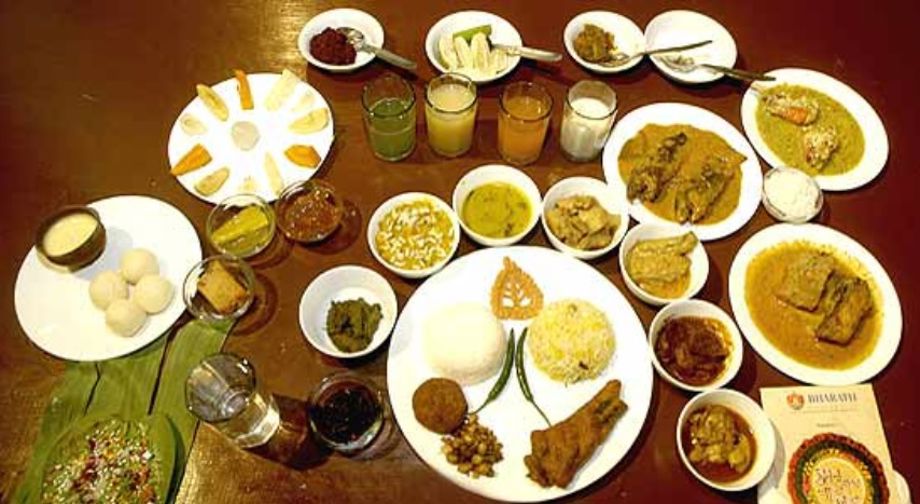
Special cuisines during Bengali New Year (Poila Baisakh)
The celebration also includes wearing new clothes and starting the day by visiting temples. Poila Baisakh also marks the traditional accounting New Year for the merchants. The merchants also start new accounting books and lend sweets to their loyal clients. Women put red sindoor (vermilion) on each other's head as a mark of good wishes, especially seeking long life for their husbands. The rallies of Mangal Shobhajatra is also observed in the streets of Kolkata and various parts of Bengal. Even the festive Mangal Shobhajatra is organized in Bangladesh. In 2016, the UNESCO declared this festivity organized by the Faculty of Fine Arts, the University of Dhaka as a cultural heritage of humanity. The Bangabandhu Council of Australia also hosts a Poila Baisakh event at the Sydney Olympic Park.
The current Bengali calendar in use in the Indian states is based on the Sanskrit text Surya Siddhanta. It retains the historic Sanskrit names of the months, with the first month as Baishakh. This calendar gives the dates and times for various Bengali Hindu festivals. Some historians attribute the Bengali calendar to the 7th-century king Shashanka, which was later modified by Mughal emperor Akbar for the purpose of tax collection. The royal astronomer Fathullah Shirazi was asked by Akbar to create a new calendar by combining the lunar Islamic calendar and solar Hindu calendar already in use. The new calendar was then known as Fasholi shan (harvest calendar). Some historians say that this started the Bengali calendar. However, some argue with historical pieces of evidence that the Bengali calendar existed before Akbar's time.


 Google News