

Locusts not hit rabi crops; efforts on to prevent spread before monsoon to save kharif crops
- Country:
- India
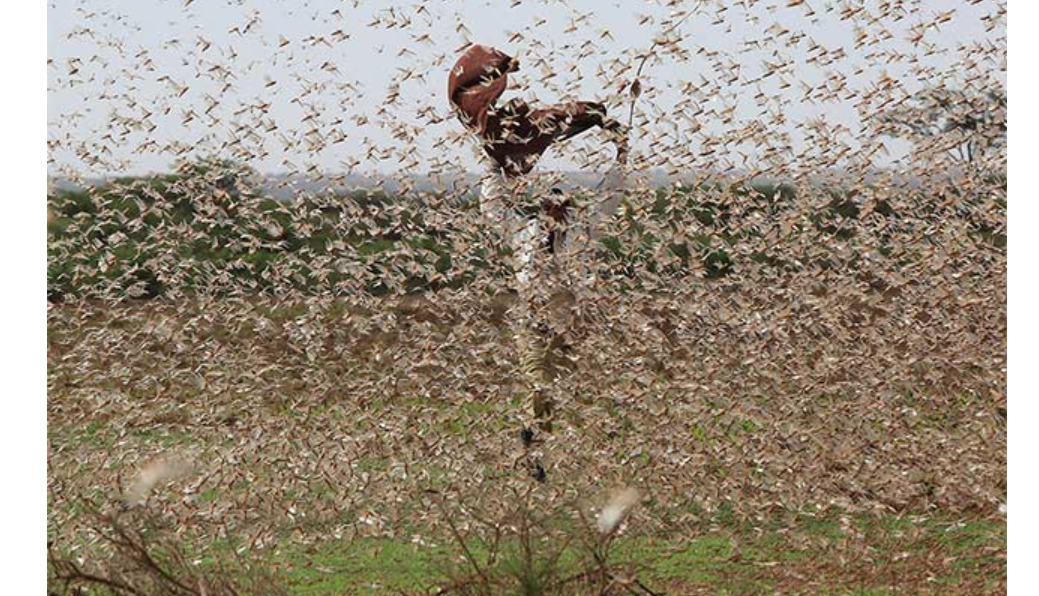
Desert locusts -- the crop-destroying insects -- have not impacted rabi crops in India but the government efforts are on to eliminate the insects before the monsoon in order to save Kharif crops, officials from the Locust Warning Organisation (LWO) said on Wednesday. The officials, however, said that locust swarms would not have posed a big threat to India, had neighboring Pakistan controlled its spread at its end. Locusts belong to the family of grasshoppers and are usually harmless but certain environmental conditions like a monsoon and heavy cyclones make them reproduce faster. The swarm is highly mobile and covers 50 to more than 100 km in a day. Locusts -- the oldest migratory pest in the world -- entered India after traveling from Africa through Yemen, Iran, and Pakistan. After massive devastation in Pakistan, the swarms of locusts have entered the country through Rajasthan and Gujarat. "There is a continuous locusts invasion from Pakistan. It is not a new problem and we had been facing it for a long time. This year, the locust's attack is worse in 26 years. However, a coordinated effort has been made to curb its spread," a senior official from the Faridabad-headquartered LWO told PTI.
Earlier, locusts had been confined to Rajasthan and Gujarat. Since insects are not finding enough food to survive, they are moving to other areas with the help of heavy winds, he said. But the locust's attack this year has been severe as swarms are moving at a much higher speed depending on wind direction. It has largely impacted Rajasthan and parts of Gujarat, Madhya Pradesh, and Maharashtra, he said. However, both central and federal agencies have effectively controlled at various locations. The focus is on eliminating these insects in Rajasthan itself and preventing its spread to other states, he added. According to the Indian Council of Agricultural Research (ICAR) Director General Trilochan Mohapatra these insects have attacked about 40,000 to 42,000 hectares of land. There is no impact on rabi (winter) crops like wheat, pulses, and oilseeds as most of them are harvested by now.
"The focus now is to stop the outbreak prior to the arrival of monsoon rainfall in June-July when locusts will mature and breed. If infestation is not controlled, it will pose a threat to Kharif crops," he said. Mohapatra said the insects are being killed with the help of chemical pesticides that are being sprayed with specialized machines. Around 700 tractors have been deployed for spraying. In Rajasthan, the LWO's field officer at Jalore district Bal Ram Meena said, "The problem has aggravated as swarms are moving fast at more than 100 km a day in search of food in other areas. Earlier, they used to travel 50 km a day, and controlling it was easy." Now, they have crossed the Pakistan border and infested Jaipur, Jodhpur, Dausa, Kaurali, and Sikar districts in the state. They are polyphagous and feed on green vegetation, he said, adding that they will move depending on change in the wind pattern.
Another field officer from LWO's Barmer center said that the state government is using a chemical pesticide called 'Malathion' for controlling the spread of locusts swarms. It's a highly concentrated chemical pesticide. Since it is poisonous, farmers cannot do it. A team of officers from the LWO is trained to handle it using specialized machines, the official said.
However, in Gujarat, a field officer of LWO A K Bharia said locusts infestation was reported in scattered form, not in swarms, in parts of Surendranagar and Bhavnagar districts. "The state has been asked to be on alert in June-July and keep a watch on the breeding of locusts in scattered areas during monsoon and take measures," the official said. According to the UN body Food and Agriculture Organisation (FAO), the locust's attack poses a threat to the food security of the affected countries as an adult locust can eat a quantity equal to its weight of about 2 grams every single day. A single square kilometer of the swarm can contain somewhere between 40 to 80 million adult locusts. Every single day, if they cover 130-150 km, they can eat the food consumed by as many as 35,000 people, it said.
As per the FAO's May 21 update, spring breeding continues in southern Iran and southwest Pakistan where control operations are in progress against hopper groups and bands as well as an increasing number of adult groups. As vegetation dries out, more groups and swarms will form and move from these areas to the summer breeding areas along both sides of the India-Pakistan border as several waves from now until at least early July. Good rains are predicted during the first half of June along the India-Pakistan border that would allow egg-laying to occur. This should reduce the further eastward movement of swarms that have already arrived in Rajasthan, it added. The Met Department has forecast a normal southwest monsoon during the July-September period. Sowing of Kharif crops like rice is underway and it will pick up the pace with the onset of monsoon.


 Google News