

Tropical Cyclone Idai: Mozambique facing major humanitarian emergency, warns WFP
Five days after the storm made landfall in Mozambique, causing widespread damage and flooding, at least 1,000 people are feared dead there alone.
- Country:
- Malawi
- Mozambique
- Zimbabwe
The full scale of the devastation caused by Tropical Cyclone Idai in south-west Africa is becoming clearer, the UN said on Tuesday, warning that the emergency "is getting bigger by the hour".
Five days after the storm made landfall in Mozambique, causing widespread damage and flooding, at least 1,000 people are feared dead there alone.
Victims are reportedly trapped on roofs and clinging to trees awaiting rescue, UN agencies said, while across Mozambique, Malawi and Zimbabwe, tens of thousands of people have lost their homes, while roads, bridges and crops have been washed away.
"We are talking about a massive disaster right now where hundreds of thousands -in the millions of people – (are) potentially affected," said Jens Laerke from the UN Office for the Coordination of Humanitarian Affairs (OCHA). "We need all the logistical support that we can possibly get."
Although floodwaters have reportedly begun to recede in Zimbabwe and Malawi, allowing some people to return home, the World Food Programme (WFP) warned that Mozambique is facing "a major humanitarian emergency that is getting bigger by the hour".
An estimated 1.7 million people were in the path of the cyclone in Mozambique, WFP spokesperson Herve Verhoosel told journalists in Geneva, in addition to the 920,000 people affected in Malawi and "thousands more" impacted in Zimbabwe.
Flooding resembles 'inland oceans'
Aid access is "the biggest challenge", the WFP spokesperson insisted, while the agency reported that staff members who flew over the area inundated since the weekend, when two swollen rivers burst their banks, spoke of "inland oceans extending for miles and miles".
In Mozambique, WFP aims to support 600,000 people affected by the cyclone, which struck with wind speeds in excess of 150 kilometres per hour. In Malawi, the UN agency plans to target 650,000 people with food assistance.
Amid the humanitarian response, heavy rain is continuing and more is forecast, according to Clare Nullis, spokesperson for the World Meteorological Organization (WMO). "The Mozambican President is quoted as saying they are fearing there are more than 1,000 casualties," she said. "If these reports, these fears are realized, then we can say that this is one of the worst weather-related disasters - tropical cyclone-related disasters - in the Southern hemisphere."
Thousands fighting for their lives on rooftops, in trees
UN Children's Fund UNICEF confirmed the scale of the emergency, noting that 260,000 children have been affected in Mozambique, which bore the brunt of Idai.
"Many people are in desperate situations, several thousand are fighting for their lives at the moment sitting on rooftops, in trees and other elevated areas," said spokesperson Christophe Boulierac. "This includes families and obviously many children."
Matthew Cochrane, the spokesperson for the International Federation of Red Cross and Red Crescent Societies (IFRC), underlined the perilous situation, noting that colleagues "talked of flooding perhaps in parts as deep as six metres, covering roofs, covering palm trees covering telephone poles".
WFP hails 'incredible pilots' delivering vital food aid
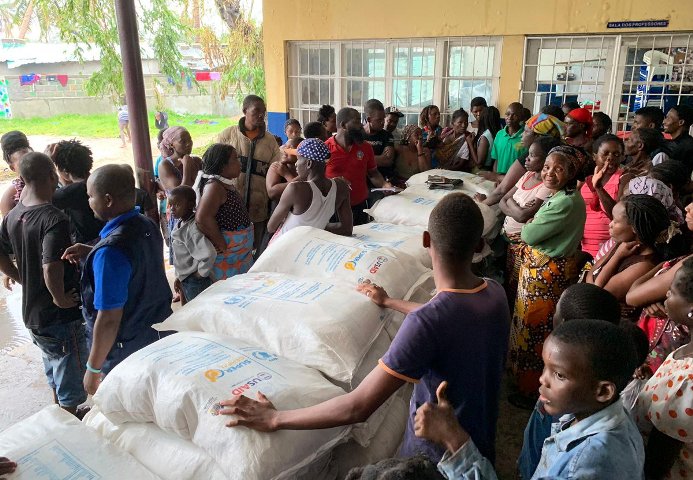
To date, WFP has coordinated airlifts of high-energy biscuits, water and blankets to people crammed on rooftops and elevated patches of land outside the port city of Beira, where 90 per cent of buildings are damaged, including the agency's warehouse and port unloading machinery.
"It was very difficult to land a plane like this," said Mr Verhoosel. "Can you imagine in an airport, damaged by the water, dark with no light or radio communication with the control tower, nothing. I mean, those pilots are incredible."
Four tonnes of biscuits are to be delivered by air later on Tuesday, in addition to the 1.2 tonnes dispatched on Monday - part of a 20-tonne consignment flown in from Dubai.
Negotiations are also "at an advanced stage" to bring in two freight aircraft to Beira, including a Hercules C-130, the agency said.
To respond to people's health needs, Christian Lindmeier from the World Health Organization (WHO) explained that the initial priority is helping those with crush and trauma injuries.
"So for the immediate needs, WHO is positioning health kits, emergency health kits, trauma kits and also cholera kits in order to be able to assist people on the ground, as soon as these kits get there," he said.
Longer-term needs will include dealing with a potential rise in waterborne diseases and rebuilding "many destroyed health centres", the WHO spokesperson added.
ALSO READ
-
WHO and KEI Explore Community Rights in Traditional Medicine Research and Innovation
-
Cholera Deaths Rise 30% as WHO Reports Highest Annual Toll in More Than Two Decades
-
World Leaders Push for Fairer Pandemic Protection as COVID’s Heavy Toll Drives Action
-
WHO Sets 2027 Southern Hemisphere Flu Vaccine Formula as Viruses Shape Risks
-
WHO Expands Quality Checks for Contraceptives and AI Tools That Help Spot Tuberculosis


 Google News