

Health News Roundup: China COVID policy: Major changes in further easing; China eases COVID quarantine rules in major policy adjustment and more
Most cases of infection with the coronavirus are asymptomatic or mild with no special treatment required, the National Health Commission said in a statement. China medical expert says COVID has mutated, should be renamed - state media China should change its official name for COVID-19 to reflect the virus' mutation, and patients with light symptoms should be allowed to quarantine at home, a leading authority on traditional Chinese medicine was quoted as saying on Wednesday.
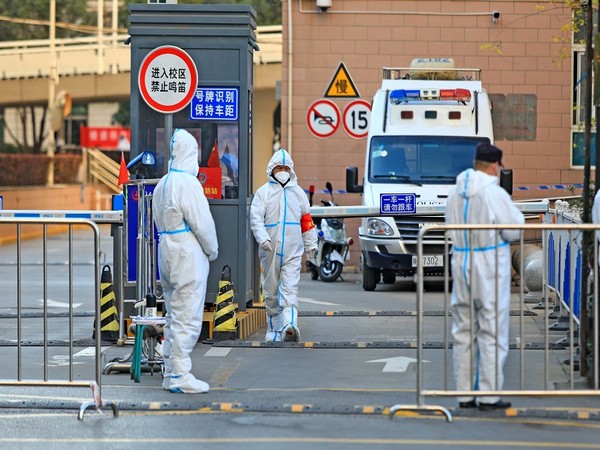
Following is a summary of current health news briefs.
China COVID policy: Major changes in further easing
China's National Health Commission announced on Wednesday the most significant relaxation of its COVID-19 prevention and control protocols since the pandemic erupted three years ago. Rules covering quarantine, people movement, lockdowns and testing were loosened, and other aspects of policy were also adjusted. The main changes are listed below: - High-risk areas must be accurately designated by buildings, units, floors, and households, and cannot be arbitrarily expanded to residential compounds and communities.
China eases COVID quarantine rules in major policy adjustment
China's national health authority said on Wednesday that asymptomatic COVID-19 cases and people with mild symptoms can quarantine at home, in the strongest sign yet that China is preparing its people to live with the disease. Most cases of infection with the coronavirus are asymptomatic or mild with no special treatment required, the National Health Commission said in a statement.
China medical expert says COVID has mutated, should be renamed - state media
China should change its official name for COVID-19 to reflect the virus' mutation, and patients with light symptoms should be allowed to quarantine at home, a leading authority on traditional Chinese medicine was quoted as saying on Wednesday. Gu Xiaohong told the state-run Beijing Daily newspaper that the coronavirus' Chinese name, which identifies it as a pneumonia-causing disease, should be changed to call it simply an infectious virus.
Factbox-China's rigid zero-COVID-19 policy starts to thaw
China unveiled new measures to ease some of the world's toughest COVID-19 curbs on Wednesday, after three years of a "zero-COVID" policy that triggered widespread protests and hammered the economy. What do the measures mean?
Pandemic lockdowns linked to decline in U.S. twin births, study suggests
Reduced access to infertility treatments early in the pandemic may have contributed to a drop in twin births, data from the U.S. Centers for Disease Control and Prevention suggest. The number of twin births fell 7% between 2019 and 2020 - from 120,291 to 112,437 - compared to an average 2%-per-year decline from 2014 to 2019, researchers reported on Wednesday in the CDC's National Vital Statistics Reports, based on data from 50 states and the District of Columbia.
E-cigarette maker Juul reaches settlement with nearly 10,000 plaintiffs
E-cigarette maker Juul Labs on Tuesday said it has reached settlements with about 10,000 plaintiffs covering more than 5,000 cases in California. Juul did not disclose the settlement amount as part of the settlement and court process in the federal multidistrict litigation and related JUUL Labs Product Cases. The company has obtained equity investment to fund it, a spokeperson told Reuters in a statement.
Britain's health regulator backs COVID vaccine for infants from six months
Britain's health regulator on Tuesday authorized a COVID-19 vaccine for infants as young as six months, opening the door for vaccinating the country's youngest children once the UK's Joint Committee on Vaccination and Immunisation (JCVI) agrees. The Medicines and Healthcare products Regulatory Agency (MHRA) authorized the vaccine - made by Pfizer and BioNTech - for children aged six months to four years old, after it was deemed safe and effective based on an ongoing clinical trial involving 4,526 participants.
'We're going to be free': Chinese cheer as COVID curbs are loosened
China on Wednesday announced the most sweeping changes to its resolute anti-COVID regime since the pandemic began three years ago, loosening rules that curbed the spread of the virus but sparked protests and hobbled the world's second-largest economy. The relaxation of rules, which includes allowing infected people with mild symptoms to quarantine at home and dropping testing for people travelling domestically, is the clearest sign yet Beijing is pivoting away from its zero-COVID policy to let people live with the disease.
GSK, Sanofi shares soar as Zantac litigation fears abate
Shares of GSK and Sanofi surged on Wednesday, adding more than $20 billion in combined value in early trade following the dismissal of thousands of U.S. lawsuits claiming that the heartburn drug Zantac caused cancer. The ruling on Tuesday by U.S. District Judge Robin Rosenberg in West Palm Beach, Florida, knocked out about 50,000 claims in federal court on the basis that they were not backed by sound science.
U.S. FDA grants priority review to Pfizer's RSV vaccine
Pfizer Inc said on Wednesday the U.S. Food and Drug Administration will review its respiratory syncytial virus (RSV) vaccine candidate on priority. The drugmaker is seeking approval for use of the vaccine, RSVpreF, in adults aged 60 years and older and the agency is set to make its decision by May 2023. It could become the first approved RSV vaccine in the U.S. for older adults who are at risk of the lung disease.


 Google News