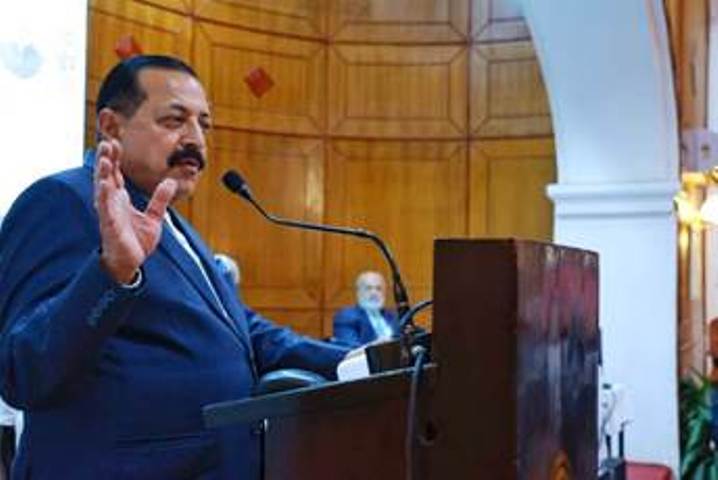
Union Minister of State (Independent Charge) for Science and Technology, Earth Sciences, and other key departments, Dr. Jitendra Singh, announced significant developments in India's exploration of atomic minerals and nuclear technology during a recent Rajya Sabha session.
Dr. Singh revealed that the Atomic Minerals Directorate for Exploration and Research (AMD), a unit of the Department of Atomic Energy (DAE), has discovered lithium resources in Mandya and Yadgiri districts of Karnataka. Preliminary surveys and subsurface exploration in Yadgiri district have established 1,600 tonnes of lithium resources at the G3 stage in the Marlagalla area of Mandya district. This discovery positions India as a notable player in the global lithium market, crucial for battery technology and energy storage.
Additionally, AMD is exploring lithium potential in other regions, including Korba District in Chhattisgarh and significant mica and pegmatite belts across Rajasthan, Bihar, Andhra Pradesh, Odisha, and Karnataka. These areas are identified as key geological domains for lithium resources.
In another development, Dr. Singh reported that AMD has identified surface uranium occurrences in Masanbal, Hamirpur district, Himachal Pradesh. However, there are currently no plans by the Atomic Energy Commission to establish an atomic energy plant in Himachal Pradesh.
Regarding advancements in nuclear technology, Dr. Singh noted that the Department of Atomic Energy is monitoring global trends in small modular reactors (SMRs). While various technologies and designs from international vendors are being reviewed, there are no current plans to collaborate with foreign entities or to involve private players in small modular reactor production. However, some private players have expressed interest in deploying small reactors at their own sites.
Furthermore, Dr. Singh highlighted ongoing cooperation between the Government of India and the Russian Federation in the field of nuclear energy, including potential collaboration on small modular reactors. This partnership underscores India's commitment to expanding its nuclear energy capabilities for peaceful purposes and technological advancement.
These developments reflect India's strategic approach to leveraging atomic minerals and advancing nuclear technology to support its energy security and sustainability goals.


 Google News
RSS
Google News
RSS



