

Aero India 2025: Rajnath Singh Emphasizes Co-Development and Resilient Partnerships
The Defence Minister highlighted the Indian Government’s efforts under Prime Minister Shri Narendra Modi to bolster defence capabilities through comprehensive policy reforms.
- Country:
- India
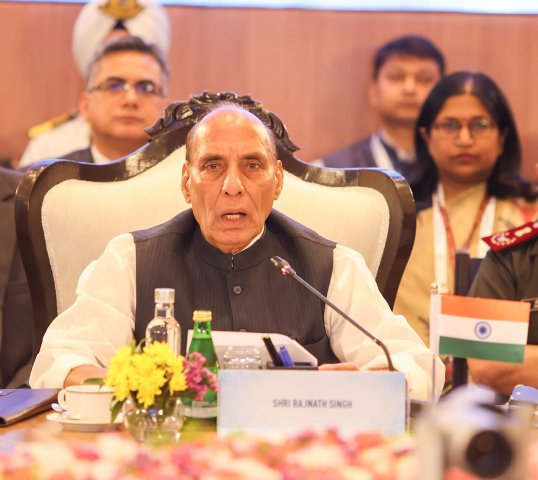
February 11, 2025: Raksha Mantri Shri Rajnath Singh has urged the international community to join India in co-developing and co-producing advanced defence systems, citing the pressing need for innovative approaches and stronger partnerships amidst evolving global security challenges. Speaking at the Defence Ministers' Conclave titled 'Building Resilience through International Defence and Global Engagement (BRIDGE),' part of the 15th Aero India event, the Defence Minister addressed over 162 delegates from 81 countries, including 15 Defence Ministers, 11 Deputy Defence Ministers, 15 Permanent Secretaries, and 17 Service Chiefs.
Highlighting the increasing number of conflicts, new power dynamics, weaponization methods, the influence of non-state actors, and disruptive technologies, Shri Rajnath Singh emphasized the fragility of the current world order. "The lines between border security and internal security are blurring due to hybrid warfare, capable of targeting critical infrastructure even during peacetime. Cyberspace and outer space are redefining the traditional concept of sovereignty," he stated.
Shri Rajnath Singh underscored the transformative impact of disruptive technologies like Artificial Intelligence, quantum computing, hypersonic weapons, and directed energy systems on modern warfare. He called for a reassessment of defence capabilities to address these emerging vulnerabilities and threats effectively.
India's Defence Transformation and Policy Regime
The Defence Minister highlighted the Indian Government's efforts under Prime Minister Shri Narendra Modi to bolster defence capabilities through comprehensive policy reforms. "We have established a conducive policy environment that encourages investment in and production of state-of-the-art land, maritime, and air systems. India is rapidly emerging as a global hub for R&D and innovation in defence," he remarked.
Shri Rajnath Singh noted that India has a vibrant defence start-up ecosystem, boasting the third-largest number of unicorns globally. He pointed to the unparalleled collaboration opportunities within India's thriving aerospace and defence sectors, supported by a strong R&D base and entrepreneurial spirit. "Our skilled workforce allows us to produce at highly competitive costs. India is committed to sharing cutting-edge defence equipment, technology, and services with our partners," he affirmed.
Guiding Principles and Global Vision
Shri Rajnath Singh articulated India's inclusive and collaborative vision for peace, security, and development, guided by Prime Minister Modi's dynamic five 'S' approach: Samman (Respect), Samvaad (Dialogue), Sahyog (Cooperation), Shanti (Peace), and Samriddhi (Prosperity). These principles, he stated, form the cornerstone of India's international engagements, resonating strongly in today's increasingly divided world.
Reiterating India's commitment to 'Security and Growth for All in the Region (SAGAR)' for the Indian Ocean Region (IOR), Shri Rajnath Singh highlighted key focus areas such as maritime security, economic development, and the blue economy. He emphasized India's collaborative efforts in combating non-traditional threats like piracy, terrorism, illegal and unregulated fishing, and climate-related challenges, showcasing the nation's dedication to global cooperative action beyond the IOR.
Equitable Partnerships and Defence Exports
Shri Rajnath Singh stressed that India does not believe in transactional relationships or imposing solutions. Instead, India's approach focuses on mutual capacity building, prosperity, and security while respecting the sovereignty of partner nations. "Our aim is to empower partners to chart their own paths, offering support that aligns with their national priorities. Equitable partnerships form the foundation of our defence collaborations, whether it's supplying Indian-made ships and aircraft, sharing expertise, or conducting joint training programmes," he said.
He emphasized India's position as a preferred partner for defence exports, driven by a commitment to quality, reliability, and meeting partners' specific needs. "Our defence industry is capable of delivering diverse solutions, from cutting-edge technology to cost-effective systems. We pride ourselves on offering customized support that strengthens our partners' capabilities to address their security challenges effectively," he added.
Global Reception and BRIDGE Initiative Impact
The BRIDGE initiative was praised by the attending Defence Ministers as a testament to India's commitment to transforming dialogue into actionable outcomes. The conclave highlighted the importance of resilient, adaptable, and forward-looking partnerships to address global challenges ranging from terrorism and cybercrime to humanitarian crises and climate-induced disasters.
Delegates expressed appreciation for the Department of Defence Production, Ministry of Defence, for organizing Aero India 2025, providing a platform for showcasing world-class innovations and technologies. They welcomed the BRIDGE initiative's focus on fostering peace and prosperity, expressing a strong willingness to collaborate with India on defence and strategic needs.
Transfer of Technology, co-development, and co-production of the latest equipment and products were key themes during the discussions. Delegates acknowledged India as a crucial partner in creating resilient supply chains and praised its role in peacekeeping and capability-building across sectors like defence, health, and education.
Shared Security Concerns and Global Cooperation
The conclave also addressed shared security concerns, with all participating nations agreeing to avoid armed conflict, describing it as detrimental to people and development. Key challenges discussed included illegal drug trafficking, illicit fishing, terrorism, and cybercrime. The countries pledged to work together against these threats, collectively embracing the philosophy of 'One Earth, One Family, One Future,' the theme of India's G20 Presidency.
Closing Remarks and Future Outlook
Delivering the closing remarks, Raksha Rajya Mantri Shri Sanjay Seth expressed gratitude to the dignitaries for their active participation and contributions to the conclave. He emphasized the collaborative spirit embodied by the BRIDGE theme and expressed optimism for continued partnerships and new areas of mutual prosperity through cooperation.
Secretary (Defence Production) Shri Sanjeev Kumar delivered the welcome address, while prominent defence officials, including Chief of Defence Staff General Anil Chauhan, Chief of the Naval Staff Admiral Dinesh K Tripathi, Chief of the Army Staff General Upendra Dwivedi, Chief of the Air Staff Air Chief Marshal AP Singh, Defence Secretary Shri Rajesh Kumar Singh, and DRDO Chairman Dr. Samir V Kamat, were present at the event.
The conclave provided a vital platform for discussing key issues such as defence capacity building through investment, joint ventures, co-production, collaboration in R&D, training, technological advancements in AI and space, maritime security cooperation, and strategic partnerships.


 Google News