

Innovative Solutions for Electric Bus Scheduling: Tackling Non-Linear Charging and Grid Limits
Electric bus scheduling faces significant challenges due to non-linear charging behaviors and power grid constraints, prompting researchers to develop advanced models like the charge increment domain approach to ensure efficient and sustainable public transport electrification. This novel method provides accurate approximations and integrates dynamic recharge rates, offering a robust solution for optimizing electric bus operations.
 CoE-EDP, VisionRI
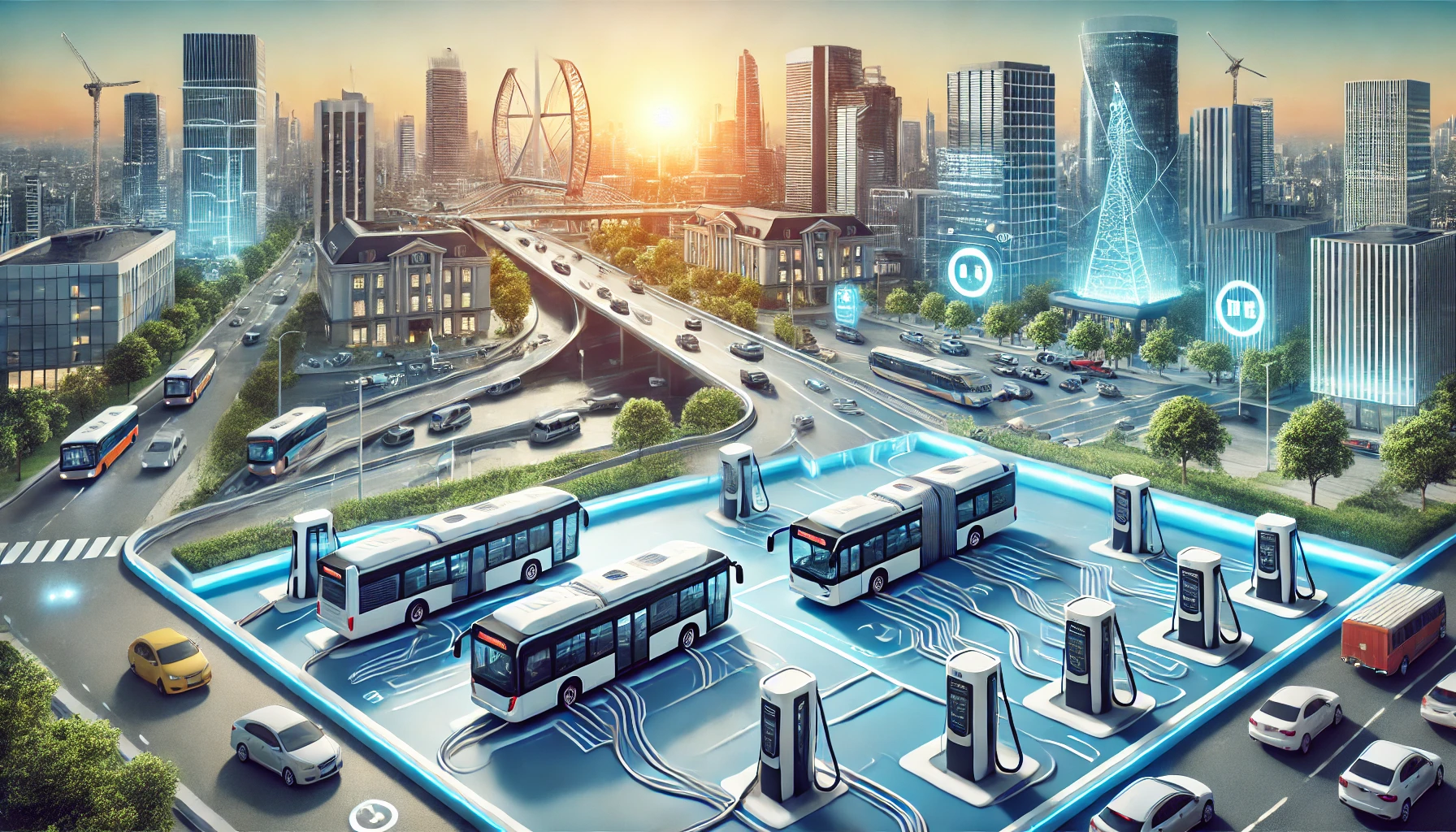
Electric bus scheduling faces numerous challenges, especially with the gradual shift from combustion to battery-powered buses. Research by Fabian Lobel, Ralf Borndorfer, and Steffen Weider from the Zuse Institute Berlin and IVU Traffic Technologies AG delves into these challenges, focusing on the non-linear relationship between charging time and the replenished driving range. Approximation errors in this relationship can result in significant miscalculations in fleet size requirements. Traditional piecewise linear approximations often fail to predict charge states accurately, necessitating more precise models. Additionally, the increasing electricity demand outpaces power grid upgrades, prompting operators to adopt active charge management systems. These systems adjust charging speeds based on available energy, thereby integrating the power grid's load limitations into electric bus scheduling models. A novel mixed-integer programming formulation is proposed to better approximate non-linear battery charging and dynamic recharge rates. This model utilizes a charge increment function, which is linearly interpolated, providing better error control and easier integration into integer programming models.
Germany's Electrification Commitment
Public transport in major German cities like Berlin, Hamburg, and Munich is set to fully electrify by 2030, with a significant reduction in fossil-fuel-powered bus acquisitions. Battery-powered buses, though preferred for their lower acquisition costs and compliance with political and legal frameworks, have shorter driving ranges and longer refueling durations compared to combustion buses. This necessitates in-service recharging, especially during extreme weather conditions that further reduce available ranges. Operators like Hamburg's Hochbahn AG use active charge management systems to optimize energy costs by dynamically adjusting charging rates. In some cases, rural operators use bus batteries as grid buffers, achieving net negative electricity costs. However, the capacity of the power grid is a significant bottleneck, with load-dependent energy prices and hard grid limits restricting power extraction.
Tackling the Electric Bus Scheduling Problem
The Electric Bus Scheduling Problem (EBSP) extends the traditional Bus Scheduling Problem (BSP) by accounting for battery capacities, energy consumption, and charging slots. A key aspect of EBSP is the non-linear charging behavior, partial charging, dynamic recharge rates, time-of-use electricity prices, charger slot capacities, grid load limits, and mixed fleets of electric and non-electric buses. Various studies have attempted to address these challenges using different models, such as energy state expansion, linear spline approximations, and exact algorithms. However, most do not simultaneously consider grid load and non-linear charging. To fill this gap, a charge increment domain approach is introduced, focusing on linearizing the dynamic charging process via a charge increment function. This method ensures that the charging model remains accurate while being computationally feasible.
Innovative Solutions for a Sustainable Future
The transition to electric buses necessitates advanced scheduling models that account for non-linear charging behaviors and dynamic recharge rates. The proposed charge increment domain approach offers a promising solution by providing accurate approximations and integrating grid load constraints, ensuring efficient and sustainable public transport electrification. In their computational study, the researchers tested their model on sixteen anonymized real-life EBSP instances using Gurobi optimization software. The results showed that traditional linear approximations often failed to provide feasible solutions under more exact models, highlighting the need for the proposed approach. The researchers found that for many instances, the initial vehicle schedule was not energy-feasible under the more exact charging model. However, the new approach managed to repair these solutions and produce schedules that were both feasible and optimal within numerical tolerances.
Empirical Evidence of Model Efficacy
The study concluded that using a time step size of five minutes and more than two linear segments for the charge increment domain provided the best performance. The new model's accuracy was further demonstrated by its ability to handle various real-life instances with different grid load constraints and charging technologies. The researchers highlighted the importance of considering dynamic recharge rates and grid load limits in electric bus scheduling models. By incorporating these factors, the new approach ensures that electric buses can operate efficiently without overloading the power grid, thereby supporting the broader goal of sustainable public transport electrification. This research provides valuable insights for public transport operators and policymakers aiming to transition to electric bus fleets. The proposed charge increment domain approach offers a robust solution for addressing the challenges of non-linear charging behaviors and dynamic recharge rates, ultimately contributing to more efficient and sustainable public transport systems.
Path Forward for Public Transport Electrification
The gradual electrification of public transport bus fleets introduces new challenges that require advanced scheduling models. The research conducted by the Zuse Institute Berlin and IVU Traffic Technologies AG addresses these challenges by proposing a novel charge increment domain approach. This method provides accurate approximations of non-linear battery charging behaviors and integrates dynamic recharge rates and grid load constraints into electric bus scheduling models. The computational study demonstrates the practical usefulness of this approach, offering valuable insights for public transport operators and policymakers aiming to achieve efficient and sustainable electrification of bus fleets.
- FIRST PUBLISHED IN:
- Devdiscourse


 Google News