

Astronomers discover rapidly growing black hole using Hubble data
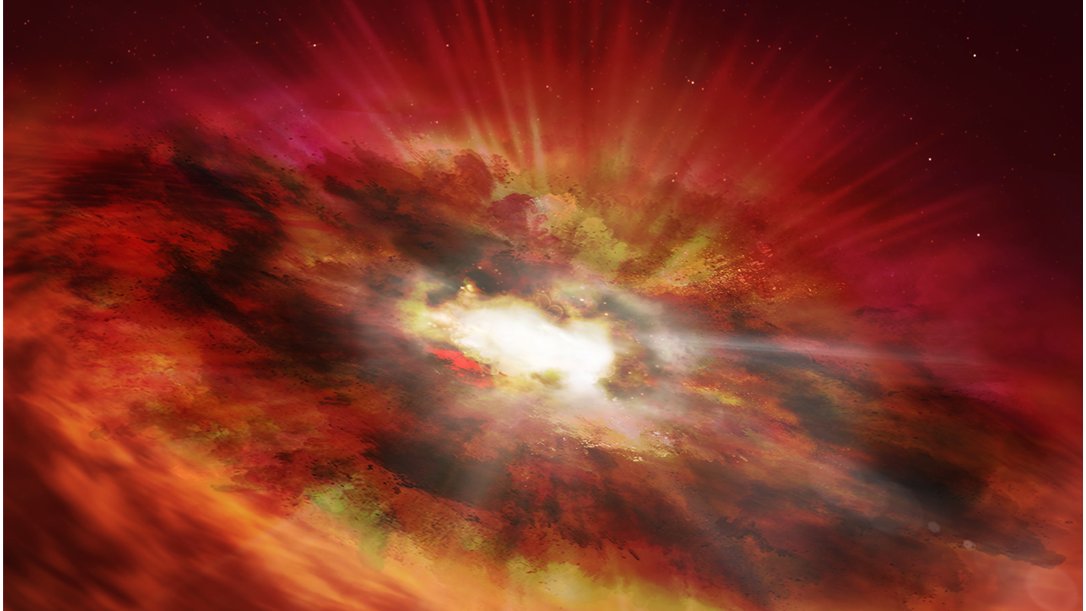
Using archival data from the NASA/ESA Hubble Space Telescope and other observatories, an international team of astronomers has discovered a rapidly growing black hole in the Great Observatories Origins Deep Survey-North (GOODS-North) field, one of the best-studied areas of the night sky.
Nicknamed GNz7q, the monster existed when the universe was just 750 million years old and is considered a crucial "missing link" between young star-forming galaxies and the first supermassive black holes.
Commenting on this development, Seiji Fujimoto, an astronomer at the Niels Bohr Institute of the University of Copenhagen and lead author of the Nature paper describing this discovery, said, "Our analysis suggests that GNz7q is the first example of a rapidly growing black hole in the dusty core of a starburst galaxy at an epoch close to the earliest supermassive black hole known in the universe."
Hidden in Hubble archival data, a mysterious red dot was spotted in the middle of the Great Observatories Origins Deep Survey-North (GOODS-North) area of the sky. (1/6) 🧵 pic.twitter.com/2ER3hEMeny
— Hubble Space Telescope (@HubbleTelescope) April 13, 2022
According to the team, GNz7q has exactly both aspects of a dusty starburst galaxy - galaxies that rapidly form stars - and a quasar - the brightest type of active galactic nucleus, believed to be powered by a supermassive black hole. The object lacks various features usually observed in typical, very luminous quasars, which is most likely explained that the central black hole in GN7q is still in a young and less massive phase.
GNz7q's host galaxy is forming stars at the rate of 1,600 solar masses per year, and the object itself appears bright at UV wavelengths but very faint at X-ray wavelengths, the team says. The analysis suggests that GNz7q is a rapidly growing black hole still obscured by the dusty core of its star-forming host galaxy.
The researchers now hope to systematically search for similar objects using dedicated high-resolution surveys and to take advantage of the newly-launched NASA James Webb Space Telescope's spectroscopic instruments to study them in unprecedented detail.
More details can be found here.


 Google News