

Study analyzes aftermath of 2014 supernova; uncovers new clues about mysterious explosion
- Country:
- United States
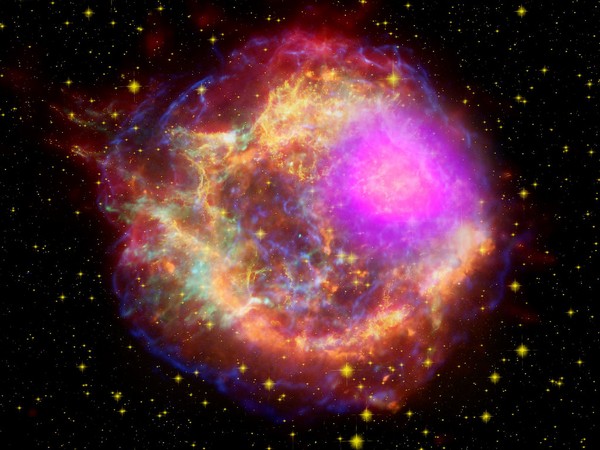
A new study, led by researchers at the University of Texas at Austin, has uncovered new clues about the 2014 supernova, a mysterious stellar explosion far out in space.
The explosion, known as 2014C, looked like what's called a Type Ib supernova. These supernovae are what happen when the largest known stars in the universe die.
Astronomers believe that 2014C was probably originally not one but two stars orbiting each other, one bigger than the other. The more massive star evolved more quickly, expanded, and its outer layer of hydrogen got sucked away. When it eventually ran out of fuel, its core collapsed, triggering a gigantic explosion.
The researchers set out to collect all of the data on 2014C, including new data they obtained as well as from studies over the past eight years. While the X-ray emissions, infrared light, and radio waves all showed the distinctive pattern of increasing and then decreasing, the optical light -measured by UT Austin's Hobby-Eberly Telescope - appeared to stay steady.
Different wavelengths indicated different speeds of the shockwave. For instance, the radio signal showed that the shockwave was expanding at a very high speed, whereas the optical light indicated a much slower speed.
The findings will help astronomers better understand the process of how massive stars - giants far larger than our own sun - live and die.
"In a broad sense, the question of how massive stars lose their mass is the big scientific question we were pursuing. How much mass? Where is it? When was it ejected? By what physical process? Those were the macro questions we were going after. And 2014C just turned out to be a really important single event that's illustrating the process," said UT Austin professor and team member J. Craig Wheeler.
The study, published in The Astrophysical Journal, also included scientists from the University of Chicago. More information can be found here.


 Google News